



Only Hindus, Sikhs, Buddhists can claim Scheduled Caste status: SC ruling
- In Reports
- 05:12 PM, Mar 24, 2026
- Myind Staff
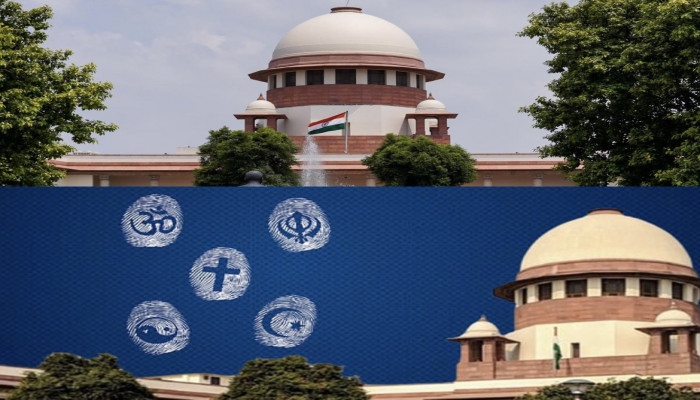
In an important ruling, the Supreme Court of India has clarified that only individuals who follow Hinduism, Sikhism, or Buddhism are eligible to claim Scheduled Caste (SC) status. The court stated that if a person converts to any other religion, they will lose their SC status and will not be entitled to the legal protections provided under laws meant for the Scheduled Castes. This judgment reinforces the long-standing legal position that religious identity plays a key role in determining eligibility for such constitutional safeguards.
The ruling was delivered by a bench comprising Justices PK Mishra and NV Anjaria, who upheld a previous decision of the Andhra Pradesh High Court. The case involved an appeal filed by a pastor named Chinthada Anand, who had challenged a judgment delivered in May 2025. Anand had approached the court alleging that he had been subjected to caste-based abuse, assault, and threats by certain individuals in his village.
According to Anand, he was attacked and harassed by a group of people, including Akkala Ramireddy, who allegedly used caste-based slurs and threatened his life and the safety of his family. Based on these claims, Anand filed a complaint under the Scheduled Castes and Scheduled Tribes (Prevention of Atrocities) Act, seeking legal protection and action against the accused.
However, the accused contested his claim, arguing that Anand had converted to Christianity and was actively working as a pastor. They stated that since he was no longer practising Hinduism, Sikhism, or Buddhism, he could not be considered a member of a Scheduled Caste and therefore was not eligible to seek protection under the SC/ST Act. This argument became central to the case.
After the investigation was completed and a chargesheet was filed, Anand moved the Andhra Pradesh High Court to quash the case against the accused. Justice N Harinath of the High Court examined the matter and ruled that Anand had indeed lost his SC status upon converting to Christianity. As a result, the court set aside the FIR, stating that he could not claim the benefits or protections reserved for the Scheduled Castes under the law.
The High Court also made it clear that merely possessing a Scheduled Caste certificate would not be enough to establish eligibility. It was observed that conversion to another religion, especially one where caste distinctions are not officially recognised, effectively nullifies SC status. This observation further strengthened the legal reasoning behind the decision.
Unhappy with the High Court’s ruling, Anand approached the Supreme Court, seeking relief. However, the apex court upheld the earlier judgment, agreeing with the reasoning provided by the High Court. While delivering its verdict, the Supreme Court clearly stated, “No person who professes a religion other than Hindu, Sikh or Buddhist shall be a member of the Scheduled Caste. Conversion to any other religion results in loss of Scheduled Caste status.”
The bench also examined the facts of the case in detail and noted that Anand had been practising Christianity for a long time. "In the present case, it is not the case of the petitioner that he re-converted from Christianity to his original religion or has been accepted back in the folds of the Madika community. It establishes that the appellant continued to profess Christianity and has been functioning as a pastor for more than a decade, conducting regular Sunday prayers at the houses of the village," the court said.
The judges further pointed out that Anand was actively engaged in religious activities at the time of the alleged incident. "It is also admitted that at the time of the alleged incident, he was conducting prayer meetings at the house. These concurrent facts leave no room for doubt that he remained a Christian on the date of the occurrence," the bench added. These observations played a crucial role in confirming that Anand could not claim SC status at the time of filing the complaint.
Through this judgment, the Supreme Court has once again underlined that the Scheduled Caste status is closely tied to specific religious identities as recognised under the Constitution. The decision makes it clear that conversion to another religion is a decisive factor and leads to the loss of such status, regardless of previous social background.
The ruling is significant as it not only resolves the dispute in this particular case but also reinforces the broader legal framework governing caste-based protections in India. It highlights that the benefits and safeguards provided under laws like the SC/ST Act are conditional and depend on meeting specific criteria, including religious affiliation.



 Loading...please wait
Comments