




Old photos from a French Museum help discover Kashmir’s 2,000-year-old Buddhist history
- In Reports
- 12:47 PM, Dec 29, 2025
- Myind Staff
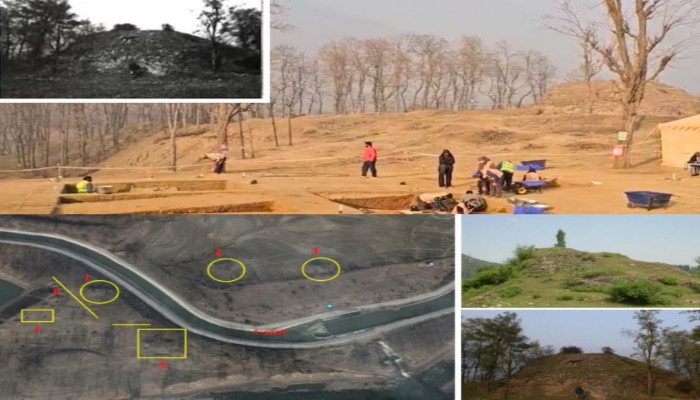
For many years, a few quiet mounds in Zehanpora village of Baramulla district in Jammu and Kashmir stood unnoticed between apple orchards and paddy fields. Local people were curious about them, and archaeologists from Srinagar and Delhi had visited the area several times. Surveys were done and guesses were made, but nothing clear was known about what lay beneath these small hill-like structures. It was only recently that these mounds began to reveal their real story — a story connected to Kashmir’s ancient Buddhist past and helped by three blurry photographs found far away in France.
Zehanpora village lies in a valley along the Jhelum River and is close to an old Silk Route that once connected Kashmir to Kandahar and other regions beyond. Because of this location, historians and archaeologists had long believed that the area could be important. When experts started using modern methods like drone surveys, aerial photography and detailed mapping, they realised that the mounds were not natural formations. They were part of a large and planned ancient structure.
Around the same time, a key discovery was made thousands of kilometres away. In the archives of a museum in France, three old and unclear photographs were found. These photographs showed three Buddhist stupas in Baramulla. This single find changed the direction of the research and helped confirm that the Zehanpora mounds were linked to Buddhism.
Prime Minister Narendra Modi spoke about this discovery in his recent Mann Ki Baat address. He said, “Three Buddhist stupas were visible in that photograph of Baramulla. From there, the course of discovery changed, and Kashmir’s forgotten past began to reveal itself. This history goes back nearly 2,000 years.”
The excavation at Zehanpora has since revealed important remains from ancient times. Archaeologists have found Buddhist stupas, an urban-style settlement complex that could include chaityas and viharas, pottery pieces from the Kushan period, copper objects and stone walls. Experts believe that many more discoveries are still waiting to be uncovered in the coming phases of excavation.
Prime Minister Modi also said that the Buddhist complex found at Zehanpora reminds people of Kashmir’s rich and deep history. He noted that it reflects the Valley’s strong cultural identity and its important place in the past.
The discovery is especially important because it brings attention to a part of Kashmir’s history that has often been ignored. Buddhism is believed to have reached Kashmir during the time of Emperor Ashoka, between 268 and 232 BCE. It continued to grow during the Kushan period, from the 1st to the 3rd centuries CE, when Kashmir became an active centre for Buddhist learning and monastic life.
The Kushans were a powerful dynasty that ruled large areas of north India and Central Asia during this time. They supported trade, developed cities and played a major role in spreading Buddhism across different regions. The artefacts found at Zehanpora strongly suggest that the site belongs to the Kushan period.
Harmeet Singh Soodan, Head of the Department of Political Science at Government Degree College, Katra, said that the Zehanpora discovery clearly places Kashmir within the Gandhara Buddhist network. He explained that it shows Kashmir as an important cultural and intellectual meeting point that connected South Asia with Central Asia nearly 2,000 years ago.
Baramulla Deputy Commissioner Minga Sherpa also spoke about the importance of the discovery. He was quoted by the Srinagar-based Greater Kashmir on November 30 as saying, “Baramulla has historically been a key corridor for trade and cultural exchange. The findings here will offer valuable insights into Kashmir’s past.”
In an article published on December 21 in the Jammu-based Daily Excelsior, Harmeet Singh Soodan explained why the discovery of stupas and a large Buddhist complex at Zehanpora is a major moment in Kashmir’s history. He said that the findings establish Baramulla as an important gateway linking Kashmir with the Gandhara region in present-day Afghanistan. According to him, the discovery provides strong physical evidence to support references to Buddhism in Kashmir found in ancient texts.
Soodan also pointed out that the size and layout of the structures suggest that the site received support and patronage over many centuries. This, he said, shows that Kashmir was well connected to larger trade routes, pilgrimage paths and intellectual networks that linked South Asia with Central Asia. He added that the findings prove Kashmir was not on the edges of Buddhist history, but was instead a central hub of learning and monastic activity.
Although interest in the Zehanpora mounds existed for decades, full-scale excavation began only recently. According to a report by the Srinagar-based Kashmir Dispatch, proper archaeological excavation started in July 2025. Before digging began, teams carried out detailed surveys using drone images, mapping and ground checks. These surveys confirmed that several large mounds near Zehanpora were likely the remains of ancient stupas.
The major breakthrough, however, came earlier in 2023. Mohammad Ajmal Shah, Assistant Professor of Archaeology at the University of Kashmir, found an old photograph in the archives of a French museum. The photograph showed three stupas in Baramulla and helped firmly connect the Zehanpora site to Kashmir’s Buddhist past, according to Greater Kashmir.
Javaid Ahmed Matto, an excavation assistant with the Jammu and Kashmir Department of Archives, Archaeology and Museums, described the work as a proud moment. Speaking to news agency ANI in November, he said, “The work at the site was a matter of pride.”
Matto explained that archaeologists already had many clues from earlier explorations and written sources. “We had several clues from years of exploration at the site, as well as references in literary sources. Even the Chinese pilgrim Xuanzang (Hiuen Tsang), in his travelogue, mentions entering Kashmir along the Silk Route. That is why the department collaborated with the University of Srinagar and undertook the work using scientific techniques. As a result, apsidal stupa and urban-type settlements are now being exposed,” he told ANI.
An apsidal stupa is an early Buddhist structure with a rounded or semi-circular back. In such shrines, a stupa or an image of the Buddha is placed inside. This design is commonly seen in prayer halls known as chaitya-grihas at places like Sanchi, Bavikonda and Barikot. These halls allowed worshippers to walk around the shrine as part of their prayer ritual.
Matto added that all the artefacts found so far appear to belong to the Kushan period. “All the artefacts recovered so far — pottery, copper objects and stone walls — appear to belong to the Kushan period. There are more stupas at the site, which we plan to excavate in the coming phases,” he said.
The Zehanpora excavation is also important because it is the first excavation carried out independently by the Department of Archives, Archaeology and Museums, Jammu and Kashmir. The project is being done in collaboration with the Centre of Central Asian Studies, University of Kashmir. It was approved by the Archaeological Survey of India and funded through the Capex Budget of the Jammu and Kashmir Union Territory government.
The excavation work on the ground is being led by Mohammad Ajmal Shah and supervised by Kuldeep Krishan Sidha, Director of Archives, Archaeology and Museums.
Together, old blurred photographs from a French museum, ancient texts and modern scientific methods have helped bring back a forgotten chapter of Kashmir’s history. The discoveries at Zehanpora not only reveal a 2,000-year-old Buddhist past, but also support the idea that Kashmir was once a major centre of Buddhist learning, culture and monastic life.



 Loading...please wait
Comments