




NSA Ajit Doval says BRICS has a special role to play in addressing international challenges
- In Reports
- 08:13 PM, Jun 23, 2026
- Myind Staff
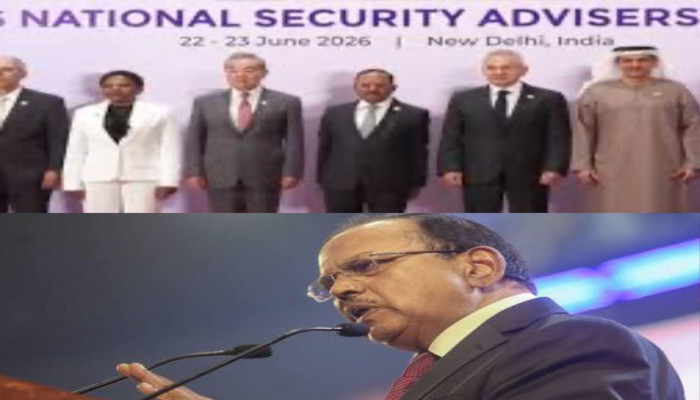
National Security Advisor Ajit Doval on Tuesday described BRICS as a “very special coalition” and underlined the growing importance of the grouping in a rapidly changing global environment. Speaking at the 16th BRICS National Security Advisers’ Meeting in New Delhi, Doval said member countries have a significant role to play in addressing international challenges at a time when the world is facing rising geopolitical and economic uncertainties.
Senior security officials and representatives from BRICS nations attended the meeting. Doval welcomed the delegates and stressed the need for greater cooperation among member countries as the world continues to deal with several complex issues affecting peace, security and development.
Addressing the delegates, Doval pointed out that the world is currently going through a difficult period marked by conflicts and instability. He said, “We are meeting at a very tumultuous time. Military conflicts and complex security problems have beleaguered the world. It is facing geopolitical uncertainties, economic strains, and disruptive technology. Not only are the threats compounding, but the instruments and institutional mechanisms are increasingly proving inadequate to resolve or mitigate these conflicts. Multilateralism is on the decline.”
His remarks highlighted concerns about the declining effectiveness of existing global institutions and mechanisms formed to resolve international disputes. Doval noted that challenges are becoming more complicated while traditional methods of conflict resolution are losing their effectiveness.
Speaking about the origins and objectives of BRICS, Doval said the grouping was created as a platform for emerging economies to work together and contribute to a more balanced global order. He said BRICS was formed to strengthen economic cooperation among developing nations and provide a stronger voice to countries of the Global South. The grouping has also consistently supported reforms in international institutions and global governance structures.
Emphasising the importance of the bloc, Doval said, “BRICS was conceived as an informal grouping of emerging economies for a more multipolar world order. It was intended to advance economic cooperation and strengthen the voice of the Global South. It also envisioned reforms in global governance and institutional improvements. BRICS is a very special coalition of countries that believe in peace, progress, development and cooperation. I’m happy to see that it is gaining strength day by day.”
He noted that the growing influence of BRICS reflects the increasing importance of emerging economies in global affairs. According to him, the grouping has become an important platform for cooperation among countries that share common goals related to development, peace and economic growth.
Doval also highlighted the unique position of BRICS countries in dealing with global challenges. He said the member nations come from different regions and continents and bring varied experiences and perspectives to the table. This diversity, he noted, can help the grouping contribute meaningfully to discussions on international peace and stability.
Referring to the current state of global affairs, Doval said, “We are here from different continents and regions, bringing with us diverse experiences. We have got a very special role to play in this world, which appears to be in turmoil, a world that is changing and where the instruments of conflict resolution are probably getting blunted. What role we as a grouping can play is a matter that is important for us to ponder.”
His comments reflected the need for BRICS nations to think collectively about how they can contribute to resolving conflicts and reducing instability in different parts of the world. He suggested that the grouping should consider its future role carefully as international challenges continue to evolve.
The meeting began with Doval welcoming senior representatives from all participating countries. Among those present were Chinese Foreign Minister Wang Yi, Russian Security Council Secretary Sergey Shoigu, Iran’s Deputy Secretary of the Supreme National Security Council Ghadir Nezamipour, UAE Supreme Council for National Security Secretary-General Ali Mohammed Hammad Al Shamsi, and South African Minister in the Presidency Khumbudzo Ntshavheni.
A group photograph of the national security advisers and senior security officials was taken at the start of the meeting, marking the formal beginning of the discussions.
The meeting comes in the wake of India assuming the 2026 BRICS Chairship. India will hold the chairship for the fourth time after previously leading the grouping in 2012, 2016 and 2021. The chairship is be guided by the theme “Building for Resilience, Innovation, Cooperation and Sustainability.”
The theme reflects the people-centric and humanity-first approach outlined by Prime Minister Narendra Modi during the 2025 Rio Summit. It is expected to focus on strengthening cooperation among member nations while promoting sustainable growth, innovation and resilience in the face of global challenges.
BRICS currently consists of 11 emerging economies. The member countries are Brazil, China, Egypt, Ethiopia, India, Indonesia, Iran, Russia, Saudi Arabia, South Africa and the United Arab Emirates. Together, these nations represent a significant share of the global population and economy, making the grouping an increasingly influential voice in international affairs.



 Loading...please wait
Comments