




North Korea earns $14 billion from Russia’s war in Ukraine
- In Reports
- 07:21 PM, Mar 19, 2026
- Myind Staff
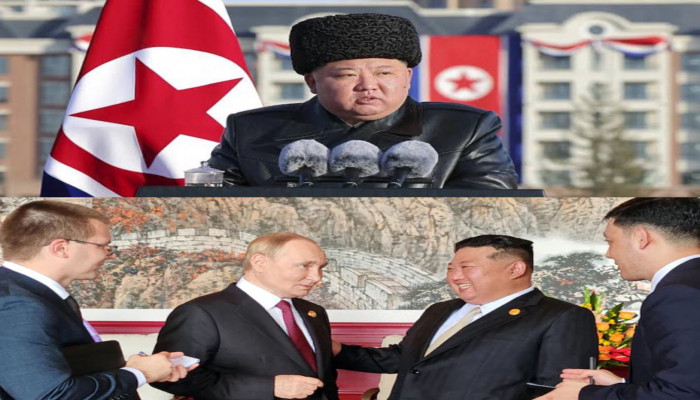
North Korea may have earned billions of dollars by supporting Russia in its ongoing war in Ukraine. A recent report by the Institute for National Security Strategy (INSS), based in Seoul, suggests that Pyongyang’s involvement through troop deployments and arms supplies has brought in significant economic gains. The report is titled “The Economic Impact of North Korea’s Deployments to Russia and Military Exports,” and it highlights how this cooperation could reshape the country’s financial position.
According to the findings, North Korea generated between $7.67 billion and $14.4 billion between August 2023 and December 2025. These earnings came from sending military personnel as well as exporting weapons and other supplies. However, the report also points out that the confirmed value of goods delivered, such as fuel, food, and weapons, is much lower. These verified exchanges are estimated to be worth only between $580 million and $1.5 billion. This gap suggests that a large portion of the transactions may not be directly visible or recorded in standard trade forms.
The report draws on information from South Korean intelligence authorities, who have tracked North Korea’s military involvement. It states that troop deployments began in October 2024. These deployments were not carried out all at once but instead happened in four major phases. The first phase began in January 2025, followed by another in August, and then continued from September to December 2025. This phased approach indicates a steady and strategic level of support rather than a single large-scale operation.
In addition to sending troops, North Korea has also increased its arms exports to Russia. These exports have been rising steadily since July 2023. The supplies reportedly include artillery, shells, and both guided and ballistic missiles. This growing flow of military equipment shows a deeper level of involvement in the conflict and reflects a long-term partnership rather than short-term assistance.
One of the key observations in the INSS report is that only a small portion of the estimated earnings has been received in direct forms such as cash or physical goods. The majority, estimated to be between 80 per cent and 96 per cent, may have been delivered in less visible ways. These could include advanced military technology, precision components, or specialised materials. Such exchanges are harder to track but can be highly valuable, especially for a country like North Korea that faces strict international restrictions.
Experts mentioned in the report have raised concerns about the long-term impact of these earnings. They warn that if North Korea manages to receive full compensation for its support, it could weaken the effect of international sanctions. These sanctions are mainly designed to limit the country’s ability to earn foreign currency. If alternative channels, such as military cooperation, provide large financial returns, the pressure created by sanctions may be reduced significantly.
The study also provides an estimate of North Korea’s foreign currency reserves under different scenarios. Without including the earnings from troop deployments and arms exports, the country’s reserves are expected to fall to about $7.25 billion by the end of 2025. This would represent a drop of around $3.35 billion compared to the end of 2016. However, when the additional revenue from its support to Russia is included, the situation changes sharply. The reserves could increase by $5.2 billion to $12.56 billion, bringing the total to between $15.8 billion and $23.16 billion. The report gives an average estimate of about $19.8 billion in this case.
Overall, the report presents a detailed picture of how North Korea’s involvement in the Russia-Ukraine conflict may be providing it with substantial economic benefits. It highlights the possibility that much of this value is being transferred in indirect ways, making it difficult to measure fully. At the same time, it raises important questions about the effectiveness of existing sanctions and how global political alliances can influence economic outcomes.



 Loading...please wait
Comments