




North Korea commissions second nuclear-capable destroyer as US, South Korea, Japan begin military drill
- In Reports
- 02:43 PM, Sep 07, 2026
- Myind Staff
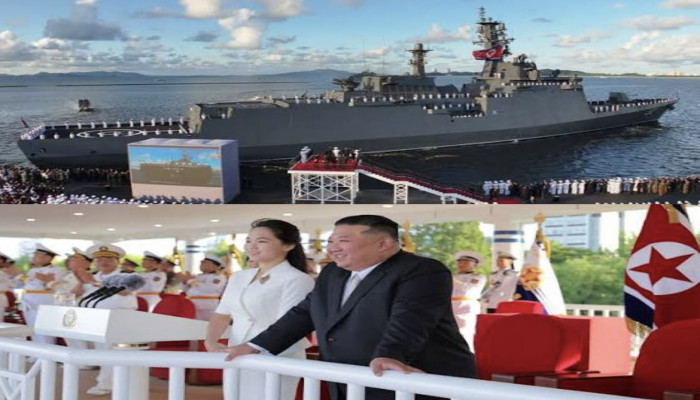
North Korean leader Kim Jong Un has commissioned the country’s second naval destroyer and called for a stronger and more reliable nuclear deterrent. The move came as the United States, South Korea and Japan began a five-day trilateral military exercise near South Korea. North Korea has strongly opposed such drills, calling them a threat to its security.
The new destroyer, named Kang Kon, was commissioned on Sunday at a ceremony in the eastern port city of Wonsan. Kim Jong Un attended the event along with his teenage daughter. South Korea’s spy agency has described her as Kim’s likely heir. State media images showed the girl wearing a white dress and blazer as she walked with her father on a red carpet. She also toured the warship and posed with sailors.
The Kang Kon and the Choe Hyon, which was commissioned in June, are both 5,000-tonne destroyers. They are equipped with nuclear-capable missiles and are considered North Korea’s most advanced naval vessels. The commissioning of the two ships marks a major step in Pyongyang’s efforts to expand its naval capabilities and strengthen its nuclear forces at sea.
Speaking at the commissioning ceremony, Kim said the arrival of the two destroyers would increase pressure on North Korea’s opponents. He said the Navy’s nuclear armament would allow the country to use its nuclear deterrent in more practical and varied ways. “Concerns of the enemies will be surely deepened,” Kim said. "We must establish more clearly a powerful and reliable nuclear war deterrent, to put into practice the diverse and effective operation of our nuclear combat systems and further strengthen our military activities for maritime defence and war deterrence.”
The commissioning took place as the US, South Korea and Japan prepared to begin their five-day Freedom Edge exercise on Monday. The drills are being held in waters near South Korea’s southern Jeju Island. South Korea’s military has said the exercise is defensive in nature and is aimed at responding to North Korea’s growing nuclear and missile threats.
North Korea has criticised the exercise and accused Washington of taking a more confrontational position. Its Foreign Ministry recently pointed to the Freedom Edge drills and reports that US officials remain committed to the complete denuclearisation of North Korea. Pyongyang sees the continued military cooperation between the three countries as a direct security threat.
The latest developments also follow the early conclusion of the annual Ulchi Freedom Shield exercise between the US and South Korea. The two countries ended the drill on August 21, six days ahead of schedule. US President Donald Trump had earlier said he ordered the Pentagon to “substantially reduce” the exercise. Trump pointed to his good relationship with Kim Jong Un and has previously sought a more conciliatory approach toward Pyongyang. North Korea, however, has not responded positively to the move.
Kim’s sister and senior North Korean official, Kim Yo Jong, dismissed the decision to shorten the drill. She said reducing its duration would not change what she described as its “provocative, aggressive nature.” Soon after, North Korea launched around 10 short-range ballistic missiles toward the sea. The launches appeared to follow through on Pyongyang’s earlier warning that it would respond to the US-South Korean military exercise.
Kim Jong Un has previously said North Korea could consider returning to negotiations with the United States if Washington ends what he calls its “hostile policy” and recognises North Korea’s status as a nuclear state. Earlier diplomatic efforts between Kim and Trump broke down in 2019. The two sides failed to agree on the economic benefits North Korea would receive in exchange for limited steps toward denuclearisation.
Since then, North Korea has continued to develop its nuclear and missile programmes. Its closer ties with Russia and China have also changed the strategic situation. Experts say these developments have given Kim greater leverage than he had during his earlier negotiations with Washington.
The commissioning of the Kang Kon has exacerbated existing tensions in the region. With two advanced destroyers carrying nuclear-capable missiles, North Korea is seeking to expand the role of its navy in its broader nuclear strategy. At the same time, the US, South Korea and Japan are strengthening their military coordination through joint exercises. The opposing moves are likely to keep tensions high on the Korean Peninsula.



 Loading...please wait
Comments