




No press freedom: Vance blames Pakistan for the delay in making US-Iran MoU public
- In Reports
- 06:04 PM, Jun 20, 2026
- Myind Staff
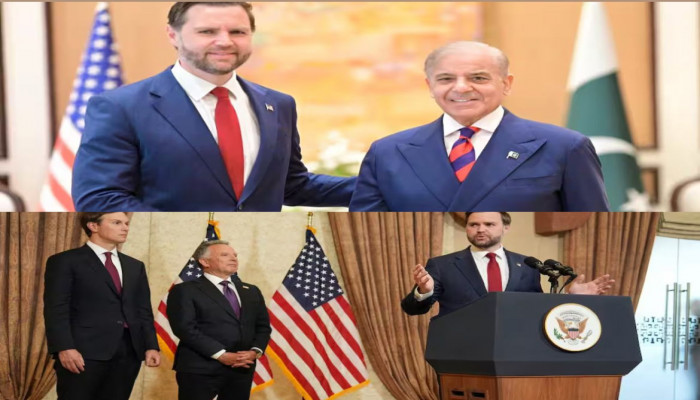
US Vice President JD Vance has sparked fresh controversy by linking the delay in releasing the full details of the US-Iran Memorandum of Understanding (MoU) to the lack of press freedom in Pakistan and Qatar. His comments have added to the growing embarrassment faced by Pakistan, which had earlier highlighted its role in helping broker the agreement along with Qatar.
Speaking on the podcast Interesting Times with Ross Douthat, Vance explained why the United States took two days to release the complete text of the agreement. While US President Donald Trump announced the interim peace deal with Iran on June 15, the full MoU was made public only on June 17.
According to Vance, the delay was partly due to differences in expectations regarding transparency and public access to government agreements. He said, "We actually wanted to get it out. I think part of the misalignment here is that in the Pakistani and Qatari systems, they don't quite have the First Amendment and freedom of the press."
The First Amendment of the US Constitution protects freedom of speech, freedom of the press and freedom of religion. These protections allow journalists and citizens to closely examine government decisions. Vance suggested that such expectations are not as strong in Pakistan and Qatar.
He further said, "And so, there isn't this expectation (in Pakistan) that the text is going to be out there for the American people to actually interrogate and look at and analyse and understand for themselves. But it will be out."
The agreement was eventually released after criticism from Democratic leaders and growing public pressure. Many critics had questioned why the details were being withheld. Some even speculated that the United States may have offered major concessions to Iran to secure an end to the conflict. The war had already caused concerns around the world because of its impact on oil supplies and Iran’s control over the Strait of Hormuz, a key shipping route for global energy trade.
Vance’s remarks have highlighted concerns about press freedom in Pakistan. The country currently ranks 153rd out of 180 countries in the World Press Freedom Index. Journalists and media organisations have long described Pakistan as one of the most difficult places in the world for independent reporting.
Concerns have also increased following the passage of Pakistan’s 27th Constitutional Amendment in November 2025. Critics argue that the amendment weakens democratic checks and balances by removing the Supreme Court’s ability to independently review fundamental rights cases. Many observers believe the move could further limit press freedom and freedom of expression in the country.
The controversy comes at a difficult time for Pakistan, which had presented the US-Iran agreement as a major diplomatic success. Pakistani Prime Minister Shehbaz Sharif had earlier announced that an official signing ceremony for the agreement would take place in Switzerland on June 19.
However, events unfolded differently. On Thursday, Donald Trump and Iranian President Masoud Pezeshkian signed the MoU digitally instead of attending a ceremony in Switzerland. The development left Pakistan in an awkward position after its earlier announcements.
Before the digital signing took place, Iran’s Foreign Ministry had already clarified that no official signing ceremony would be held in Switzerland. Following these developments, Sharif quietly removed references to the Switzerland event from his public statement. He also cancelled his planned visit to the country.
During the podcast, Vance also discussed some of the key provisions included in the 14-point agreement. One of the most important elements involves Iran’s enriched uranium stockpile. Under the deal, Iran has agreed to dilute its enriched uranium in return for broad economic relief measures.
Vance described this provision as a significant achievement for the Trump administration. He said, "The (Barack) Obama-Iran deal allowed them to generate a stockpile of enriched uranium. Our deal ensures that the stockpile is destroyed and eliminated. That's a big difference."
His comments referred to the Joint Comprehensive Plan of Action (JCPOA), the nuclear agreement negotiated by former US President Barack Obama with Iran in 2015. Donald Trump later withdrew the United States from that agreement in 2018, arguing that it failed to adequately address concerns about Iran’s nuclear programme.
Another major issue surrounding the new deal has been the proposed $300 billion reconstruction plan for Iran. The proposal has generated political debate in the United States, with critics questioning whether American taxpayers would ultimately bear the cost.
Vance strongly rejected those concerns. He clarified that the United States would not provide direct financial support to Iran under the reconstruction plan.
He said, "Not a cent of American money goes to Iran. There could be economic benefits for Iran paid for by investment from other countries, but only if they fundamentally transform their country. We have transformed their country. Isn't that good for America?"
His remarks were aimed at reassuring critics who fear that the agreement could place a financial burden on the United States. According to Vance, any economic gains for Iran would depend on investments from other nations and on major changes within the country itself.
The comments made by the US Vice President have not only reignited the debate over press freedom in Pakistan but have also shifted attention back to the wider implications of the US-Iran agreement. At the same time, Pakistan’s handling of the diplomatic process and the confusion surrounding the planned Switzerland ceremony have further intensified scrutiny of its role in the deal.



 Loading...please wait
Comments