




NIA to probe terror link in Rajasthan oil refinery fire incident following a global pattern
- In Reports
- 06:55 PM, Apr 23, 2026
- Myind Staff
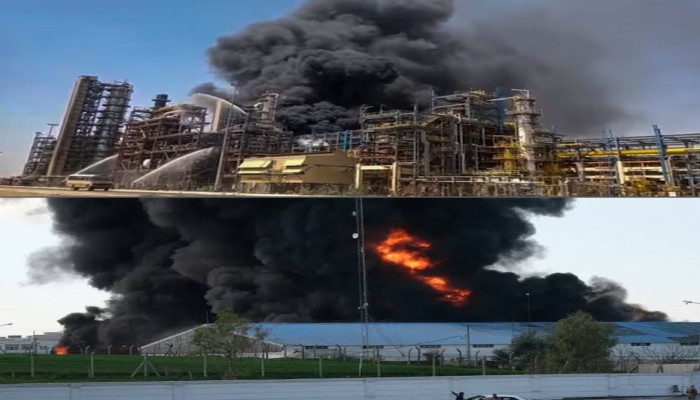
A series of fire incidents at oil refineries across multiple countries has raised concerns globally, with authorities in India now examining whether sabotage or a terror angle could be involved in one such case. In the latest development, a team from the National Investigation Agency (NIA) reached HPCL’s refinery in Pachpadra, Rajasthan, on Wednesday to investigate a major fire that broke out on April 20, just a day before its scheduled inauguration.
The Rajasthan refinery incident is part of a larger pattern that has emerged over the past 50 days, during which refineries and energy facilities in at least six countries have reported fires or explosions. These incidents come at a time when the global energy sector is already under stress due to the ongoing conflict in the Middle East. The situation has led to growing speculation about whether these events are linked or simply a coincidence.
The most recent case outside India was reported in Erbil, the capital of Iraq’s Kurdistan region, where an explosion occurred at a refinery on Wednesday. Details about the cause and damage remain unclear, but the incident has added to the list of unexplained fires at oil installations worldwide. Notably, many of these incidents have occurred in countries that are not directly part of the conflict zone.
The fire at HPCL’s Pachpadra refinery began on Monday and required extensive firefighting efforts before it was brought under control. According to HPCL, an initial internal probe pointed to a leakage of hydrocarbons from a valve or flange in the heat exchanger circuit as the likely cause. The Ministry of Petroleum and Natural Gas later confirmed that the refinery is “structurally safe,” although its operational timeline remains uncertain.
Given the unusual timing and scale of the incident, the NIA has stepped in to assess whether there could be any external involvement. The agency typically handles cases involving terrorism or sabotage. The team that arrived from Jaipur includes intelligence officers, forensic experts, and cyber specialists. They are focusing on the Crude Distillation Unit (CDU), where the fire is believed to have started. Alongside the NIA, officials from the Rajasthan Anti-Terrorism Squad (ATS) also visited the site and interacted with refinery authorities.
India had already witnessed another fire earlier this month. On April 4, a blaze broke out at ONGC’s SHP platform at Mumbai High, injuring ten personnel. The fire was quickly contained, but the company has not disclosed the cause, adding to the uncertainty surrounding such incidents.
The pattern of refinery fires began on March 1 in Ecuador, where operations at the Esmeraldas oil refinery were halted after a fire in its charge pumps. This facility is the country’s largest and plays a key role in its oil processing capacity. Soon after, on March 17, a deadly fire at Mexico’s Olmeca refinery claimed five lives. Authorities said the blaze started after oily water spread around the facility’s perimeter.
Further incidents were reported in the United States. On March 23, an explosion occurred at the Valero Port Arthur refinery in Texas after a diesel hydrotreater caught fire. While there was early speculation about possible links to Iran, no official confirmation was made. Another fire broke out on April 10 at Marathon’s El Paso refinery, reportedly due to “technical issues,” and was quickly controlled.
Australia also reported a significant refinery fire on April 16 at Viva Energy’s Corio facility in Geelong. The refinery is a major supplier, providing about half of Victoria’s fuel and roughly 10 per cent of Australia’s total supply. Authorities warned that the incident could affect petrol production as the facility has not yet returned to full operations.
Adding to the list, a thermal plant in Bucharest, Romania, caught fire on April 20, the same day as the Rajasthan refinery incident. Despite being outside the main conflict zones, these repeated events have raised serious concerns among observers and experts.
Amid these developments, speculation has been growing on social media about possible coordinated disruptions. A verified account on X had earlier warned about potential risks to India’s oil infrastructure. “Indian oil refineries must take extra steps on security and sabotage from the inside,” Aravind posted on April 16. The user further wrote, “Adversaries can burn a refinery to increase oil prices for geopolitical reasons and derail India's economy.”
Another account based in North America suggested that the incidents form a pattern rather than isolated accidents, claiming they could be attempts to disrupt global oil supply. However, no official confirmation has supported these claims so far.
The backdrop to these incidents is the ongoing conflict involving Iran, which began with airstrikes by the United States and Israel on February 28. Since then, oil infrastructure in several countries, including the US, Mexico, Ecuador, Iraq, Australia, and India, has experienced fires or explosions. Interestingly, even Iraq’s facilities had not been targeted earlier, despite its proximity to the conflict.
While the exact causes behind these incidents vary and remain under investigation, the frequency and spread of such events have led to growing concern. Authorities believe that only detailed investigations, like the one currently underway in Rajasthan, will determine whether these incidents are linked or purely accidental.



 Loading...please wait
Comments