




Nepal foreign minister says original document of the Treaty of Sugauli may be missing
- In Reports
- 07:24 PM, Aug 12, 2026
- Myind Staff
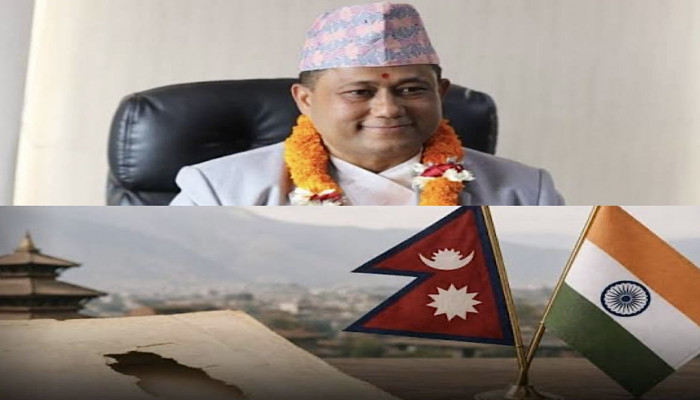
Nepal’s government has said it is still unclear whether the country has the original copy of the 1816 Sugauli Treaty, which helped establish its boundary with British India. The disclosure comes at a time when tensions over the Nepal-India border have increased following an agreement between India and China to reopen the Lipulekh trade route.
Foreign Minister Shisir Khanal told Nepal’s House of Representatives that the government does not have clear information about whether it possesses the official treaty signed with Britain. He was responding to a question from Nepali Congress lawmaker and Chief Whip Nishkal Rai. Khanal said, "The Government of Nepal does not have clear information on whether we possess the official treaty documents. There are records showing that some documents related to certain treaties are kept at the National Archives. But we do not have clear information as to whether those are the actual official treaties." He added that Nepal does have documents related to the 1816 treaty and the 1950 treaties.
The Sugauli Treaty formed the basis for the demarcation of the boundary between Nepal and British India. The treaty was signed in 1815 between Nepal and the East India Company after Nepal’s defeat in the Anglo-Nepal War. Under the agreement, Nepal ceded large areas of territory. Parish Bradshaw signed the treaty on behalf of the East India Company, while Raj Guru Gajaraj Mishra signed it on behalf of Nepal. The agreement played a major role in defining Nepal’s territorial boundaries and its relationship with British India.
Questions over the availability of the original treaty have existed for several years. In 2016, the Eminent Persons’ Group on Nepal-India Relations began discussions on reviewing or replacing the 1950 Treaty of Peace and Friendship. During that process, the Nepali side tried to locate the original 1950 treaty. The document had been signed by then Prime Minister Mohan Shumsher and India’s Ambassador to Nepal Chandeshwar Prasad Narayan Singh. Nepal could not find the original and later gave the Bhekh Bahadur Thapa-led committee a second copy of the treaty.
The missing documents later became the subject of a parliamentary inquiry. On July 22, the Delegated Legislation and Governance Committee of Nepal’s National Assembly said it could not find the original copies of either the Sugauli Treaty or the 1950 Treaty of Peace and Friendship. The committee said it searched several places where historical documents could have been preserved. These included libraries, archives, government repositories, the Department of Archaeology, Narayanhiti Palace Museum, the Ministry of Law and the Ministry of Foreign Affairs.
The issue had also come up in Nepal’s House of Representatives in 2019. Then Foreign Minister Pradeep Gyawali said the ministry had copies of both treaties but could not confirm whether they were the originals. Gyawali said, "We have both treaties, but we have to forensically verify whether these copies are originals or not," and added, "We are also trying to find historical documents and maps in India and the United Kingdom."
The 1950 Treaty of Peace and Friendship remains another important document in Nepal-India relations. Signed between the Rana government of Nepal and the Government of India, it gave Nepalis and Indians reciprocal rights in several areas in each other’s countries. The treaty helped shape relations between Nepal and independent India. Some sections of Nepal’s political establishment have long criticised it as an unequal agreement.
Khanal also said Nepal plans to review its treaties and agreements while keeping the country’s national interests at the centre. He made the statement on Monday while answering questions in the House of Representatives. According to Khanal, Nepal currently has 655 treaties and agreements. These include 412 bilateral agreements with neighbouring countries, other friendly nations, regional organisations and other parties. The remaining 243 are multilateral agreements.
So far, Nepal has concluded or amended 55 of these treaties and agreements. The government plans to review the remaining 600 based on their necessity and relevance. Khanal said old and inactive agreements would be reviewed, amended or renewed in coordination with the countries and organisations concerned.
Khanal was responding to questions raised by Rai during Monday’s House meeting. He said, "It is a fact that, as stated in the report submitted pursuant to Article 53 of the Constitution of Nepal, treaties and agreements will be reviewed, amended, and renewed and brought into implementation based on necessity and relevance, in accordance with decisions of the Government of Nepal."
He further said, "Under the general principles of international treaty law, the review, amendment, or renewal of any bilateral or multilateral treaty or agreement depends on the mutual consent and approval of the concerned state parties or relevant international organisations. This is an established practice under international law and diplomacy."
Khanal said Nepal would therefore carry out the review, amendment and renewal of such agreements in cooperation with the relevant friendly countries and international organisations. The government’s comments on the Sugauli Treaty come as the Lipulekh issue adds fresh sensitivity to Nepal-India border relations. The uncertainty over the original treaty has also renewed attention on the historical documents that form the basis of Nepal’s territorial boundaries and its relations with India.



 Loading...please wait
Comments