




Nepal ends decade-long ban on high-denomination Indian currency notes
- In Reports
- 06:17 PM, Dec 16, 2025
- Myind Staff
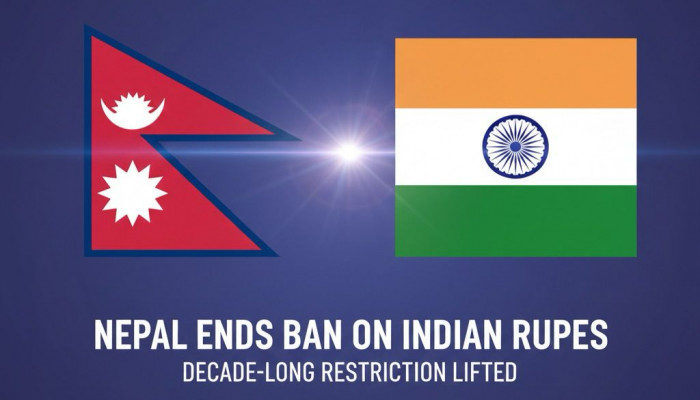
After almost a decade, the Government of Nepal has officially decided to lift the long-standing ban on high-denomination Indian rupee notes, a senior official has confirmed. The move, announced on Monday, comes as a relief for many people who travel frequently between Nepal and India for work, business, education, healthcare, and tourism.
The decision was taken during a meeting of Nepal’s Council of Ministers, where the Cabinet agreed to allow the import and export of Indian currency notes of Rs 200 and Rs 500 denominations. The announcement was made by Jagdish Kharel, Nepal’s Minister for Information Technology and Communication, who also serves as the official government spokesperson.
Speaking to ANI over the phone, Minister Kharel explained the new arrangement. He said the government’s decision will permit Nepalese and Indian citizens to carry high-value Indian notes when travelling between the two countries, but with a cap on the amount.
“The provision has been made for Nepalese or Indian citizens to bring Rs 25,000 per person from India to Nepal and take the same amount from Nepal to India,” Kharel said.
“With the government lifting the ban on high-denomination Indian notes, those notes issued after November 9, 2016, can be brought into circulation.”
Under this new policy, people can carry up to Rs 25,000 worth of Indian currency notes of denominations Rs 200 and Rs 500 when crossing the open border in either direction. This essentially reverses the older restriction that prohibited such notes from being brought into or used in Nepal.
The ban on higher-denomination Indian rupee notes has been in place since India’s demonetisation move in November 2016, when the Government of India removed large value notes from legal use, including older series of Rs 500 and Rs 1,000. Soon after that decision, Nepal responded by prohibiting the import and export of such notes and also restricted their use within the country.
For nearly ten years, Indian currency above Rs 100 could not legally circulate in Nepal. People crossing the border were only allowed to carry smaller denomination Indian notes, which often caused inconvenience, particularly for those who earned wages in India or needed to carry money home.
Officials said the decision by Nepal follows a change in India’s own rules regarding the movement of currency across borders. The Reserve Bank of India (RBI) had earlier amended its Foreign Exchange Management Regulations, 2015, to permit the import and export of high-denomination Indian notes between India and neighbouring countries like Nepal.
Once India relaxed its rules, Nepal’s government chose to align its policy accordingly. The RBI’s amendment was aimed at facilitating smoother movement of currency along the open border between India and Nepal and making cross-border travel and trade easier for citizens of both countries.
Nepal and India share one of the longest unfenced land borders in the world, and both countries maintain close economic and social ties. Indian currency is widely used in parts of Nepal, especially in border towns where trade and daily transactions often involve rupees.
For years, people travelling between the two countries faced difficulty carrying larger Indian notes, even when such currency was legal in India. This was particularly challenging for Nepali migrant workers who earn money in India but were not allowed to bring back high-value notes due to Nepal’s earlier ban.
With this restriction now lifted, travellers and workers are expected to benefit significantly. Carrying higher-denomination notes means less bulk and ease in handling money during trips. Officials say this change could make travel more convenient and may also help boost tourism and small-scale cross-border commerce.
Minister Kharel clarified that the policy applies only to Indian notes issued after November 9, 2016, the date when India’s demonetisation reforms were introduced. Older, demonetised notes remain out of circulation and are not covered under this permission.
The government’s decision is expected to be formalised soon after publication in the Nepal Gazette, the official government record that gives full legal effect to policies and regulations. Once that is done, the Nepal Rastra Bank is likely to issue guidelines to banks and financial institutions on how to implement the new rules.
The lifting of the ban marks a significant policy shift for Nepal after nearly ten years. By restoring the ability to carry and use higher-denomination Indian notes with reasonable limits, the government has responded to a long-standing demand from citizens and traders who interact daily with India.
Analysts say that while the change does not affect every traveller, it will bring noticeable relief to frequent border crossers, especially migrant workers, families, and small business operators. A smoother and more flexible currency policy may also strengthen economic cooperation and people-to-people connectivity between the two neighbouring countries.



 Loading...please wait
Comments