




‘Nehru wrote 17 letters opposing Somnath Mandir construction, glorifying Mughal invaders’: BJP reveals
- In Reports
- 05:11 PM, Jan 07, 2026
- Myind Staff
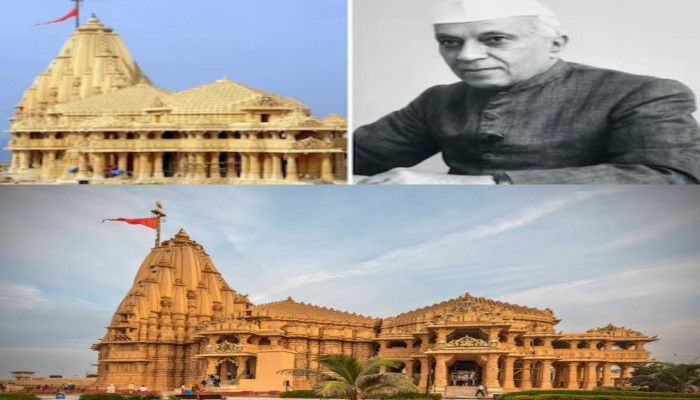
Amid the celebrations of Somnath Parv, marking 1,000 years since the first attack on the Somnath temple, the Bharatiya Janata Party (BJP) has brought focus to a series of letters written by India’s first Prime Minister Jawaharlal Nehru, which, according to the party, show his consistent opposition to the reconstruction and consecration of the Somnath Mandir after Independence.
The BJP stated that Nehru wrote more than 17 letters between 1950 and 1951 expressing discomfort, opposition, and concern regarding the reconstruction of the Somnath temple and the involvement of the Indian government and its constitutional authorities in the ceremony.
BJP spokesperson Sudhanshu Trivedi, in a post on social media platform X, strongly criticised Nehru’s position. He wrote, “In the past, Somnath was looted by Muhammad Ghazni and Khilji, but in independent India, Pandit Nehru harboured the greatest hatred toward Lord Somnath. See the biggest example of this: Pandit Nehru wrote a letter to Pakistan’s Prime Minister Liaquat Ali Khan on April 21, 1951, addressing him as ‘Dear Nawabzada,’ and in it, he described the story of Somnath’s doors as ‘completely false.’ Pandit Nehru wrote to Liaquat Ali Khan, in a way, surrendering, that nothing like the construction of the Somnath temple was happening.”
Questioning Nehru’s approach, Trivedi further asked, “If this wasn’t the politics of blind appeasement and the glorification of Mughal invaders, then what was it?”
According to the BJP, Nehru’s letters were addressed to several key figures, including the President of India, Cabinet Ministers, Chief Ministers, foreign diplomats, and even the Prime Minister of Pakistan. These letters questioned the need for the temple’s reconstruction, discouraged participation in the consecration ceremony, and repeatedly attempted to distance the Government of India from the event.
The BJP also claimed that Nehru issued instructions to public broadcasters to minimise coverage of the Somnath Mandir inauguration and downplay its importance. Additionally, Indian embassies were reportedly directed not to assist the Somnath Trust, including refusing requests related to sacred river water for the consecration ceremony.
On April 21, 1951, Nehru wrote to Pakistan Prime Minister Liaquat Ali Khan, dismissing the narrative surrounding the Somnath temple gates as “completely false” and assuring him that nothing of the sort was happening. The BJP alleged that instead of countering Pakistan’s propaganda or asserting India’s civilisational history, Nehru chose to reassure Pakistan by downplaying the temple’s reconstruction.
In a letter dated April 28, 1951, addressed to R.R. Diwaker, then Minister of Information and Broadcasting, Nehru asked that coverage of the Somnath consecration be toned down. He described the ceremony as “pompous” and stated that it was injuring India’s image globally. He also expressed unhappiness over the President attending the event.
On May 2, 1951, Nehru wrote twice to Chief Ministers, distancing the Government of India from the Somnath ceremonies. Although he acknowledged public support and participation by his colleagues, he invoked secularism to justify non-association and expressed concern over political optics.
In another letter dated August 1, 1951, also addressed to Chief Ministers, Nehru blamed the “pomp and ceremony” of the inauguration for creating a “very bad impression abroad” and weakening India’s secular image.
Earlier, on July 20, 1950, in a letter to K.M. Munshi, then Union Minister of Food and Agriculture, Nehru questioned the need to rebuild the Somnath temple at a time when the country faced economic challenges and housing shortages.
On June 13, 1951, Nehru wrote to Vice President Dr. S. Radhakrishnan, dismissing the inauguration as an unnecessary “fuss” and admitting that he had tried to prevent Cabinet Ministers from associating with it.
In a letter dated April 17, 1951, to K.M. Panikkar, Indian Ambassador to China, Nehru acknowledged that he had attempted to “tone down the effects” of the President’s visit to Somnath.
On April 21, 1951, Nehru wrote to U.N. Dhebar, Chief Minister of Saurashtra, objecting to the use of public funds for the ceremony and stating that temples were not a government matter.
The following day, on April 22, 1951, he wrote to Digvijaysinghji, the Jam Saheb of Nawanagar, expressing anxiety over Somnath trustees approaching foreign missions for sacred river water and soil. He feared it would give the impression of government involvement and attract Pakistan’s propaganda.
In another letter to Digvijaysinghji dated April 24, 1951, Nehru described the inauguration as “revivalism” and warned of “bad consequences nationally and internationally” if the President and Ministers participated.
On April 17, 1951, Nehru instructed the Ministry of External Affairs that Indian embassies should not assist the Somnath Trust with requests for sacred river water.
On May 9, 1951, writing to S. Dutt, Secretary in the Ministry of External Affairs, Nehru again objected to any government association with the Somnath ceremony, calling it “most unfortunate.”
Earlier, on March 19, 1951, Nehru wrote to Khub Chand, India’s High Commissioner to Pakistan, formally disapproving the use of Indus water for the consecration and ordering that there be “no publicity under any circumstances.”
In a March 2, 1951, letter to President Rajendra Prasad, Nehru admitted that he “did not like” the President associating with the inauguration and urged him not to preside over it.
On March 11, 1951, in a letter to C. Rajagopalachari, then Union Home Minister, Nehru stated that he would have preferred the President not attend the ceremony.
Another letter to Rajagopalachari on April 17, 1951, revealed that Nehru was “very much troubled” by the Somnath temple issue.
Finally, on April 24, 1951, in a letter to Congress leader Mridula Sarabhai, Nehru again expressed that the Somnath issue was “giving him much trouble,” reinforcing his continued discomfort with the reconstruction.
According to the BJP, taken together, these letters demonstrate Jawaharlal Nehru’s sustained opposition to the reconstruction and public recognition of the Somnath Mandir and his repeated efforts to distance the Indian state from the event.



 Loading...please wait
Comments