



Navi Mumbai International Airport commences commercial flight operations
- In Reports
- 06:25 PM, Dec 25, 2025
- Myind Staff
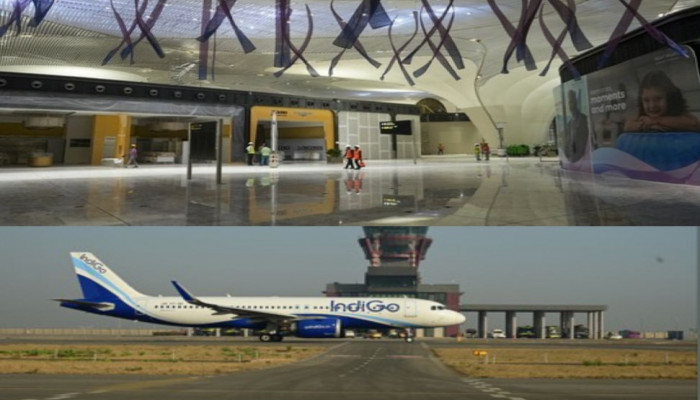
The Navi Mumbai International Airport (NMIA) officially began commercial flight operations on Thursday, marking a major development for India’s civil aviation sector and significantly boosting air travel capacity in the Mumbai Metropolitan Region (MMR).
The airport became operational with its first commercial arrival when an IndiGo flight from Bengaluru landed at NMIA at 8 am. The aircraft was welcomed with a ceremonial water cannon salute, a traditional aviation practice used to mark important milestones. According to the airport operator, the water salute was given to celebrate NMIA’s “first commercial touchdown and departure.”
An official statement issued by the airport operator said, “The aircraft was welcomed with a ceremonial water cannon salute, a traditional aviation gesture to mark NMIA’s first commercial touchdown and departure.”
Soon after the first arrival, the airport recorded its first commercial departure. IndiGo flight 6E882 departed for Hyderabad at 8:40 am, completing NMIA’s first full arrival and departure cycle on its opening day.
With this, the Navi Mumbai International Airport officially entered India’s operational airport network, easing pressure on the existing Chhatrapati Shivaji Maharaj International Airport in Mumbai and providing additional connectivity for passengers in the region.
On the first day of operations, domestic flight services are being operated by IndiGo, Air India Express, Akasa Air and Star Air. These airlines are connecting NMIA to nine destinations across India. According to the airport operator, a total of 15 scheduled departures are being handled on the opening day.
During the initial phase of operations, NMIA will function for 12 hours daily, from 8 am to 8 pm. In this phase, the airport will handle up to 24 scheduled daily departures to 13 destinations. The airport has been designed to manage up to 10 aircraft movements per hour, including both arrivals and departures.
The operator stated that the airport’s capacity and systems are prepared to gradually scale up operations. From February next year, airport services are planned to expand step by step to round-the-clock, 24-hour operations.
The Navi Mumbai International Airport was inaugurated earlier this year by Prime Minister Narendra Modi on October 8. The launch of commercial services marks the transition of NMIA from an infrastructure project to a fully functioning airport.
The airport is being developed in five phases. The first phase of the project has been constructed at a cost of Rs 19,650 crore. Once all five phases are completed, NMIA is expected to handle up to 90 million passengers every year. The airport will also feature dedicated cargo terminals and multimodal connectivity, strengthening both passenger and freight movement in the region.
The project is being implemented through a special purpose vehicle called Navi Mumbai International Airport Ltd (NMIAL). The Adani Group holds a 74 per cent stake in NMIAL, while the remaining 26 per cent is owned by the City and Industrial Development Corporation (CIDCO).
With the start of commercial operations, NMIA is expected to play a key role in meeting the growing air travel demand of the Mumbai Metropolitan Region. The airport’s phased expansion plan aims to steadily increase capacity, destinations and operating hours, while maintaining smooth and efficient flight movements.
The first day’s operations, marked by the ceremonial water salute and successful arrival and departure of commercial flights, signal the beginning of a new chapter in India’s aviation infrastructure development.



 Loading...please wait
Comments