



Naval Power in the Age of Strategic Flux: Lessons for Bharat from Indo-Pacific Alignments and Subsurface Transformation
- In Military & Strategic Affairs
- 11:18 AM, Apr 23, 2026
- Siddhartha Dave
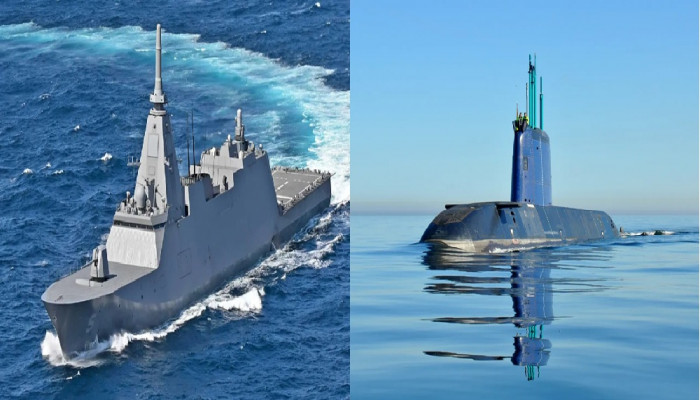
In the rapidly evolving character of modern warfare, the maritime domain has emerged as the decisive arena of power projection, deterrence, and geopolitical influence. The age when land wars alone determined strategic outcomes is receding. Today, control over the seas—spanning trade routes, choke points, and undersea domains—defines not only military superiority but also economic security and diplomatic leverage. This transformation is visible across theatres, where maritime thinking increasingly shapes joint-force operations. The current leadership of United States Central Command (CENTCOM) by US Navy Admiral Brad Cooper reflects this doctrinal shift, underscoring how naval power is no longer confined to oceans but influences the broader architecture of warfare.
For Bharat, this evolving strategic environment presents both a challenge and an opportunity. Two recent developments—the Japanese proposal for co-production of Mogami-class stealth frigates and the forward movement in the long-delayed Project 75(I) submarine programme with Germany—together signal a decisive transition. They represent not merely acquisitions, but the emergence of a globally networked naval industrial ecosystem anchored in Bharat.
Japan’s proposal to co-produce Mogami-class stealth frigates is a landmark in Indo-Pacific defence cooperation. The Mogami-class, designated as 30FFM, represents a new generation of multi-role surface combatants designed for high-intensity, technology-driven warfare. These vessels combine stealth features with a powerful arsenal that includes vertical launch systems, anti-ship missiles, advanced sonar suites, and integrated air defence systems. With a displacement of over 5,000 tonnes at full load and speeds exceeding 30 knots, they are both agile and formidable. The most distinctive feature lies in their high degree of automation, allowing operations with a relatively small crew, thereby reducing operational costs while maintaining combat effectiveness.
More importantly, the Mogami-class reflects the future of naval warfare through its modular design and integration of unmanned systems. Its ability to deploy Unmanned Underwater Vehicles and Unmanned Surface Vehicles transforms it into a multi-domain platform capable of mine countermeasures, surveillance, and extended operational reach. In essence, it is not just a warship but a networked combat node in an increasingly digitised battlespace.
Tokyo’s willingness to transfer design and production capabilities marks a significant departure from its historically restrictive arms export policies. For Bharat, this aligns perfectly with the strategic vision of Atmanirbhar Bharat. Indian shipyards, particularly Mazagon Dock Shipbuilders Limited, have matured into capable centres of complex warship construction. The proposed collaboration is therefore not a dependency arrangement but a partnership of mutual strategic interest. It strengthens Indo-Pacific security while simultaneously enhancing Bharat’s industrial capacity.
However, to view this transformation solely through the Indo-Pacific lens would be limiting. The parallel development in Bharat’s engagement with Germany points to a broader globalisation of its naval partnerships. The progress in Project 75(I), involving Thyssenkrupp Marine Systems, reflects the expansion of Bharat’s defence cooperation beyond regional alignments into a wider, multi-vector global framework.
For nearly two decades, Project 75(I) symbolised the challenges of defence procurement in Bharat—marked by delays, procedural complexities, and evolving requirements. Yet, recent developments indicate a turning point. Under the stewardship of Defence Minister Rajnath Singh, the programme has witnessed tangible progress, with cost negotiations concluded and the pathway to finalisation becoming clearer. This is not merely an administrative update; it is a strategic correction.
The importance of this progress cannot be overstated. Bharat’s submarine fleet has long faced the dual pressures of ageing platforms and delayed replacements. Several legacy submarines are nearing the end of their operational life, while the absence of fully operational Air Independent Propulsion systems has limited underwater endurance. The advancement of Project 75(I) thus represents a critical step in reversing this trend. It signals that the government has moved beyond acknowledging delays to actively resolving them, transforming a long-standing vulnerability into an area of renewed focus and capability building.
What emerges from these developments is a clear pattern: Bharat is no longer approaching naval modernisation in isolation. Instead, it is building a diversified network of strategic partnerships—Japan in the Indo-Pacific and Germany in Europe—each contributing to different dimensions of maritime capability. This multi-alignment approach enhances resilience, reduces dependence on any single partner, and accelerates technological absorption.
Naval power in the contemporary era is not simply about fleet size; it is about integration, readiness, and adaptability. Control over sea lanes ensures economic continuity, while a credible submarine force underpins strategic deterrence. Surface platforms like the Mogami-class provide flexibility and multi-role capability, whereas submarines offer stealth and survivability. Together, they form the twin pillars of maritime dominance.
Equally important is the industrial dimension of naval power. Indigenous production, supported by global partnerships, ensures that capability development is both sustainable and scalable. The co-production of advanced frigates and the domestic construction of next-generation submarines represent a shift toward industrial sovereignty. This is essential in an era where supply chains can be weaponised and technological access can be restricted.
The lessons for Bharat are therefore clear. Strategic intent must be matched by execution. Delays, when addressed with political will and institutional reform, can be converted into opportunities for recalibration. Partnerships, when structured around mutual benefit and technology transfer, can accelerate capability development without compromising autonomy. And above all, maritime thinking must occupy a central place in national security planning.
As Bharat moves forward, the convergence of Indo-Pacific cooperation and global defence partnerships marks the beginning of a new phase in its maritime journey. The seas are no longer peripheral to its strategic imagination; they are central to its aspirations.
In this emerging maritime century, the nations that command the oceans will shape the global order. Bharat, through its evolving naval strategy and expanding network of partnerships, is positioning itself not merely as a participant but as a shaper of that order.
Disclaimer: The opinions expressed within this article are the personal opinions of the author. MyIndMakers is not responsible for the accuracy, completeness, suitability, or validity of any information on this article. All information is provided on an as-is basis. The information, facts or opinions appearing in the article do not reflect the views of MyindMakers and it does not assume any responsibility or liability for the same.


 Loading...please wait
Comments