




NATO leaders meet in Ankara amid Trump’s remarks on Greenland, Iran rekindles disputes
- In Reports
- 01:32 PM, Jul 08, 2026
- Myind Staff
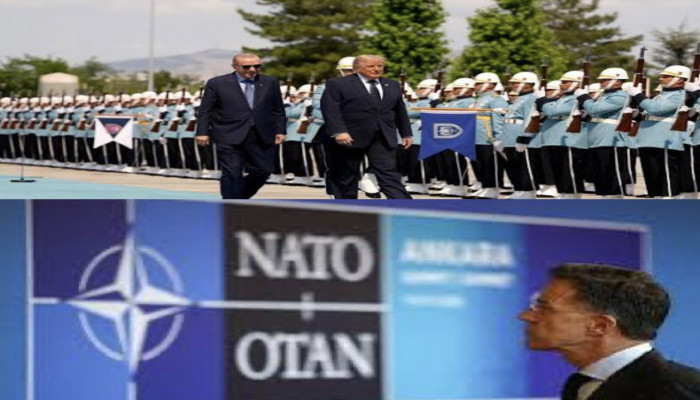
NATO leaders gathered in Ankara on Wednesday for a crucial summit as European members tried to secure U.S. President Donald Trump’s commitment to the military alliance. The meeting came at a time of growing tensions after Trump reopened disputes with European allies over the Iran conflict and Greenland. European leaders hoped the summit would strengthen unity and reassure members about the alliance’s future.
Trump arrived in the Turkish capital on Tuesday and immediately raised concerns about NATO’s direction. He said he might have skipped the summit if not for his friendship with Turkish President Tayyip Erdogan. He also refused to rule out further withdrawals of American troops from Europe. His remarks increased uncertainty over the United States’ long-term role in European security.
Earlier on Tuesday, NATO announced a series of defence agreements worth at least $50 billion. The alliance introduced the deals to show that European members were responding to Trump’s repeated demands to spend more on defence. NATO also wanted to demonstrate that Europe was reducing its dependence on the United States for its security.
Trump continued his criticism of the alliance during a joint appearance with Erdogan. He said he was “very disappointed” with NATO and claimed the United States did not receive enough support during the recent U.S.-Israeli war against Iran. He said, “Why are we spending hundreds of billions of dollars, and they're not there for us? We've always been there for them.”
Trump also accused several European countries of refusing to allow U.S. forces to use their airspace and military bases during the conflict with Iran. European officials rejected the claim. They said they largely fulfilled their commitments to American forces. They also pointed out that the United States did not consult them before launching a conflict that affected European economies and remained deeply unpopular across Europe.
In recent weeks, Trump also targeted Italian Prime Minister Giorgia Meloni, who had earlier maintained a close relationship with him. During his remarks on Tuesday, Trump said, “his relationship with Meloni became a little bad because she refused to help us" with Iran,” while also describing her as a “nice person”. Italian officials tried in recent days to reduce tensions and move past the disagreement.
Trump also repeated his demand for U.S. control over Greenland, the semi-autonomous territory that belongs to NATO member Denmark. His statement revived another dispute with European allies. Danish Prime Minister Mette Frederiksen responded within hours while speaking in Ankara. She said she expected NATO allies to respect the sovereignty of the Danish kingdom and accept that Greenland was not for sale.
The leaders of all 32 NATO member countries attended a dinner on Tuesday evening before the main summit session on Wednesday. Ahead of the meeting, ambassadors from every NATO member approved a draft summit declaration. The document reaffirmed an “ironclad commitment” to collective defence. However, leaders planned to issue the declaration only after they formally endorsed it during the summit.
The Trump administration has consistently urged European countries to increase their defence spending. It wants European allies to take primary responsibility for the continent’s conventional defence while the United States shifts more military attention toward the Indo-Pacific region. This strategy has shaped Washington’s recent approach to NATO.
The United States has already announced plans to reduce its military presence in Europe. It has withdrawn troops from the region and reduced the forces assigned to NATO’s defence plans. These reductions include an aircraft carrier, refuelling aircraft, fighter jets and drones. Washington has also started a six-month review of its overall military presence across Europe.
European leaders acknowledged that they are preparing to assume greater responsibility for the continent’s security. At the same time, they stressed the need for a stable and predictable transition. They warned that any sudden reduction in U.S. military support could leave security gaps that Russia might exploit.
Despite the disagreements, European officials remained hopeful ahead of the summit. They believed Trump’s personal relationship with President Erdogan and his positive ties with NATO Secretary General Mark Rutte could help ease tensions during the discussions. European leaders aimed to use the summit to reinforce cooperation, rebuild trust and maintain NATO’s unity at a time of growing geopolitical challenges.



 Loading...please wait
Comments