




NASM-SR Missile Salvo Test: Strengthening Bharat’s Naval Strike Capability
- In Military & Strategic Affairs
- 12:34 PM, Jun 25, 2026
- Siddhartha Dave
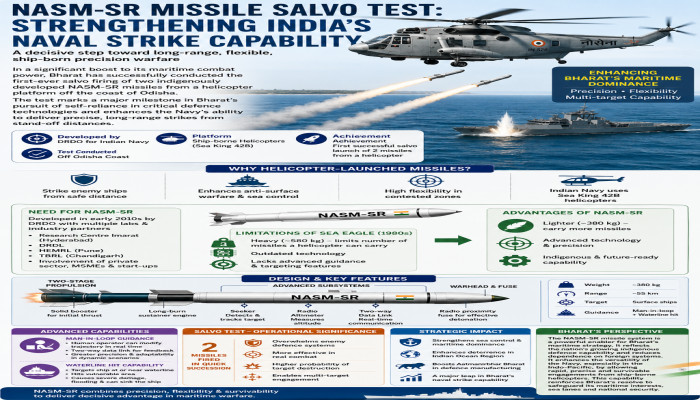
India has taken a significant step in enhancing its maritime combat capability with the successful salvo test of the indigenously developed Naval Anti-Ship Missile Short Range (NASM-SR). The test, conducted by the Defence Research and Development Organisation (DRDO) in collaboration with the Indian Navy, involved firing two missiles in quick succession from a helicopter off the Odisha coast. This marks the first successful salvo launch of an anti-ship missile from a rotary-wing platform in India, reflecting a major advancement in naval warfare technology.
Background and Significance of the Test
The NASM-SR has been designed specifically for deployment from ship-borne helicopters, offering enhanced operational flexibility compared to traditional ship-launched missile systems. The ability to launch missiles from helicopters allows naval forces to strike targets beyond the horizon while keeping their ships at a safe distance from potential threats.
The recent test demonstrated the missile’s capability to perform a salvo launch, where multiple missiles are fired in rapid succession. This capability is critical in modern warfare as it can overwhelm enemy ship defence systems, thereby increasing the probability of successful target neutralisation. It also showcases India’s growing expertise in integrating advanced weapon systems with aerial platforms.
Role of Helicopter-Launched Missiles in Naval Warfare
Helicopter-launched missile systems have become a key component of modern naval operations. They enable navies to extend their strike range without exposing high-value assets such as warships to direct threats.
These systems are particularly useful in anti-surface warfare, where the objective is to detect and neutralise enemy vessels. Helicopters can operate from ships and quickly reach forward positions, allowing them to launch missiles at hostile targets with precision.
The Indian Navy has previously used systems like the British-origin Sea Eagle missile deployed on Sea King 42B helicopters. However, such legacy systems have become technologically outdated, necessitating the development of advanced indigenous alternatives like NASM-SR.
Need for NASM-SR: Modernisation of Naval Arsenal
The older Sea Eagle missile, introduced in the 1980s, had several limitations. Weighing approximately 580 kg, it restricted the number of missiles that a helicopter could carry. Additionally, it lacked modern features such as real-time guidance and advanced targeting capabilities.
To overcome these challenges, DRDO initiated the development of NASM-SR in the early 2010s. The project involved multiple premier laboratories, including-
- Research Centre Imarat (Hyderabad)
- Defence Research and Development Laboratory
- High Energy Materials Research Laboratory (Pune)
- Terminal Ballistics Research Laboratory (Chandigarh)
The programme also incorporated private sector firms, MSMEs, and start-ups, aligning with India’s push for self-reliance in defence manufacturing (Atmanirbhar Bharat).
Design and Key Features of NASM-SR
The NASM-SR missile is designed with a two-stage propulsion system, consisting of:
- A solid booster rocket for initial acceleration
- A long-burn sustainer engine for extended flight
It is equipped with advanced subsystems such as:
- Seeker for target detection and tracking
- Radio altimeter for accurate altitude measurement
- Two-way data link for real-time communication
Weighing around 380 kg, it is significantly lighter than older missiles, enabling helicopters to carry more weapons and enhancing operational flexibility. Although its range is about 55 km, which is lower than some legacy systems, it compensates with improved accuracy, adaptability, and survivability.
The missile uses a radio proximity fuse, ensuring detonation when it reaches close proximity to the target, thereby maximising damage.
Advanced Capabilities
1. ‘Man-in-Loop’ Guidance
One of the most important features of NASM-SR is its “man-in-loop” capability. This allows a human operator to monitor and modify the missile’s trajectory during flight through a high-bandwidth data link.
This capability provides:
- Real-time control and flexibility
- Higher precision in targeting
- Reduced risk of collateral damage
Unlike traditional “fire-and-forget” missiles, this feature makes NASM-SR highly effective in dynamic combat scenarios, especially in crowded maritime environments.
2. ‘Waterline Hit’ Capability
Another critical feature is the missile’s ability to target the waterline of an enemy ship. The waterline is structurally vulnerable, and a strike in this region can lead to rapid flooding and potentially sink the vessel.
This precision targeting significantly enhances the missile’s lethality compared to older systems that lacked such capabilities.
Operational Significance of the Salvo Test
The successful firing of two missiles in quick succession demonstrates the system’s readiness for real-world combat scenarios. The key operational advantages include:
- Ability to overwhelm enemy defence systems
- Increased probability of successful target destruction
- Enhanced multi-target engagement capability
- Improved survivability of launch platforms
This marks a major leap in India’s naval strike capability, combining precision, flexibility, and effectiveness.
Strategic Implications for India
The NASM-SR programme reflects India’s growing emphasis on indigenous defence development and technological self-reliance. It strengthens the Indian Navy’s ability to maintain sea control and operate effectively in contested maritime environments, particularly in the Indian Ocean Region (IOR).
The development of such advanced systems also enhances India’s deterrence capability and positions it as a significant player in global defence technology.
Conclusion
The successful NASM-SR salvo test represents a transformative step in India’s naval warfare capabilities. By integrating advanced technologies such as real-time guidance and precision targeting, India has significantly enhanced its ability to conduct effective maritime operations.
As geopolitical competition intensifies in maritime domains, systems like NASM-SR will play a crucial role in ensuring national security, operational readiness, and strategic dominance at sea.
Disclaimer: The opinions expressed within this article are the personal opinions of the author. MyIndMakers is not responsible for the accuracy, completeness, suitability, or validity of any information on this article. All information is provided on an as-is basis. The information, facts or opinions appearing in the article do not reflect the views of MyindMakers and it does not assume any responsibility or liability for the same.



 Loading...please wait
Comments