




NASA’s Artemis II lunar mission successfully takes off with four astronauts on board
- In Reports
- 12:16 PM, Apr 02, 2026
- Myind Staff
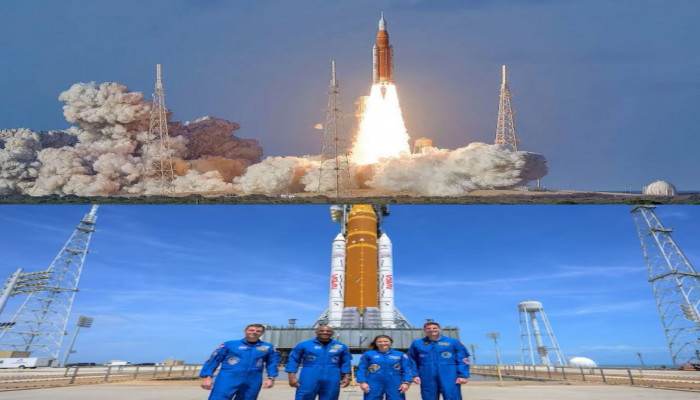
More than 50 years after humans last travelled beyond Earth’s orbit, NASA has launched the Artemis II mission, sending astronauts around the Moon once again. The mission lifted off on Wednesday from Kennedy Space Centre during its scheduled launch window between 6:24 pm ET and 8:24 pm ET. This marks a significant moment in space exploration, as it is the first crewed lunar mission since 1972.
The spacecraft is carrying four astronauts—Reid Wiseman, Victor Glover, Christina Koch, and Jeremy Hansen—on a 10-day journey around the Moon before returning safely to Earth. Although the crew will not land on the lunar surface, they will travel thousands of miles close to it. The mission is designed as a crucial step toward future Moon landings, focusing on testing the systems that will support human life in deep space.
At the centre of this mission is the Orion spacecraft, which is built to carry astronauts far beyond Earth. During the flight, the crew will rely on Orion’s life support systems and other technologies, all of which are being tested under real conditions. NASA aims to ensure that these systems perform safely before attempting more complex missions, including landing astronauts on the Moon.
The Artemis II mission is also notable for the powerful Space Launch System rocket used to send the crew into space. The rocket stands 322 feet tall and weighs approximately 5.75 million pounds when fully fuelled. After launch, the astronauts continue their journey inside the Orion capsule deeper into space.
During the mission, the astronauts are expected to travel as far as 43,000 miles from Earth towards the Moon. If everything goes as planned, this journey could set a new record for the farthest distance humans have ever travelled from Earth. It would surpass the distance achieved during the Apollo 13 mission, which previously held that record.
NASA sees Artemis II as part of a broader plan to return humans to the Moon in the coming years. The agency is aiming for a future mission that could include a lunar landing, possibly as early as 2028. To achieve this, NASA is working with private companies such as SpaceX and Blue Origin, which are developing additional spacecraft and technologies needed for these ambitious goals.
The last time astronauts walked on the Moon was during the Apollo 17 mission in December 1972. After that, interest in lunar exploration declined. NASA shifted its attention to missions closer to Earth, including the space shuttle program and the development of the International Space Station. The renewed focus on the Moon came with the Artemis program, which was revived during the presidency of Donald Trump and continued under his successor. Artemis I, an uncrewed mission, successfully orbited the Moon in 2022, setting the stage for this current mission.
Apart from the scientific and technical aspects, the astronauts also shared personal details about what they carried with them on this historic journey. According to the BBC, each crew member brought meaningful items from home. Pilot Victor Glover carried his Bible, while Jeremy Hansen brought family pendants. Commander Reid Wiseman took a notepad and pencil, and Christina Koch carried handwritten messages from loved ones.
The Artemis II mission represents a major step forward in space exploration. It reconnects humanity with deep space travel and lays the groundwork for future missions that may once again place humans on the lunar surface.



 Loading...please wait
Comments