




NASA’s Artemis II launch created 3,100-mile atmospheric disturbances, disrupted GPS signals: Study
- In Reports
- 08:36 PM, Nov 06, 2026
- Myind Staff
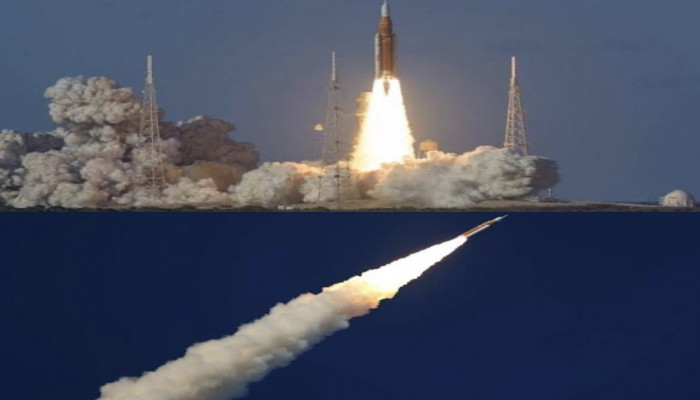
NASA’s Artemis II rocket launch created two massive disturbances in Earth’s upper atmosphere, each stretching around 3,100 miles (5,000 kilometres), a new study has found. Researchers also detected changes in GPS signals following the historic April 2026 mission, raising concerns about the impact of powerful rocket launches on navigation systems.
According to a report by Space.com, researchers from Taiwan’s National Cheng Kung University found that the atmospheric disturbances were up to 10 times stronger than those recorded after SpaceX’s Starship test launches. This was despite Starship having nearly twice the liftoff thrust of NASA’s Space Launch System (SLS) rocket.
Ground-based GPS stations detected changes in electron density in the ionosphere during the launch. These disturbances caused positioning errors of several metres, potentially affecting technologies such as self-driving cars and drones.
Charles Lin, an Earth science professor at National Cheng Kung University and co-author of the study, warned about the risks of such inaccuracies. "A positioning error of a couple of meters is enough to cause an autonomous car to change lanes," Lin told Space.com. He added that drone positioning could also face disruptions.
Researchers identified two major disturbances. The first followed the rocket's 212-foot-long (65-metre) core stage, while the second occurred after two upper-stage thruster burns. Both stretched across the American continent, covering approximately 3,100 miles from east to west.
The disturbances occurred in the ionosphere, an electrically charged layer of Earth's upper atmosphere that supports radio communication and satellite navigation.
Rockets travelling at supersonic speeds generate shock waves that disturb charged particles in this region. This can create temporary areas with reduced electron density, commonly described as atmospheric holes. Unlike solar storms, which can disrupt GPS signals for days, rocket-induced disturbances usually last for a shorter period.
Launched in April 2026, Artemis II carried four astronauts — Christina Koch, Victor Glover, Jeremy Hansen and Reid Wiseman — on the first crewed lunar flyby in more than 50 years. The crew included the first woman, first person of colour and first non-American astronaut on a crewed lunar mission.
The astronauts travelled 252,756 miles (406,771 kilometres) from Earth, setting a new human spaceflight distance record and surpassing Apollo 13's 1970 record by more than 4,000 miles.
The crew also captured the 'Earthset' photograph, witnessed a solar eclipse from space and reported flashes believed to be meteorite impacts on the Moon. They flew around its far side at an altitude of approximately 4,000 miles.
Artemis II was the first crewed flight of NASA's SLS rocket and Orion spacecraft. NASA aims to use the programme to return humans to the lunar surface and establish a sustained presence there, laying the groundwork for future Mars missions. China is also targeting a crewed Moon landing by 2030.



 Loading...please wait
Comments