




NALSAR students protest row: CJI slams BCI calls enrolment restriction order ‘absolutely uncalled for’
- In Reports
- 05:55 PM, Aug 14, 2026
- Myind Staff
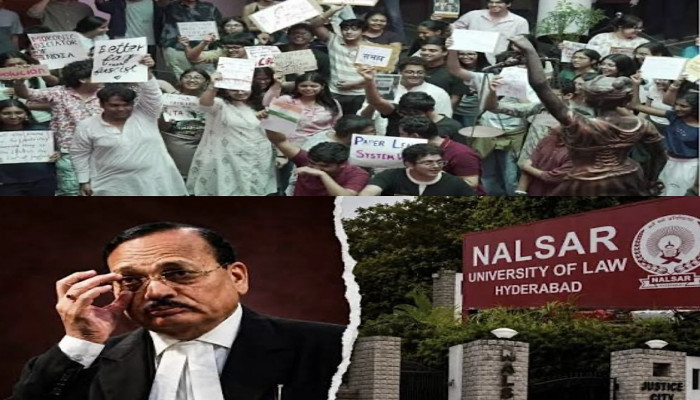
Chief Justice of India Surya Kant has strongly criticised the Bar Council of India (BCI) over its decision to stop the enrolment of NALSAR University of Law’s 2026 graduating batch as advocates. Calling the move “absolutely uncalled for”, the CJI said students have the right to protest. The Supreme Court has also directed that no punitive action be taken against NALSAR students or faculty members.
The court sought a response from the BCI on the circulars issued during the controversy. The intervention came after the BCI first directed State Bar Councils not to enrol students graduating from the Hyderabad-based National Academy of Legal Studies and Research (NALSAR) in 2026 until further orders.
The dispute began after a section of NALSAR students objected to the reported invitation of CJI Surya Kant as the chief guest at the university’s upcoming convocation. Their objection was linked to remarks made by the CJI during proceedings related to alleged police action against protesters at Delhi’s Jantar Mantar.
Reacting to the BCI’s intervention, CJI Surya Kant said the matter should have remained between him and the students. “Absolutely uncalled for. I myself was a student who was actively engaged in protests. It's a dialogue between me and students; who are they (BCI) to interfere,” the Chief Justice said.
The BCI had initially asked State Bar Councils to stop the enrolment of the entire 2026 NALSAR graduating batch. It also began an inquiry into what it described as a campaign against the CJI’s participation in the convocation.
The council sought information from NALSAR about students who were allegedly involved in initiating, organising or coordinating the campaign. In its initial position, the BCI said students entering the legal profession were expected to show respect for the highest judicial office. It also suggested that participation in protests and boycotts could affect professional standards.
The decision drew strong criticism from members of the legal community and political leaders. Vikas Singh, president of the Supreme Court Bar Association and a senior advocate, called the BCI’s action “arbitrary, illegal and disproportionate”.
The BCI later withdrew its original enrolment restrictions following the criticism. BCI chairman Manan Kumar Mishra announced on Thursday that the earlier directions had been modified. Under the revised decision, all students who graduated from NALSAR in 2026 would be allowed to seek enrolment with the State Bar Council of their choice.
The council initially said its factual inquiry would continue. It indicated that further action could be considered after the inquiry report. Mishra later announced that the proceedings had been closed altogether.
The BCI chairman said the council had considered representations from senior advocates, members of the Bar, law students and members of the public. After considering these representations, the council concluded that the 2026 NALSAR batch had no role in any disturbance or movement.
The students’ protest had its roots in a request made by a group of graduating students to the NALSAR administration. They asked the university to reconsider the reported decision to invite CJI Surya Kant as the chief guest for the convocation.
The students connected their objection to proceedings before a Supreme Court bench headed by Justice Surya Kant. The proceedings concerned allegations of police excesses against protesters during a July 20 demonstration at Jantar Mantar.
During proceedings on July 22, a lawyer seeking urgent listing of a petition referred to alleged police brutality. The lawyer also said that video evidence of the incident was available. Remarks attributed to CJI Surya Kant during the exchange later became a point of concern for the NALSAR students.
Justice Surya Kant subsequently clarified that the Supreme Court had not refused to hear the matter. He said a proper petition had to be filed in accordance with the court’s procedure.
The Supreme Court’s intervention on Friday has now shifted the focus to protecting NALSAR students and faculty members from punitive action. The court will examine the BCI’s circulars issued during the dispute.
The episode has also raised broader questions about students’ right to dissent and express disagreement. It has brought academic freedom and the powers of regulatory bodies into focus. The controversy also highlights concerns over professional consequences being attached to student protests.
The BCI’s decision to halt the enrolment of an entire graduating batch had created uncertainty for students preparing to enter the legal profession. With the order withdrawn and the proceedings closed, the 2026 NALSAR graduates can now seek enrolment with State Bar Councils. The Supreme Court’s direction further protects the students and faculty from punitive action as it examines the matter.



 Loading...please wait
Comments