




Naga students protest over mandatory Vande Mataram, government urges NSF to withdraw
- In Reports
- 06:47 PM, Sep 03, 2026
- Myind Staff
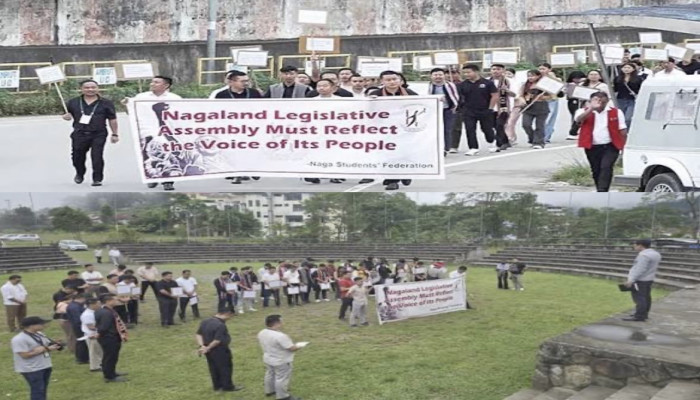
The Naga Students' Federation (NSF) continued its protest outside the Nagaland Assembly on Thursday, opposing the compulsory singing of Vande Mataram at official functions. The agitation entered its second day as the issue also came up during Zero Hour in the state Assembly. The Nagaland government appealed to the student body to withdraw the protest while a committee examines the legal implications of the Centre's directive.
During the protest, NSF members sang Christian hymns, including "When the Roll Is Called Up Yonder", "Onward, Christian Soldiers" and "I Have Decided to Follow Jesus". The students have maintained that they will continue their agitation unless the Nagaland Assembly passes a resolution opposing the compulsory singing of Vande Mataram.
NPF MLA Achumbemo Kikon raised the matter during Zero Hour. Kikon, who is also a former president of the NSF, said the issue was not limited to any particular constituency and concerned Nagaland as a whole. He said the compulsory singing of Vande Mataram had already led to extensive discussion in the Assembly.
Kikon said the state government, led by Chief Minister Neiphiu Rio, had taken note of the concerns raised by legislators from different tribal and political groups. He also referred to the views expressed by the Church, civil society organisations, tribal bodies and the NSF.
According to Kikon, the Union Ministry of Home Affairs issued an order on January 28 directing states to ensure the compulsory singing of Vande Mataram during the arrival of important VVIPs at national functions. This includes occasions such as the arrival of the governor at the state Assembly.
The matter was later sent to a committee formed to examine whether laws passed by Parliament can be applied in Nagaland in view of Article 371A of the Constitution. Parliamentary Affairs Minister K G Kenye heads the committee. It has been examining the issue and is expected to submit its report during the ongoing Assembly session.
Kikon said the legal position now needs another examination after Parliament enacted the Prevention of Insults to National Honour Act, 2026. The legislation has added a new element to the debate over whether the Centre's directive can be applied in Nagaland.
Appealing to the NSF to end its protest, Kikon said the concerns raised by the students could be addressed through the appropriate forum. "I would like to appeal, on behalf of the Government, and in the capacity of the former President of NSF, to the NSF friends, to kindly call off their agitation," he said.
Kenye also explained the committee's position in the Assembly. He described the matter as "very contentious" and "hypersensitive", particularly in relation to Article 371A and other constitutional provisions.
The committee has already held two meetings in May and June, and was prepared to place its report before the House. However, the President's assent to the Bill passed by both Houses of Parliament changed the legal situation, Kenye said.
"Earlier it was an executive directive, and now that it has been enacted by Parliament, it takes the shape of law," Kenye said.
The committee is now waiting for the legislation to be published in the Gazette of India. Kenye said the committee would examine the provisions of the law after its publication and then submit its report to the Assembly.
The government has urged the NSF to withdraw its agitation while the committee completes its examination. However, the student organisation has rejected the appeal and said it will continue its protest. The NSF wants the Nagaland Assembly to adopt a resolution against compulsory singing of Vande Mataram.
Nagaland's lone Lok Sabha member, S Supongmeren Jamir, also visited the protest site and expressed support for the protesting students. He assured the NSF members that he would raise the matter with the Centre.



 Loading...please wait
Comments