




Mystical Codes Of Temples
- In Religion
- 05:12 PM, Oct 29, 2018
- Akanksha Damini Joshi
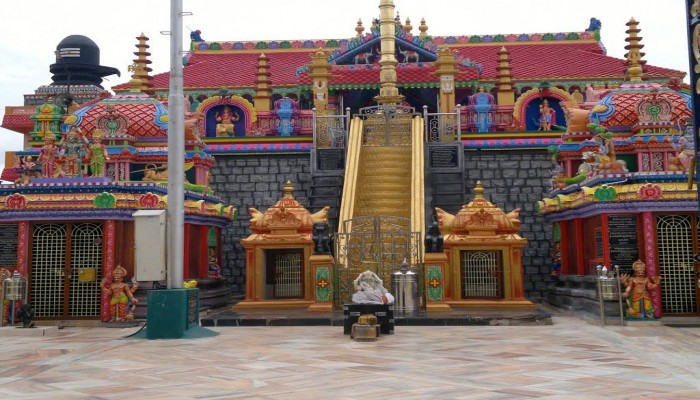
Each one of us has Stories. Intimate and collective. Some true, some over time, built as truth. Some we embrace the falsity of, some we reject even the truth of. But in our worlds - and each of us is a world in ourselves - to tell and to live our own stories, we have every right. No one else should be given the power to destroy the stories we tell ourselves, we tell others, the stories that make us who we are. Uniquely, us. But this has happened. Again, and again. In spaces intimate, in spaces Collective. Stories have been hijacked, narratives destroyed. People, their pride in themselves, shattered.
In India, it happened during colonisation. It is happening again, during this ... center-i-zation.Right in the face of this diverse land of stories ... the 950-year-old lived narrative of Ayyappa is being tampered with and destroyed. By people sitting far away in, what has come to be a very bland power center of multi-hued India, Delhi.
And sadly, no. It is not about women’s rights. It is about the rights of a people to their own living-story. A story about the only son of Shiva and Vishnu. Yes, you read it right. Hari Hara putra. A son, who would be Mahishi Mardan, the destroyer of Mahishi, the sister of the demon Mahishasura. Yes, the one Goddess Durga - who much of India is celebrating these nine nights - destroyed. The narrative may be true, it may not. But it is what is lived by a people. It is what makes them uniquely, them. Read on, for - if you have any heart connect with the air of the many diverse stories of India - it will find resonances within you.
In the subtle rendering of the stories that float around in India, this one is about an argument that once happened. As arguments go, this happened between a husband and a wife. Only they were no ordinary couple. The husband was Rishi Dattatreya -the son of Rishi Atri and Anusuya - and his wife Leelavati was the daughter of Rishi Galava and the Trinity Goddesses.
The argument, one hears, was on the eternal philosophical fight we have going in this land. The fight between Maya and Ananda. One says all is Maya. Another says all is Ananda. A few verbal biff baffs, curses fly in all directions and what have you ... Leelavati taking birth as a demoness Mahishi, to learn her lesson in her next life!
Of course, if you are thinking this is not the story, you are probably right. You see, we have many stories, and many versions of the same story too. The ultimate story flexibility. Anyways, going by this version. Mahishi was born as a She-Buffalo Demoness. Her bother was the demon Mahishasura, the He-Buffalo slain by Durga. Mahishi, in order to avenge his death, prayed to Brahma. Now, in India, everybody has a right to have their prayers heard, even if they are demons. So did Mahishi. Pleased by her austerities, Brahma ji gave her a boon.
Mahishi asked for, “Life, life, more life”. Brahma ji said, “Long I give, but has to stop”. She said, “Ah! then only death by the hands of a son of … of… Shiva and Vishnu!”
Now Shiva and Vishnu, who could imagine them having a baby! Our demoness Mahishi smiled, satisfied in having got her desire for eternal life.
BUT. The unexpected happened. Remember the churning of the ocean?! Ah! Yes! So the poison came out, Shiva drank. Then Nectar came, Demons were running after it, so Vishnu came in the form of Mohini? As per plans, Shiva then and there fell head over heels for Vishnu in the form of Goddess Mohini! And soon … Yes! Baby is Born! Hari-Hara-Putra. A baby who was adopted by the Pandala King in Kerala. Raised as a prince till he was 12 years. And then became the death of Mahishi. Releasing her from the torture of playing the role of a demoness, releasing her from Maya. This baby is Lord Ayyappa of Sabarimala. And the once Leelavati, then demoness Mahishi, is ... none other than the Goddess Maalikapurathamma, whose shrine is right there near Lord Ayyappa's!
Now, another aspect of the story of Sabarimala is the understanding of Lord Ayyappa as an incarnation of Lord Dharma Sastha. Many of us from other cultures in India, like myself, had never heard of Lord Sastha before now. But Lord Sastha is an ancient deity worshipped thousands of years ago across the globe. There are references to Sastha worship in the submerged Lemuria, Vietnam and Africa. And Sastha also appears in ‘various Puranas and Upa-puranas spreading over the other three yugas, including Ramayana and Mahabharata’.I am told, there are at least eight main forms of Shasta. And at least 6000 temples of worship of Sastha across Tamil Nadu and Kerala. In Tamil Nadu he is worshipped in the form of Ayyanar, and in Kerala as Ayyappa. Sabarimala Lord, Ayyappa is held by the people as the incarnation of Lord Dharma Sastha, “a man who has the power to make and implement dharmas or righteousness in the society”
To please such a Lord is not an easy task. One needs to practice austerities. Forty-one days of abstinence - from all sensory pleasures - is no joke by any standards. The idol of Lord Sashta/Ayyappa in Sabarimala is possibly the only one in India where he is seen in such a yogic pose. It is a mudra of transmission of knowledge through a strict training of the mind. Any sincere practitioner of any spiritual practice in India will tell you, each methodology has its own rules. What applies to one, does not work for the other. There are lenses through which wisdom can be seen, accessed: Shiv, Shaakta, Vaishnav, Tantra and many many thousands of uncategorized-ed/able methods!
In India, each of the temple deities too have their own codified methodologies. They are not in the language we modern folks understand, but they work the same way any deep meditation practice does. It is my instinctive feeling as a practitioner, the avoidance of women of a certain age group is a part of that deeply codified secret system which can be understood only in a language of energetics of Tantra. It is something that no court or no constitution can decode.
In a temple not so far away from Sabarimala, Attukal temple, only women are allowed to participate in the Pongala ritual. Linga Bhairavi Temple in Coimbatore doesn’t allow men to conduct rituals inside the main sanctum, there are no priests - only priestesses. Bhagwati Ma temple in Kanya Kumari, no married men are allowed.
One can sense the resonances of these traditions in many Tantric practises only for women, and some which they can only do during their periods.
MeditationDesign -Pilgrimage Ayyappa
In the complex esoteric multi-tradition methods in India, there are probably as many ways as interpreting these practices as there are saadhaks.
But in the little that I can sense, the entire meditation design of Lord Ayyappa's pilgrimage, is perhaps a directing of Kundalini Shakti upwards from the root chakra, Mooladhara to Sahasrara.
KundaliniChakras -PolarityPlay
In the language of Tantra, the chakras in a male body are exactly of the opposite charge as that in a women’s body. This is the natural cause of attraction, ‘sparks’ between the sexes.
The mooladhara, first chakra, in a man’s body contains a positive, extroverted energy. It moves towards the outward direction easily. In a woman’s body it is receptive, introverted. It receives that extroverted energy. The second chakra is exactly the other way around. For the women, it is extroverted, positive. For men, negative, introverted. It goes on like this till the sixth. The Seventh is, as is.
This causes an energy circle between the two which is used in many Tantric practices to direct the Shakti upwards towards the Sahasrara, Seventh Chakra. The seat of the thousand petaled lotus.
This is a language few know, even fewer fathom.
Ayyappa’s sadhana padhati method, in my vision, is clearly to by pass this polarity interplay between the two sexes. The idea very likely is to straight away target, to direct the energy of the devotees towards the higher chakras over a retreat period of 41 days followed by a darshana.
Hence the natural feeling of elevation that many devotees claim to feel. It is perhaps most likely a spontaneous rise of the Kundalini via Ayyappa’s padhati. Hence also the stress on him being a Naishtika Brahmachari. That is likely not just about celibacy, but mapping the #EsotericPath of the practise.
Six Temple Pilgrimage -Six Chakras
As I research, I find, my instinct may just be on the right track. There are supposed to be Six temple pilgrimage of Lord Sastha of which Sabarimala is a part.Each of them represents one of the Chakras activations as a part of its paddhati, methodology, “Six Kshetrams within oneself and also outside as separate temples” Sori Muthaiyan Kovil lights a fire in the Muladhara chakra. Achankovil moves the next chakra, Svadhishthana, below the navel. Aryankavu animates the Manipura chakra of willpower at the solar plexus. Kulathupuzhai spins the heart chakra, Anahata. Erumeli opens the Vishuddha chakra at the throat, and, finally Sabarimala electrifies the third eye of divine sight, Ajna chakra.The seventh, Sahasrara, is a darshan of the Self. The language of why-all-this-is-so belongs to an ancient world. Not to the world of law books. It belongs to a world made of stories. A world sensing songs. In nature, of nature. Nature not just as environment, but wild nature latent in the base of the spine of every man and every woman. Kundalini Shakti. The ways to awaken it, and the ways not to. This is a language that, even if it is not understood, needs to be respected. This is a language which, even if not seen as a language, needs to be sensed as a story. A story making a people, making a culture, unique.
https://bit.ly/2AfErVv
https://bit.ly/2CMSeoY
https://bit.ly/2QYEhYg


 Loading...please wait
Comments