



Myanmar’s Army chief Min Aung Hlaing elected as president
- In Reports
- 06:46 PM, Apr 03, 2026
- Myind Staff
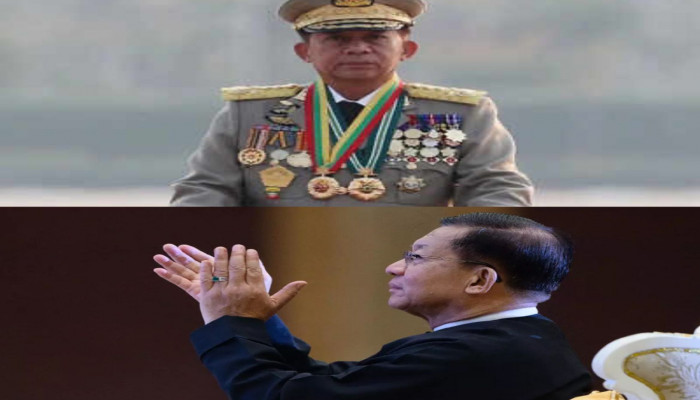
Myanmar’s Army chief Min Aung Hlaing has been elected as the country’s president after securing victory in a parliamentary vote dominated by pro-military lawmakers. This marks a significant step in formalising his control over the country, nearly five years after he led a coup that removed the elected civilian government.
The 69-year-old general won the presidency through a parliament largely controlled by the military-backed Union Solidarity and Development Party, along with representatives appointed by the armed forces. His elevation comes after elections held in December and January, which were won by the army-supported party.
Min Aung Hlaing has been at the centre of Myanmar’s political crisis since 2021, when he overthrew the civilian government led by Aung San Suu Kyi. Following the coup, Suu Kyi was placed under arrest, and the country witnessed widespread protests. These protests later turned into an armed resistance movement, reflecting deep opposition to military rule.
The recent elections that paved the way for his presidency have been strongly criticised by opposition groups and Western governments. Critics argue that the polls lacked credibility and were designed to extend military rule under the appearance of a civilian government. During a live broadcast of the vote count, Min Aung Hlaing comfortably crossed the required threshold to secure his position as president.
His transition to the presidency has also been accompanied by changes within the military leadership. Earlier in the week, he nominated Ye Win Oo, a former intelligence chief and close ally, as his successor to lead the armed forces. Analysts believe this move is a calculated step to maintain control while presenting a shift towards civilian governance.
An independent analyst, Aung Kyaw Soe, commented on this development, saying, "He has long harboured the ambition to trade his title of commander-in-chief for president, and it appears his dreams are now becoming a reality." This statement highlights the long-standing political ambitions of Min Aung Hlaing and the significance of his new role.
The leadership change is also being seen as an attempt to gain international legitimacy. However, despite the transition, the military continues to hold a strong influence over governance. Myanmar remains deeply unstable, with ongoing conflict across the country. Armed resistance groups, including those linked to Suu Kyi’s party and various ethnic minority forces, have increased their coordination against the military.
In response to the evolving situation, the Steering Council for the Emergence of a Federal Democratic Union issued a statement outlining its objectives. The group said, "Our vision and strategic objectives are to completely dismantle all forms of dictatorship, including the military dictatorship, and to collectively initiate a new political landscape." This reflects the determination among opposition groups to challenge military dominance.
Experts have warned that the new political arrangement could lead to increased pressure on opposition forces. They also suggest that changing dynamics with neighbouring countries may influence the conflict. Analysts believe that the current political and economic environment may create additional challenges for resistance groups trying to stay united.
Sai Kyi Zin Soe, an analyst, highlighted the difficulties ahead, stating, "Amidst global oil and fuel shortages and economic crises, maintaining organisational stability could become difficult." He further added, "As these hardships grow, it may become even harder to build mutual understanding and trust between groups, reach firmer agreements, and sustain cooperation." These concerns underline the broader challenges facing opposition movements.
Overall, the development signals a continuation of military dominance in Myanmar’s political system. While the shift to a presidential role creates an appearance of civilian rule, the underlying power structure remains largely unchanged. The country continues to face internal conflict, with no immediate resolution in sight.



 Loading...please wait
Comments