




MP High Court declares Bhojshala site as Saraswati temple, bans namaz at disputed Dhar complex
- In Reports
- 05:52 PM, May 15, 2026
- Myind Staff
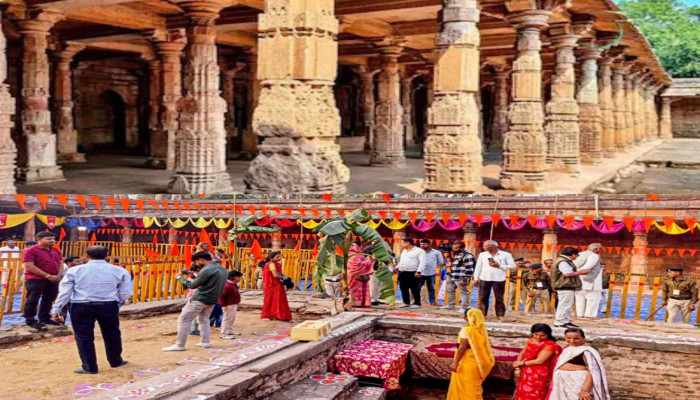
MP High Court declares Bhojshala site a Saraswati temple, bans namaz at disputed Dhar complex
In a major judgment in the long-standing Bhojshala-Kamal Maula Mosque dispute, the Madhya Pradesh High Court on Friday declared the disputed site in Dhar as Bhojshala, a temple dedicated to Maa Saraswati. The court also prohibited the offering of namaz inside the complex.
The verdict was delivered by a division bench of Justice Vijay Kumar Shukla and Justice Alok Awasthi. The bench ruled in favour of the Hindu petitioners and stated that the religious nature of the site is that of a Hindu temple linked to Maa Vagdevi Saraswati. The court also recognised the place as an important historical centre of Sanskrit learning associated with Raja Bhoj of the Paramara dynasty.
“We have noted continuity of Hindu worship at the site has never been extinguished," the court observed, adding that historical records and literature establish the disputed structure as Bhojshala.
The High Court further stated that members of the Muslim community may approach the state government for the allotment of separate land in the district for the construction of a mosque. With this ruling, the court brought a major shift to the decades-old arrangement regarding religious practices at the site.
The bench also held that the Bhojshala-Kamal Maula Mosque complex is a protected monument under the Ancient Monuments Preservation framework. According to the court, its protected status dates back to March 18, 1904. While giving the judgment, the court clarified that the Archaeological Survey of India (ASI) will continue to have complete supervisory control over the preservation and conservation of the monument.
At the same time, the High Court refused to rely on the ASI survey report submitted during the proceedings. The bench said the findings of the report did not inspire enough confidence. However, the court did not remove the ASI’s authority over the site and maintained that the agency would continue to oversee its upkeep and protection.
The court also mentioned that the state government may consider several representations seeking the return of the idol of Maa Saraswati, which is currently kept in a museum in London. It added that the government can examine the possibility of reinstalling the idol at Bhojshala.
The dispute over the Dhar monument has remained sensitive and controversial for many years. Hindu groups have consistently argued that Bhojshala is an ancient Saraswati temple. On the other hand, the Muslim side has maintained that the structure is the Kamal Maula Mosque. During the proceedings, a petitioner from the Jain community also claimed that the site originally functioned as a medieval Jain temple and gurukul.
Under an arrangement implemented by the ASI in 2003, Hindus were allowed to worship at the site on Tuesdays, while Muslims were permitted to offer namaz on Fridays. However, Hindu petitioners later challenged this arrangement in the High Court and demanded exclusive rights over the entire complex.
During the hearing of the matter, the High Court had directed the ASI on March 11, 2024, to carry out a scientific survey of the disputed site. Following the order, the ASI began the survey on March 22. The exercise continued for 98 days before the report was finally submitted to the court.
The ruling is expected to have a significant impact on the decades-old dispute surrounding the Bhojshala-Kamal Maula Mosque complex and may also lead to further legal and political discussions in the coming days.



 Loading...please wait
Comments