



Moreh: Manipur’s Deadly War Zone Part-1
- In Current Affairs
- 01:59 PM, Nov 14, 2023
- Ankita Dutta
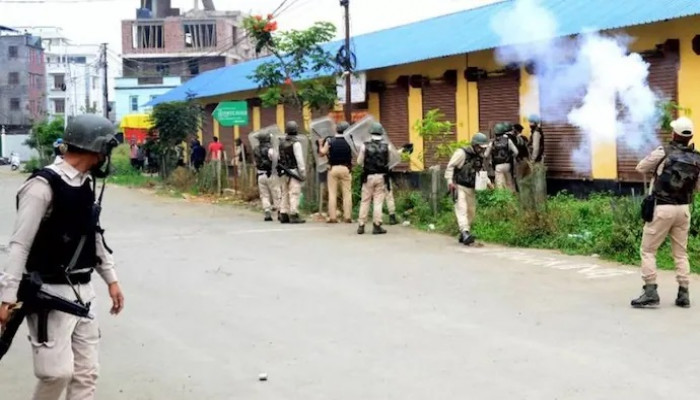
There is still no end in sight to the conflict in Manipur. While many people have already died, many are still languishing in the relief camps. A few disturbing incidences in the small yet sensitive border town of Moreh situated eastwards from the misty hills of Manipur’s Tengnoupal district has again aroused our attention to the bloody past that this dusty little town has been a witness to. On the morning of October 31, a mid-ranking Meitei police officer was brutally killed by Kuki militants while he was inspecting the construction of a helipad in Moreh, once touted as India’s ASEAN Gateway and an important transit point in India’s ‘Act-East Policy’. The Kuki militants did not just stop at this.
They also executed an extremely well-planned ambush on a team of police commandos en route to Moreh on the afternoon of that same fateful day. Located at a distance of about 109 km South-East of Imphal on the Indo-Myanmar Road (Imphal-Dimapur National Highway-2), Moreh is a flourishing border trade town in Manipur inhabited mainly by the Kuki-Chins, Meiteis, and Mizos. The Central Government has spent crores of rupees to build infrastructure in the town. At least till the 1990s, Moreh was a Hindu-majority town having a significant population of Tamil Hindus, Malayalis, Hindu Bengalis, Nepalis, Punjabis, Biharis, and Marwaris. Tamu in Myanmar is the counterpart border town of Moreh.
Kukis have long attempted to establish their social and political control over Moreh and Manipur’s international border with Myanmar through a systematic genocide of the native Naga and the Tamil Hindu communities. Numerous Kuki villages that have emerged of late along the Imphal-Moreh section of the National Highway earlier used to be the settlements of the Hindu Zeliangrong Nagas and the Rongmei Nagas. Unfortunately, there is hardly any Naga population left today in Moreh and its neighbouring areas. It would not be an exaggeration to say that in many ways, the Nagas of Manipur have been the most affected because of Kuki violence, perhaps even much more than the Meiteis.
To recall, this violence dates back to British times when there were several attempts by the nomadic Kukis to destroy Naga villages and forcibly occupy them. Between December 1917 and May 1918, in the hills of Manipur, several villages of the Kabui and the Tangkhul Nagas were mercilessly raided and destroyed by the Kukis. Many Nagas were killed, while others were taken away as slaves to Burma, i.e. present-day Myanmar. In October 1964, the Kukis again had shown their inhumanity and barbaric nature when one night about two dozen Kuki youth forcibly entered the Tribal Girls’ Hostel at Imphal’s Lambulane town, singled out the Naga girls from the Kukis and raped them repeatedly.
It had later come to light that five of the more beautiful of these girls were so brutally raped that they fell unconscious and had to be rushed to the hospital at the dead-end of the night. The beginning of the 1990s saw a sudden and drastic increase in the population of Moreh. Also, the years 1992 and 1993 were some of the bloodiest in the history of Manipur, infamous for some of the deadliest Naga-Kuki clashes, which were, however, never reported in any media of that time. On June 3, 1992, a shootout took place between the Naga insurgent outfit – National Socialist Council of Nagaland (NSCN) – and, the Kuki National Army (KNA) near Bongjang village, situated at a distance of about 7-8 km from Moreh town.
In the exchange of fire which led to the death of one Onkholet Haokip, a Kuki, the Kukis were enraged. They sought revenge. Immediately, on the very next day, i.e. on June 4, the Kuki Students’ Organisation (KSO) of Chandel district called for a complete shutdown in Moreh to protest against the killing. On that same night, Kuki youth, armed with guns and sticks, announced through loudspeakers that Nagas should leave Moreh within 24 hours or face dire consequences. This had led to a mass exodus of the Nagas residing in and around Moreh for fear of the armed Kuki commandos, and no Naga dares return to Moreh even today.
Just a few days after this incident, an excursion group of Mao Naga Students’ Union was beaten up, abused and humiliated at the Moreh bus station by some armed Kuki youngsters, high on drugs. These same youth also later entered the hotel rooms of the Naga girls, ransacked their luggage and other belongings, and molested them. In the early morning of the next day, a few Kuki youths kidnapped one Maring Naga man and his companion. Their bodies were never found. On June 29, 1992, there was a mass exodus of the Lamkang Naga villagers from a place called Betuk Shengreng near Moreh town, to Pallel in Chandel district due to mindless violence inflicted upon them by the Kukis.
Again, after a few days, a Tangkhul Naga man was abducted from his hotel room by some armed Kuki youth with the help of another Kuki man from Moreh. Although his body was never found, the Kuki who was instrumental in the abduction and subsequent disappearance of the man was later reported to be freely moving in Moreh. On that same day, defying security forces, one Angami Naga man from Nagaland’s Viswema village was brutally beaten up by six Kuki youths while he was waiting at the Moreh bus stand to return to Imphal. It is said that his other Meitei and Mizo friends who were also standing at the bus stand were spared, but he was singled out and assaulted simply because of his Naga identity.
On July 14, 1992 one Tangkhul Naga woman and her friends who had gone to Moreh for an outing, were abducted from their hotel room in the evening by armed Kukis. They were molested and robbed of a huge amount of money. Another ghastly incident rocked Moreh the very next day, i.e. July 15, 1992. Two Tangkhul Naga men, Mr. Ringkahao and Mr. S. Chinaochung of Moirangpan village in Manipur’s Senapati district, were called out by Kuki militants from their River View Hotel room at Moreh. They were taken to one Kuki village and severely tortured. Later, however, they were separated from one another and taken to a jungle where Mr. Ringkahao was shot in the neck.
The whereabouts of his other companion were never known. On that same day, two Tangkhul Naga girls were also abducted from their hotel room in Moreh by armed Kuki gangs. They were molested and raped for several hours and then sent back the next morning in an almost semi-naked state. Militants of the Kuki National Organisation (KNO), Kuki National Army (KNA), Kuki Defence Force (KDF), etc. sent out threatening letters to the Nagas of Moreh and other Naga villages in Chandel, Senapati, and Ukhrul districts to leave immediately. When they could no longer bear the atrocities of the Kukis, hundreds of Naga families fled Moreh and its surrounding regions by August 1992.
During the peak of the riots, several Naga Churches were vandalised by the Kukis, and their fruit orchards were destroyed. By now, violence and killings have become widespread in almost all the other Naga-dominated areas of Manipur such as Ukhrul, Senapati, Tamenglong, and even some parts of Churachandpur district. Kuki insurgents had established their control over Moreh. The situation went out of control. No media of that time took note of this dastardly violence that almost tore apart Manipur into pieces. Within three months of the beginning of the Naga-Kuki conflict in Moreh in 1992, Kukis had molested and gangraped several Naga women and kidnapped many Naga men from several places in Manipur.
Many of them could never even be traced. The badly mutilated body of one Naga man was later found at a cemetery in Moreh, but in a very unfortunate turn of events, the Kuki militants did not let his family take away his body. Nagas have been the victims of unimaginable harassment, torture and loot at the hands of the Kukis. After several waves of exoduses and displacement from their ancestral lands, the Nagas could realise that unless they retaliated to the threat of the Kuki militants, they faced a serious danger of losing their lives and lands which the Kukis were trying to grab through violent and coercive means.
Accordingly, in May 1993 the Nagas came together under the auspices of the United Naga Council (UNC) – the apex body of the Nagas of Manipur – and formed a voluntary village defence force called the ‘Nagalim Guard’ “to ensure security, to provide protection to the Naga villages, and guard the villages when paddy cultivation was going on.” Repeated appeals were made to the Government of India by various Naga village chiefs and Naga CSOs in view of the rampant kidnappings, murders, burning of houses, molestations and rape of Naga women leading to the mass exodus of the Nagas from Moreh and its neighbourhood in the early 1990s.
However, the then Congress Government of Rajkumar Dorendra Singh did precious little to provide safety and security to the victims, with no effective action being taken to stop the atrocities by the Kukis. Most importantly, the violence and horror unleashed by the Kukis in Moreh were not confined to the Naga population alone. The Tamil Hindus of Moreh too, bore the brunt of extortion in the hands of the Kuki militants belonging to the Kuki National Army (KNA). In 1995, the Kukis kidnapped a Tamil businessman from Moreh and held him hostage in the nearby village of Chang Vangphei. The trader was eventually killed because the Tamils refused to pay the tax.
This had again sparked bloody riots between the Tamils and the Kukis in Moreh. In the ongoing strife too, several houses of the Tamil Hindu community of Moreh have been burnt and destroyed by the Kuki militants. They constitute the third largest community in Moreh after the Kukis and the Meiteis. Infighting soon began between the numerous smaller factions of the Kukis. In 1997, clashes broke out between the Paites and the Kukis. The Paites are spread across different areas in Myanmar too, where they are known as Tedim Chins. In 2007, Kuki militants again began a series of attacks on the last remaining Meitei villages of Moreh, resulting in the tragic loss of many lives, including that of small children.
Eight years later, i.e., in 2015, during the campaign for the introduction of the Inner Line Permit (ILP) in Manipur, the Kukis vandalized and looted several shops and houses of the Meiteis in broad daylight, disregarding the presence of numerous State and as well as Central security forces. Subsequently, Kuki miscreants resorted to various tactics of extortion on the locals of Moreh, instilling among them a sense of constant fear and insecurity. This was the time when almost all the Punjabi, Marwari, Malayali, and Bihari families fled Moreh forever, to never return again. Kuki militants soon imposed their own laws in the area and initiated a taxation system that targeted all the remaining non-Kuki communities of Moreh.
People engaged in different forms of economic activities, especially labour work/coolie, etc. were required to obtain permission from the Hill Tribal Council (HTC) of the Kukis in Moreh. A tax collection gate was also set up in Moreh under the supervision of Kuki militants. Various forums and news outlets have already alleged the presence in Moreh of a Myanmar-based militant group – the People’s Defense Force (PDF) – a non-signatory to the Suspension of Operations (SoO) Agreement. It has been reported that militants of the KNO are providing training to the PDF cadres in the villages of Sahei and Bongjang near Moreh.
After the turmoil began in Manipur on May 3, 2023, around 800 houses of the Meiteis were destroyed and reduced to ashes by the Kuki militants. An ancient Devi temple in Moreh was also desecrated and looted by armed Kuki gangs. Shockingly, this rampage happened in the presence of heavily deployed Central forces, Assam Rifles, and State Police commandos. The older generations of the Kukis, including communities such as Kom, Vaiphei, Gangte, Simte, etc. have, however, lived harmoniously with their Meitei and Tamil neighbours. The new immigrants among the Kukis (post-1951) have been the main instigators behind almost every violent activity in Moreh and other areas of Manipur.
But it needs to be mentioned here that a significant chunk of the population of the ‘Old Kukis’ now identify themselves as Nagas and Kom-rem. The Anal, Moyon, Monsang, Chothe, Kom, and Purum, for instance, share similarities at various levels with both the Kukis and the Nagas. But, instead of adopting the Kuki identity, they have declared themselves as Nagas. An important factor that apparently induced them to join the Naga clan was their geographical proximity to the territories inhabited by the Tangkhul Nagas and the Maring Nagas. Considerations of their religious beliefs and practices facilitated this process further.
The formation of a Christian Church and collective participation in ecclesiastical affairs produced a sense of closeness that eventually led to the merger of these identities. The American Baptist Mission and the Roman Catholic Church, primarily led by major Naga tribes like the Maos and the Tangkhuls, were prominent in the Maring Naga villages. The merger of the smaller tribes with the Nagas was largely activated under Naga secessionist organisations such as the National Socialist Council of Nagaland (NSCN). There was a sudden intensification of this process during the Naga-Kuki conflict from the 1990s onwards.
‘Kuki’ is a generic term covering at least 37 tribes, most of which are concentrated in Manipur, some parts of Assam and the Naga hills. Many tribes included within the ‘Kuki’ group are ethnically fluid, and are therefore also referred to as Chin or Mizo. The term ‘Kuki’ is also applicable to the tribes residing in present-day Mizoram and the Chin state of Myanmar. After the Naga-Kuki feuds (1992-1993), the Kuki population in and around Moreh has seen an abnormally increasing growth, within a very short span of time. Many of those tribes who had earlier identified with the Kukis now disavowed their Kuki identity and declared themselves to be an independent tribe or a Naga.
As per the Census of 1881, the Kuki population in Manipur was less than 4%, unlike today. As a matter of fact, Kukis had made up only 17% of the population of Moreh back in the year 1981 but had increased to 56% by 2011. The problem has assumed complex dimensions because of the absence of stringent immigration controls along the border and shared language and ethnic ties between the Chin communities from Myanmar and certain Kuki communities in Moreh. The problem of aggressive Kuki expansionism, however, is not merely confined to Manipur. Assam, Tripura, Nagaland, and even the Chittagong Hill Tracts (CHT) area of Bangladesh have borne the brunt of this phenomenon.
(To be Contd…)
Image source: India Today



 Loading...please wait
Comments