




Mohsin Naqvi: The Man Who Holds Trophies Pakistan Cannot Win
- In LifeStyle & Sports
- 01:44 PM, Sep 16, 2026
- Dr. Siddhartha Dave
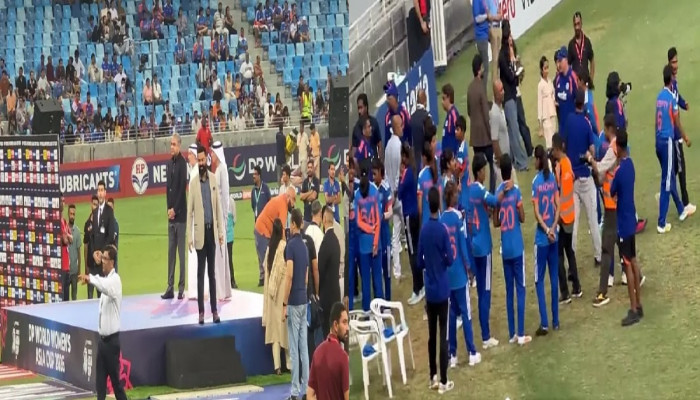
India's record-extending eighth Women's Asia Cup triumph was a statement of cricketing supremacy. The trophy presentation, however, provided an altogether different kind of spectacle.
A historic victory, followed by an unnecessary drama
India had already done everything a champion was expected to do. On Sunday, September 13, at the Dubai International Cricket Stadium, Harmanpreet Kaur's team defeated Sri Lanka by 72 runs to reclaim the Women's Asia Cup and extend its record to eight titles.
It was a fitting response to India's defeat in the 2024 final. The Indian team had returned to the summit, and the trophy was theirs. But as the cricketing contest ended, another spectacle began.
The Indian players did not come forward to receive the trophy from Mohsin Naqvi, the Pakistan Cricket Board chairman and Asian Cricket Council president. The presentation stalled, Naqvi remained on the dais, and the familiar chant of "Trophy chor, trophy chor" reportedly followed him as he left the stadium.
For a tournament that had just witnessed some excellent cricket, it was a rather unfortunate way to end the evening. And yet, there was something revealing about the episode. India had won the trophy on the field. The controversy was about who would hand it over.
When the presentation becomes the performance
A trophy presentation should be one of the simplest rituals in sport. The winners are announced, the medals are distributed, the captain lifts the silverware, and the cameras capture the moment.
It is a celebration of the players' achievement, not an opportunity for an administrator to become the principal attraction. Naqvi, however, has now found himself at the centre of two such controversies involving Indian cricket teams. In the 2025 Men's Asia Cup final, India defeated Pakistan but declined to receive the trophy from him. The presentation was delayed, and the physical trophy was subsequently seen being taken away from the presentation area.
The women's final brought the same awkward spectacle back to Dubai.
A trophy ceremony is meant to honour the champions. When it becomes a standoff, the ceremony itself becomes the story. And in this instance, the story was not flattering to the official who was supposed to preside over it.
The man with the trophy, the team without the victory
Here is where the episode becomes particularly ironic.
Naqvi occupies two positions in cricket administration. He is the chairman of the PCB and the president of the ACC. Yet, while he has repeatedly found himself in the position of presenting trophies to victorious Indian teams, Pakistan cricket has struggled to deliver the kind of results its supporters expect. And that is where the pun practically writes itself.
Pakistan cricket appears to have developed a trophy problem: its administrators keep getting involved in trophy presentations, while its players keep struggling to win the biggest prizes.
But that is precisely what makes the current situation so frustrating for Pakistani cricket fans. A country with love for cricketing tradition should be concentrating on rebuilding its team, restoring consistency and winning major tournaments. Instead, its cricket administration has found itself entangled in controversies over who gets to hand a trophy to whom.
Pakistan's women's team, meanwhile, had already been eliminated from the tournament after losing to Sri Lanka in the semi-final. India had defeated Pakistan comfortably in the group stage before going on to win the title. The contrast was difficult to miss.
India's women were celebrating an eighth continental championship. Pakistan's representatives were once again at the centre of a trophy-related controversy. One team had earned the right to lift the silverware. The other country's cricket administrator had become the subject of chants about it. There is a lesson in that contrast, and it has little to do with the physical trophy.
The 'Trophy Chor' taunt: a punchline with a history
The nickname "Trophy Chor" is not an official designation. It is a mocking label that emerged on social media after the 2025 men's Asia Cup controversy, when Naqvi ran away with the trophy after India won and refused to receive the trophy from Naqvi.
Its return during the women's final shows how quickly a sporting controversy can acquire a life of its own.
The irony is that the trophy was never the real prize for Naqvi. It was the opportunity to stand on the presentation dais, appear in photographs and be part of a moment that belonged to the victorious team. But the more the ceremony became about the administrator, the less it was about the champions. And that is a rather expensive price to pay for a few minutes of limelight.
The Indian team had no need to engage in a verbal confrontation. Its performance had already delivered the strongest possible statement. By refusing the presentation, the players made their position clear without allowing the controversy to overshadow the fact that they had won the tournament.
The stadium chants added another layer of embarrassment, but they should not be mistaken for the central achievement of the evening. The central achievement was India's cricket.
A reminder that cricket is bigger than its administrators
There is a broader issue that deserves attention. Cricket in the Indian Subcontinent has never existed in a political vacuum. India-Pakistan cricket has long carried the weight of history, diplomacy and national sentiment. Administrators often find themselves navigating circumstances that go well beyond the boundary rope.
That makes their responsibilities greater, not smaller.
The ACC president's job is to serve Asian cricket. The PCB chairman's job is to help Pakistani cricket flourish. Neither responsibility is enhanced by turning a trophy presentation into a prolonged confrontation.
If Naqvi believes that his presence at such ceremonies will strengthen his standing, the evidence suggests otherwise. Each new controversy has only reinforced the public association between his name and the trophy dispute.
A more constructive approach would be to ensure that future ceremonies are conducted smoothly, with the focus firmly on the players. There is no shortage of genuine challenges facing Pakistan cricket that require the chairman's attention.
The team's performances, its development pathways, its consistency and its inability to compete for major honours are all more important than a photograph on a presentation dais.
India keeps winning. The trophy keeps waiting.
India's eighth Women's Asia Cup title is a sporting achievement that deserves to stand on its own. The team has demonstrated consistency, depth and the ability to perform under pressure. Shafali and Smriti provided the fireworks with the bat, while India's bowlers, Shreecharani and Dipti Sharma, ensured that Sri Lanka never got close to the target.
The result also underlined India's growing authority in Asian women's cricket. This was not merely a victory over Sri Lanka; it was a successful return to the top after the disappointment of 2024.
The trophy presentation may have generated the headlines, but the cricket had already settled the important question. Indian Women team is the Asian champion.
And perhaps that is the most amusing part of the entire episode. Naqvi may have wanted to be remembered as the man handing over the trophy. Instead, he has once again become associated with a ceremony in which the champions chose not to receive it from him.
Because there is a difference between being the custodian of a trophy and being the team that earns it. One gets to stand on the dais. The other gets to lift the cup. And on Sunday night in Dubai, there was no doubt about which side India was on.
Disclaimer: The opinions expressed within this article are the personal opinions of the author. MyIndMakers is not responsible for the accuracy, completeness, suitability, or validity of any information on this article. All information is provided on an as-is basis. The information, facts or opinions appearing in the article do not reflect the views of MyindMakers and it does not assume any responsibility or liability for the same.


 Loading...please wait
Comments