



Modi, Carney set $50 billion trade target, announce broader strategic cooperation
- In Reports
- 07:04 PM, Mar 02, 2026
- Myind Staff
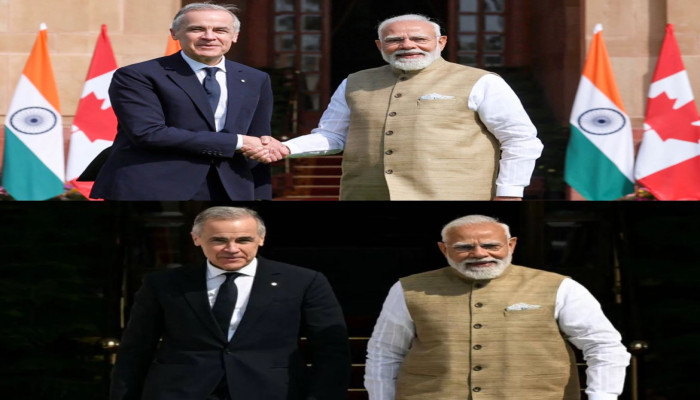
India and Canada have decided to take their bilateral relationship to a higher level, setting an ambitious target of achieving $50 billion in trade by 2030 and announcing a long-term uranium supply agreement. The decisions were taken after talks between Prime Minister Narendra Modi and Canadian Prime Minister Mark Carney in New Delhi. The meeting focused on expanding economic cooperation, strengthening energy security, and deepening strategic ties between the two countries.
During a joint press statement, Prime Minister Modi said that both leaders discussed transforming their shared vision into a next-level partnership. He clearly outlined the trade goal and the importance of a formal economic framework. He said, “Today, we discussed transforming this vision into a next-level partnership. Our goal is to reach $50 billion in trade by 2030. Unlocking the full potential of economic cooperation is our priority. Therefore, we have decided to finalise a comprehensive economic partnership agreement soon.”
The Comprehensive Economic Partnership Agreement (CEPA) was a key part of the discussion. Both sides agreed to work towards finalising it at the earliest. The agreement is expected to boost trade, increase investments, and create more opportunities for businesses in both countries. The leaders believe that a structured trade agreement will help unlock the full economic potential of India-Canada ties.
Prime Minister Modi also pointed out the strong investment presence of Canada in India. He highlighted that Canadian pension funds have invested about $100 billion in India. Calling it a strong symbol of trust, he said that this investment reflects “deep faith in India’s growth story.” This, according to him, shows confidence in India’s economic progress and long-term development.
One of the most important announcements made during the meeting was related to civil nuclear cooperation. India and Canada agreed on a long-term supply of uranium from Canada to India. This agreement is expected to support India’s growing energy needs, especially in the nuclear energy sector. The two sides also agreed to cooperate in the development of small modular reactors and advanced nuclear reactor technology. This step strengthens energy security and expands cooperation in clean and reliable power generation.
Energy cooperation was a major focus of the talks. Prime Minister Modi announced that Canada will join the International Solar Alliance and the Global Biofuel Alliance. These platforms aim to promote renewable energy and sustainable fuel alternatives. Canada’s participation is expected to strengthen global efforts in solar and biofuel development.
Modi also said that India and Canada will organise an India-Canada Renewable Energy and Storage Summit later this year. This summit will focus on expanding cooperation in renewable energy and energy storage technologies. Both leaders agreed that clean energy collaboration is important not only for economic growth but also for addressing climate challenges.
Apart from trade and energy, the talks also covered defence and security cooperation. Prime Minister Modi emphasised that India and Canada share democratic values and respect for diversity. He said these shared principles will guide their partnership in the future. The two countries agreed to strengthen cooperation in defence manufacturing and enhance coordination in maritime security.
Modi also underlined the importance of joint efforts against terrorism. He said that terrorism, extremism, and radicalisation pose serious threats not only to individual nations but to global peace and stability. Both countries agreed to step up cooperation in tackling these challenges.
Canadian Prime Minister Mark Carney described the current phase of India-Canada relations as an expansion of a valued partnership. He noted that engagement between the two governments has significantly increased in recent times. Highlighting the progress made, Carney said, “There has been more engagement between the Canadian and Indian governments in the last year than there has been in more than two decades combined. This is not merely the renewal of a relationship. It is the expansion of a valued partnership with new ambition, focus, and foresight. A partnership between two confident countries charting our own course for the future.”
Carney stressed that this renewed engagement reflects the determination of both governments to move forward with fresh ambition. He made it clear that the relationship is not simply being restored but is being expanded with greater focus and direction.
The Canadian Prime Minister also spoke about the importance of people-to-people ties, describing them as the backbone of India-Canada relations. He said that cultural links and shared history form a strong foundation for cooperation. In this context, he announced that Canadian universities will open campuses in India. This step is expected to deepen educational cooperation and strengthen cultural and academic exchange.
Carney further highlighted cooperation in sectors such as artificial intelligence, healthcare, agriculture, and innovation. These areas are seen as important pillars for future collaboration. By expanding cooperation in these sectors, both countries aim to create long-term opportunities for growth and development.
Clean energy remained another strong point in Carney’s remarks. He spoke about cooperation in wind, solar, and hydrogen power, indicating Canada’s commitment to expanding renewable energy partnerships with India. He also referred to Canada’s long-term plans to expand its electricity grid and said that India could play an important role in this growth journey.
The meeting between Prime Minister Modi and Prime Minister Carney signals a renewed push to strengthen bilateral relations across multiple areas. From setting a $50 billion trade target to announcing a long-term uranium supply agreement, the two countries have outlined a clear roadmap for deeper cooperation.
With a focus on trade expansion, clean energy development, nuclear cooperation, defence collaboration, and stronger educational ties, India and Canada are aiming to build a broader and more structured partnership. The announcements made during the meeting reflect a shared commitment to move forward with confidence and ambition.



 Loading...please wait
Comments