




Middle East Irreversible Polarisation: Shia Axis vs Sunni Bloc
- In Military & Strategic Affairs
- 11:19 AM, Apr 10, 2026
- Viren S Doshi
Overview
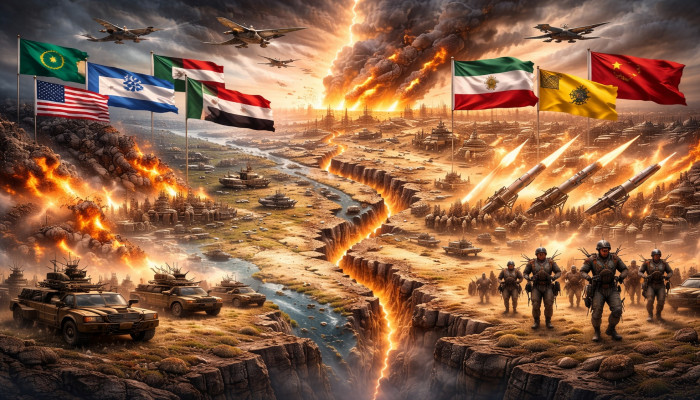
The Middle East today stands almost completely polarised along lines of power, ideology, and survival. It has many lessons embedded in it for the Indo-Pacific and South Asia.
On one side are the Arab states — overwhelmingly non-nuclear and with zero tolerance for Sunni terrorism — aligned with Israel (the region’s only Jewish state), Christian-majority Western backers, and the United States. On the other hand is a far more hardcore and aggressive bloc: the non-Arab Shia core led by the Ayatollah Regime, certain non-Arab Sunni nuclear and non-nuclear states, with many frontal Sunni and Shia deadly terrorist entities such as Lashkar-e-Taiba (LeT), Jaish-e-Mohammed (JeM), Hamas, Hezbollah, and the Houthis, and the overarching enabling patronage of CCP-occupied China, which also repeatedly vetoes or places technical holds on United Nations sanctions against these entities.
This is not ancient Sunni-Shia theology replayed; it is a cold, post-1979 contest of state-sponsored asymmetric warfare, nuclear shadowing, and big-power hedging.
And India has made its choice — loudly, repeatedly, and with strategic clarity. But first, the two poles.
The Two Axes: Structure and Capabilities
The Abrahamic Counter-Axis (Arab + Israel + US)
Arab states — Saudi Arabia, the United Arab Emirates, Egypt, Jordan, Bahrain, and others — possess no nuclear weapons but command formidable conventional forces, vast oil wealth, and deepening security partnerships. Their alignment with Israel, formalised through the Abraham Accords signed in 2020 (initially with the United Arab Emirates and Bahrain, followed by Sudan and Morocco), is pragmatic balancing against a common threat. These accords have endured into 2026 despite regional wars, producing billions in trade, technology transfers, and intelligence cooperation. The United States anchors the camp with military bases, advanced weaponry, and intelligence sharing. Jews and Christians fit here not by theology but by shared interest in stability, counter-terrorism, and open sea lanes.
Crucially, these Arab Sunni states have systematically eliminated Sunni terrorism from their soil through a combination of iron-fisted security operations and sophisticated deradicalisation programs. Saudi Arabia pioneered the Prevent, Rehabilitate, and Aftercare (PRAC) initiative in 2005 following deadly Al-Qaeda attacks inside the kingdom; the program combines religious counselling, psychological rehabilitation, job placement, family support (including financial incentives for marriage), and monitored reintegration, successfully reducing domestic extremism to near-zero levels while purging radical clerics, reforming school curricula, and dismantling terror cells. The United Arab Emirates embedded similar zero-tolerance policies within its broader modernisation drive, using intelligence-led arrests and ideological counter-narratives to eradicate Muslim Brotherhood-linked networks and jihadi sympathisers. Egypt conducted sweeping crackdowns on Gama’a al-Islamiyya and Al-Jihad remnants post-Arab Spring, pairing mass arrests with rehabilitation centres that emphasise moderate Islamic interpretations. Collectively, these measures — backed by robust intelligence sharing and regional coalitions — transformed former hotbeds of Sunni extremism into stable, terror-free societies, proving that determined state action can dismantle homegrown Sunni terrorist threats when political will exists.
The Ayatollah Regime’s Axis of Resistance
At the heart of this axis is the Ayatollah Regime — non-Arab, Shia, and “revolutionary” since Ayatollah Ruhollah Khomeini’s 1979 Islamic “Revolution”, which explicitly exported jihad as state policy.
This axis, in a way, includes non-Arab Sunni Pakistan (nuclear-armed with an estimated 170 warheads as of 2025) and Turkey, along with a network of proxies that function as a low-cost, high-impact deterrent force.
Hezbollah in Lebanon, the Houthis in Yemen, Hamas in Gaza (despite its Sunni Muslim Brotherhood roots), and various Iraqi and Syrian militias form a coordinated “ring of fire” around Israel and Arab Sunni rivals.
For 47 years, the Ayatollah Regime has poured hundreds of millions annually into this network: approximately $700 million to Hezbollah alone, up to $350 million to Hamas and Palestinian Islamic Jihad combined, and tens of millions more to the Houthis and Iraqi groups.
At its peak before heavy Israeli strikes, Hezbollah’s arsenal exceeded 100,000–150,000 rockets and missiles — far more sophisticated than anything Sunni terrorist groups like Al-Qaeda or the Islamic State ever fielded.
The Houthis have conducted over 300 attempted attacks on commercial shipping in the Red Sea and Gulf of Aden since November 2023, sinking four vessels, killing at least nine sailors, and causing a temporary 90 per cent collapse in container traffic through the Suez Canal route. Global trade worth trillions was disrupted; insurance premiums and shipping costs skyrocketed as vessels rerouted around Africa.
These are not ragtag militants. They are state-funded, battle-hardened structures with precision-guided munitions, drones, ballistic missiles, and extensive tunnel networks — ruthlessly effective and resilient even under sustained aerial campaigns.
Just as Ayatollah Regime is black listed by FATF (Financial Action Task Force), similarly black listed external enablers amplify this threat: North Korea has long supplied critical missile technology and components to the Ayatollah Regime, including approximately 150 No Dong systems in the late 1990s, Musudan ballistic missiles (19 delivered in 2005), and assistance in developing the Qiam, Emad, and Ghadr systems now used in strikes against Israel, the United States, and Gulf targets. North Korean technicians have embedded in Ayatollah Regime facilities, providing expertise in underground bunkers and propulsion systems, with payments in cash and oil sustaining a pipeline that indirectly arms Hezbollah, Hamas, and the Houthis.
Shia Terrorism’s Evolution: From Khomeini to Durable Proxy Warfare
Shia-linked terrorism, ignited by Khomeini’s 1979 revolution, has surpassed Sunni terrorism in organisational depth and staying power. Sunni extremism produced headline-grabbing atrocities — the 9/11 attacks, the Islamic State’s territorial caliphate — but proved fragile once conventional military pressure was applied. The Ayatollah Regime’s model is different: deniable proxies, embedded in local societies, sustained by steady cash, weapons, and training from Tehran. Hezbollah has absorbed decades of conflict and remains a hybrid army-polity. The Houthis have defied Saudi-led coalitions for years and pivoted seamlessly to Red Sea disruption in solidarity with Hamas after October 7, 2023. Hamas itself, though Sunni, receives critical arms, funding, and doctrinal guidance — a pragmatic sectarian override that underscores the axis’s ideological flexibility.
This ruthlessness is structural. The Ayatollah Regime’s Islamic Revolutionary Guard Corps (IRGC) and its Quds Force treat proxies as extensions of Ayatollah power projection, avoiding direct conventional war while forcing adversaries into perpetual multi-front dilemmas.
CCP-Occupied China: The Evil Enabler
No axis survives without external patronage. CCP-Occupied China plays a decisive transactional role. Beijing is not ideologically Islamist — it is ruthlessly self-interested. Through the Belt and Road Initiative and its strategic partnership with Pakistan (via the China-Pakistan Economic Corridor), it shields terrorist assets at the United Nations. CCP-Occupied China has repeatedly placed technical holds or blocked blacklistings of LeT and JeM leaders — most notoriously Jaish-e-Mohammed chief Masood Azhar — in the UN Security Council’s 1267 Sanctions Committee. Only in 2019, after intense diplomatic isolation and near-universal pressure, did Beijing relent on Azhar. It continues to water down or delay measures against the Houthis and other proxy entities when doing so protects energy imports, maritime routes, or anti-Western leverage.
Worse, CCP-Occupied China actively supplies weapons and dual-use technology that sustain the axis. In March 2026, two Ayatollah Regime-affiliated vessels left Chinese ports loaded with sodium perchlorate — a key precursor for solid rocket fuel used in ballistic missiles — enabling the Ayatollah Regime to rebuild its arsenal amid conflict. Ayatollah Regime has pursued Chinese CM-302 supersonic anti-ship cruise missiles for Strait of Hormuz denial capabilities, while its drones deployed against U.S. and Israeli targets incorporate Chinese sensors, gyro navigation devices, semiconductors, Beidou satellite systems, and voltage converters. Shipments flow indirectly via Russia, Turkmenistan, and Pakistan’s China-Pakistan Economic Corridor to evade sanctions, bolstering the IRGC’s missile and drone programs with intelligence support, electronic warfare tools, and anti-stealth radar components. This patronage keeps the second axis financially and diplomatically viable.
Arab Diplomatic Counteroffensive at the UNSC
The counter-axis has not been passive. In a striking display of unity, Bahrain — on behalf of the Gulf Cooperation Council states and Jordan — has led decisive action at the United Nations Security Council. On March 11, 2026, the Council adopted Resolution 2817, a Bahrain-sponsored text co-sponsored by a record 135 member states. It unequivocally condemned the Ayatollah Regime’s “egregious attacks” on Gulf nations, determined that these strikes breached international law and threatened international peace and security, deplored civilian casualties and infrastructure damage, and demanded an immediate halt to all such aggression — including threats to close the Strait of Hormuz. CCP-Occupied China and Russia abstained; the resolution passed with overwhelming support.
Bahrain then mooted a second resolution addressing freedom of navigation in the Strait of Hormuz. Circulated in late March 2026 and negotiated through the first week of April, the draft encouraged coordinated defensive measures by states to protect commercial shipping, demanded the Ayatollah Regime cease all interference, and initially contemplated “all necessary means” to safeguard transit. Despite being watered down amid opposition, it received 11 votes in favour when put to a vote in early April 2026 — but was vetoed by CCP-Occupied China and Russia, with two abstentions.
These twin initiatives underscore the Arab camp’s proactive diplomacy in exposing and isolating the Ayatollah Regime’s destabilising actions.
India’s Unambiguous Strategic Choice
India has chosen decisively, and the choice is rooted in national and global interest. New Delhi maintains robust defence, intelligence, and technology partnerships with Israel (one of its largest arms suppliers and innovation collaborators) and the United States (via the Quad, iCET, and joint exercises). It has deepened energy, trade, and counter-terror cooperation with the United Arab Emirates and Saudi Arabia — Arab states that have cracked down on Pakistan-backed groups and aligned against the Ayatollah Regime’s proxies.
The stakes for the Indian diaspora are enormous and personal. Over 3.5 million Indian nationals live and work in the United Arab Emirates, with nearly 2.6 million in Saudi Arabia — together forming a massive, skilled workforce that powers construction, services, healthcare, and technology sectors across the Gulf. In 2024, the United Arab Emirates alone remitted $21.6 billion to India (nearly 19 per cent of India’s total remittances that year), helping drive record inflows of $129.4 billion in 2024 and $135.4 billion in FY25. These funds support families, stabilise India’s current account, and fuel domestic consumption. Yet the diaspora’s safety depends on regional stability — stability repeatedly threatened by the very terrorist entities and state sponsors India confronts.
India has zero tolerance for LeT and JeM — perpetrators of the 26/11 Mumbai attacks (166 killed) and the 2019 Pulwama strike (40 Central Reserve Police Force personnel martyred) — and has led global efforts to isolate them. It condemns Hamas atrocities, Hezbollah rocket barrages, and Houthi shipping attacks. While pragmatic lanes remain open with the Ayatollah Regime (notably the Chabahar port for Central Asian access), India rejects any equivalence between counter-terror realism and appeasement. Its multi-alignment is tactical; its counter-terror posture is absolute.
The World Must See the Map Clearly
The polarisation is not symmetric. One camp seeks stability through normalisation, economic integration, and conventional deterrence — and has proven it can eradicate Sunni terrorism from its own territory. The other exports homegrown “revolutionary” violence through proxies, nuclear-backed patronage, North Korean missiles, Chinese Communist powered technology lifelines, and big-power shielding. Shia terrorism’s post-Khomeini evolution has produced more durable, integrated threat structures than Sunni variants ever achieved. CCP-Occupied China’s veto diplomacy and material support ensure the axis retains oxygen, even as Bahrain’s twin UNSC initiatives expose its isolation.
India’s choice is already made — security first, prosperity through partnerships that reject terror. The rest of the world, particularly energy-dependent economies and diaspora communities, would do well to decode the same map.
The Middle East’s fault lines are not abstract; they are armed, funded, and nuclear-shadowed. Ignoring the actual positions only invites the next barrage.
Disclaimer: The opinions expressed within this article are the personal opinions of the author. MyIndMakers is not responsible for the accuracy, completeness, suitability, or validity of any information on this article. All information is provided on an as-is basis. The information, facts or opinions appearing in the article do not reflect the views of MyindMakers and it does not assume any responsibility or liability for the same.


 Loading...please wait
Comments