



Massive ‘No Kings’ protests erupt across U.S. as opposition to Trump intensifies
- In Reports
- 12:32 PM, Mar 30, 2026
- Myind Staff
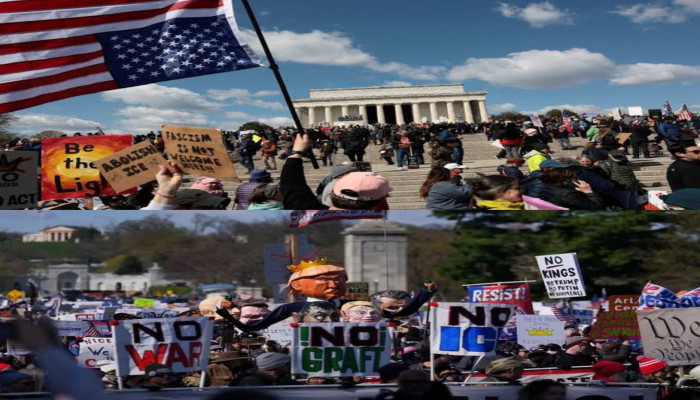
Demonstrators opposing U.S. President Donald Trump and his policies gathered in cities across the United States on Saturday, marking the third nationwide wave of the “No Kings” protests. The rallies were organised in response to concerns over aggressive deportation actions, the ongoing war in Iran, and what critics describe as increasingly authoritarian governance. Organisers said more than 3,200 events were planned across all 50 states, showing a significant expansion of the movement after earlier protests witnessed millions of participants.
While major cities such as New York City, Dallas, Philadelphia, and Washington, D.C. witnessed large gatherings, a majority of the demonstrations were held in smaller towns and communities. According to organisers, nearly two-thirds of the events took place outside big urban centres, reflecting a 40% rise in participation in less populated areas compared to the first protests held last June.
In Minnesota, one of the focal points of Trump’s immigration crackdown, thousands assembled outside the state capitol in Saint Paul. Protesters carried posters showing images of Renee Good and Alex Pretti, U.S. citizens who were fatally shot by federal immigration officers in Minneapolis earlier this year. The rally drew prominent political voices, including Minnesota Governor Tim Walz, who is also the Democratic vice presidential nominee for 2024. Addressing the crowd, Walz praised the protesters’ determination and said, “They call us radicals. You're damn right we've been radicalised - radicalised by compassion, radicalised by decency, radicalised by due process, radicalised by democracy, and radicalised to do all we can to oppose authoritarianism.”
U.S. Senator Bernie Sanders also spoke at the Minnesota event, reinforcing concerns about the direction of the country under Trump’s leadership. “We will not allow this country to descend into authoritarianism or oligarchy in America. We, the people, will rule,” Sanders said. Adding a cultural dimension to the protest, musician Bruce Springsteen performed his song “Streets of Minneapolis,” slamming the immigration policies and reflecting on the deaths that have intensified public anger.
The protests elicited strong reactions from political opponents as well. The National Republican Congressional Committee criticised Democratic leaders for supporting the demonstrations. Spokesperson Mike Marinella said, “These Hate America Rallies are where the far-left's most violent, deranged fantasies get a microphone, and House Democrats get their marching orders.” This statement highlights the deep political divide surrounding the protests and the policies they oppose.
In New York, the turnout was particularly large, with police estimating tens of thousands of participants stretching across more than ten blocks in midtown Manhattan. Actor Robert De Niro, who helped organise the event, warned about the risks posed by Trump’s leadership. He stated that no president before Trump has posed “such an existential threat to our freedoms and security.” Among the participants, Holly Bemiss, 54, drew parallels between the current protests and the country’s founding struggles. “We fought against having kings and we fought for freedom. We're just doing it again,” she said.,
In Washington, D.C., crowds gathered on the National Mall, chanting pro-democracy slogans and holding signs criticising Trump. Nearby, in Chevy Chase, Maryland, elderly residents in wheelchairs joined the movement from outside an assisted-living facility. Their signs carried messages like “Resist tyranny,” “Honk if you want democracy,” and “Dump Trump,” reflecting the wide demographic support behind the protests.
Not all demonstrations were peaceful. In Dallas, clashes broke out between protesters and counterprotest groups, including one led by Enrique Tarrio, associated with the far-right organisation Proud Boys. Minor scuffles broke out when counter protesters blocked streets, prompting police intervention and several arrests. Despite tensions, many participants said the protests were necessary. Chris Brendel, a demonstrator in Dallas, remarked, “One thing I'll give Trump credit for is mobilising the dissenters. I can't stand by and be silent anymore simply because of my boys and their friends and the future.”
In Los Angeles, similar sentiments were expressed. Theresa Gunnell, a retired resident of nearby Burbank, said the protests were about taking a stand against injustice. It is “important for everybody to make a stand against authoritarianism, fascism, and greed.” She added, “All Trump is doing is making himself wealthy while taking away from regular Americans.” However, tensions escalated in parts of Los Angeles, where federal authorities reported that two individuals were arrested for assaulting law enforcement officers during unrest near a federal building. The Department of Homeland Security said officers were injured after being struck with cement blocks. Police also reported the use of tear gas after some protesters threw objects over a fence near a federal prison.
As the United States moves closer to the November midterm elections, the protests appear to be gaining momentum. Organisers have reported increased interest in traditionally Republican states such as Idaho, Wyoming, Montana, and Utah. Leah Greenberg, co-founder of Indivisible, said there has been a surge in participation, especially in competitive suburban regions that often play a decisive role in elections.
Data from previous demonstrations shows a steady rise in participation. The first “No Kings” protest on June 14 last year reportedly attracted between 4 million and 6 million people across about 2,100 locations. The second wave in October saw around 7 million participants in over 2,700 cities, according to analysis by data journalist G. Elliott Morris. These earlier protests were fuelled by dissatisfaction over a government shutdown, strict immigration enforcement, and the deployment of National Guard troops in major cities.
Saturday’s protests also come amid rising tensions over the ongoing conflict involving the United States, Israel, and Iran. Many demonstrators expressed anger at the military action. Morgan Taylor, attending the Washington rally with her son, criticised the war strongly, calling it a “stupid war.” She said, “Nobody's attacking us. We don't need to be there.”
Trump’s declining approval rating has added to the political climate, with a Reuters/Ipsos poll placing it at 36%, the lowest since his return to office. As protests continue to spread across both large cities and smaller communities, they reflect a growing, organised opposition that could influence the upcoming elections.



 Loading...please wait
Comments