




Massive air raids leave over 250 dead in Lebanon, Hezbollah leader’s aide killed in Beirut strike
- In Reports
- 06:46 PM, Apr 09, 2026
- Myind Staff
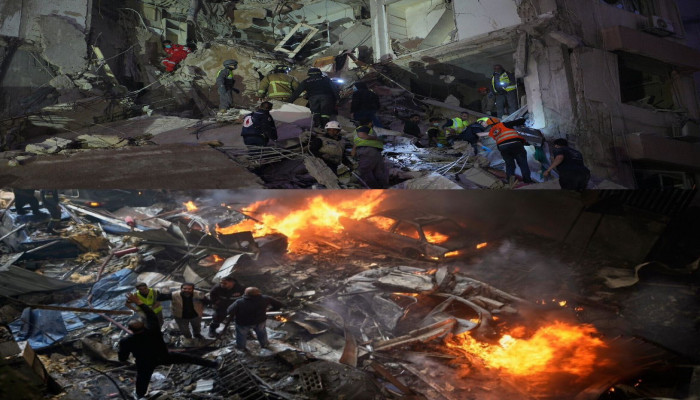
The conflict in Lebanon intensified sharply as the Israel Defence Forces (IDF) confirmed the killing of a close aide to Hezbollah’s leadership in a targeted airstrike in Beirut. The strike, carried out in the Tallet Khayat neighbourhood, killed Ali Yusuf Harshi, who was identified as the nephew and personal secretary of Naim Qassem. According to the Israeli military, Harshi played a key role in managing Qassem’s office and security operations. Visuals from the site showed a multistorey building partially collapsing due to the impact.
In its official statement, the Israeli military said, “Harshi was a close associate and personal advisor to Hezbollah Secretary-General Naim Qassem, and played a central role in managing his office and his security.” The strike marked a significant escalation in Israel’s targeting of individuals closely linked to Hezbollah’s top leadership, even in areas outside the group’s traditional strongholds in Beirut.
Alongside the Beirut strike, the IDF reported that it carried out overnight operations targeting two key crossings along the Litani River. These crossings were described as “central” routes used by Hezbollah to transport “thousands of weapons, rockets, and launchers” into southern Lebanon. The military also stated that around ten additional targets were hit, including weapon depots, rocket launchers, and Hezbollah command centres in southern Lebanon.
The broader military campaign has had devastating consequences across the country. Lebanese authorities reported that at least 254 people have been killed and over 1,100 injured in a wave of Israeli airstrikes. Hospitals in Beirut and other regions are struggling to manage the sudden influx of casualties. Many of the injured are said to be in critical condition, and the death toll is expected to rise as rescue teams continue searching through rubble for those trapped or missing.
The strikes were described as one of the most intense phases of the conflict so far. Reports indicate that more than 100 airstrikes were launched within a span of just 10 minutes, involving around 50 Israeli fighter jets. The scale and speed of the attacks left little time for civilians to seek shelter, leading to heavy casualties in densely populated areas.
One of the earliest strikes hit a café in Saida, killing eight people and injuring 22 others. In another incident in Baalbek, an airstrike struck a funeral gathering, killing at least 10 people and injuring several more. These incidents highlight the severe human cost of the ongoing conflict, with civilians increasingly caught in the crossfire.
Much of the damage has been reported in residential neighbourhoods, including areas not typically associated with Hezbollah activity. Large sections of buildings have been destroyed, and emergency responders are continuing efforts to clear debris and rescue survivors. The widespread destruction has deepened concerns about the humanitarian situation in Lebanon.
The escalation comes shortly after Donald Trump announced a 15-day ceasefire agreement and negotiations with Iran aimed at achieving a broader peace in the region. However, Benjamin Netanyahu clarified that Lebanon was not included in this truce, raising questions about its scope and effectiveness.
In response to the Israeli strikes, Iran reportedly moved to close the Strait of Hormuz, a critical global shipping route. This development has added another layer of tension, with potential implications for global energy supplies and regional stability. Iranian officials have also warned that continued Israeli attacks on Lebanon could lead to their withdrawal from the provisional ceasefire.
International reactions have called for restraint from all sides. Shehbaz Sharif, who played a role in mediating the ceasefire between the United States and Iran, urged all parties to honour the agreement. In a statement, he said, "Violations of the ceasefire have been reported at a few places across the conflict zone, which undermine the spirit of the peace process. I earnestly and sincerely urge all parties to exercise restraint and respect the ceasefire for two weeks, as agreed upon, so that diplomacy can take a lead role towards a peaceful settlement of the conflict."
Lebanon’s leadership has strongly condemned the attacks. Joseph Aoun described the strikes as brutal and unjustified. In his statement, he said, "Today, Israel persists once again in its aggression, committing a new massacre to add to its record, in blatant defiance of all human values, and in disregard of all efforts aimed at calming the situation and achieving stability."
As the situation continues to unfold, the gap between diplomatic efforts and ground realities appears to be widening. While ceasefire talks aim to reduce tensions, ongoing military operations are escalating the crisis. The heavy loss of life, destruction of civilian areas, and growing regional involvement signal a conflict that is far from resolution.



 Loading...please wait
Comments