




Maharashtra court says bigger flats cannot be charged more for common maintenance
- In Reports
- 07:52 PM, Aug 25, 2026
- Myind Staff
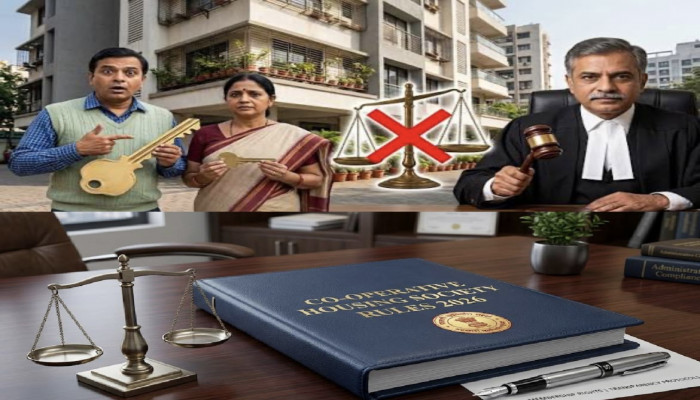
Housing societies in Maharashtra cannot levy higher common maintenance charges on owners of bigger flats or commercial units simply based on the size or nature of their premises, the Maharashtra Co-operative Court has ruled. The court held that such charges must have a clear legal basis. A higher levy cannot be justified unless the society proves that a particular unit receives additional common services or leads to extra maintenance costs.
The ruling came in a case filed by residents of a housing society in Worli, Mumbai, including Shanbhag, Dr Warke and others. The residents challenged the society’s method of calculating maintenance charges. They argued that common maintenance expenses should be divided equally among members. Instead, the society was charging members based on the area of their flats or shops. Commercial units were also being charged at a higher rate.
The residents claimed that commercial units were charged almost twice the rate applicable to residential units. They also objected to water charges being imposed on members who did not have individual water connections. They argued that they should not have to pay water expenses for the entire society. The residents also raised concerns about the management of the society and the process followed while awarding major repair contracts.
The housing society opposed the residents’ claims. It argued that the members who approached the court had defaulted on their maintenance payments. The society accepted that they were its members and that it was a registered cooperative housing society. However, it denied allegations of illegal or arbitrary billing.
On the higher charges for shops, the society argued that commercial units were governed by separate rules relating to their allotment, management and maintenance. It said the concerned allottees had accepted and signed these rules. According to the society, this created a contractual arrangement allowing it to levy different charges on commercial units.
The society also denied the allegations related to water charges and mismanagement. It said that the process for major repairs was transparent. It claimed that quotations were invited before repair work was awarded.
On August 10, 2026, the Maharashtra Co-operative Court ruled partly in favour of the residents. It rejected the society’s justification for charging higher common maintenance fees to the affected members. However, it did not grant relief on the other allegations raised by the residents.
Heena Chheda, Partner, Economic Laws Practice, told ET Wealth Online that the Bombay High Court had already addressed the issue of higher maintenance charges in Venus Co-operative Housing Society Ltd. v. Dr. J.Y. Detwani. In that case, the court held that when all members receive the same common services and amenities, a society cannot charge higher common maintenance merely on the ground that a premises is larger or is being used as a shop. However, charges such as property tax, sinking fund contributions and major repairs may be calculated separately when the law or registered bye-laws allow it.
The Maharashtra Co-operative Court relied on this principle while deciding the Worli society’s case. It noted that the society had not produced evidence to show that Shop No. 8 received any additional common services or facilities. It also failed to establish that the commercial use of the shop resulted in additional maintenance expenses. The society further failed to prove the separate rules it had relied on to justify the higher charges.
Chheda says, "The co-operative appellate court therefore directed the Society to recalculate the common maintenance and service charges on the same lawful basis applicable to similarly situated members, after adjusting the amounts already paid. The relief was limited to common maintenance and service charges. It did not affect property tax, sinking-fund contributions, major-repair charges, parking charges or other amounts lawfully calculated on a separate basis."
The court also referred to the Bombay High Court’s decision in Sunanda Janardan Rangnekar v. Rahul Apartment No.11 Co-operative Housing Society Ltd., 2006 (1) MhL.J. 734. That case distinguished property tax from common service charges. Property tax may vary according to the area or assessment of a property. Charges for common services, however, cannot automatically be increased on the same basis.
The court noted that the residents’ maintenance bills themselves showed differences in the amounts charged to different premises. However, the bills did not show a simple uniform per-square-foot formula that could explain the difference. The society also did not enter the witness box to explain how it had fixed the different maintenance charges.
The court said: “No evidence has been adduced to show that Shop No.8 receives any additional common service or facility, or that the society incurs additional maintenance expenditure merely because the premises constitute a shop.”
The court therefore held that the society could not continue charging different common maintenance or service charges merely on the basis of the size or commercial nature of a property. It must establish a legally permissible basis for such differentiation.
At the same time, the court clarified that its ruling does not apply to every component of a maintenance bill. Property tax, sinking fund contributions, major repair charges, parking charges and other amounts covered by separate laws or bye-laws can follow different methods of calculation. The court said that the legality of an area-based charge must be examined separately and cannot be decided by applying the rule for common maintenance charges alone.
The residents also raised concerns over water charges, alleged compound interest and the management of major repair work. However, the court found that the evidence was not sufficient to conclusively establish these allegations. The water-charge claim lacked specific evidence, while the material presented did not establish the allegation of compound interest to the required level.
The residents therefore secured relief only on the issue of higher common maintenance and service charges. The society has been directed to recalculate these charges on the lawful basis applicable to similarly placed members and adjust amounts that have already been paid. The ruling makes clear that larger flats or commercial units cannot be charged more for common services without proof of additional services, expenses or a specific legal or bye-law provision allowing the difference.



 Loading...please wait
Comments