



Mahabharata, Arthashastra, Rajatarangini added to UNESCO’s Memory Register
- In Reports
- 05:04 PM, Nov 06, 2026
- Myind Staff
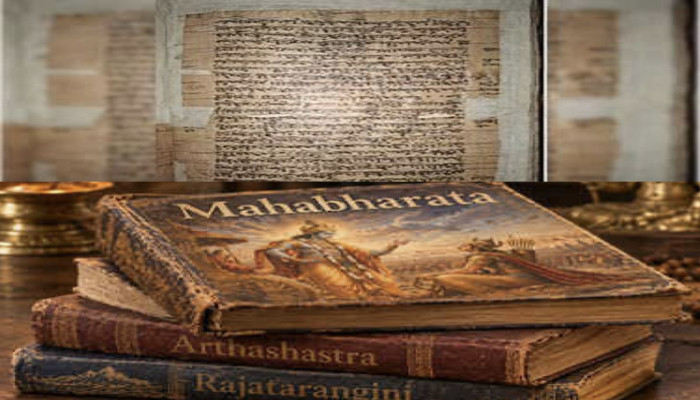
Manuscripts of three major Indian classical works — the Mahabharata, Kautilya’s Arthashastra and Kalhana’s Rajatarangini — have been added to UNESCO’s Memory of the World Asia-Pacific Regional Register. The recognition highlights the global importance of India’s rich literary, historical and intellectual heritage.
The Press Information Bureau’s Culture handle announced the development on X and shared photographs of the UNESCO certificates. Describing it as “a moment of immense pride for India,” PIB Culture called the inscription “a historic milestone in the global recognition of India’s rich civilisational heritage.”
The Mahabharata is one of the world’s longest epic poems and a foundational work of Indian literature and philosophy. Kautilya’s Arthashastra is a detailed treatise on governance, economics, statecraft and military strategy. Written by 12th-century Kashmiri historian Kalhana, Rajatarangini documents the history of Kashmir’s kings and remains an important work of early Indian historiography.
Professor Dr Ramesh Chandra Gaur, who was in charge of the UNESCO Memory of the World Nodal Agency at the Indira Gandhi National Centre for the Arts (IGNCA), said, "For me, this recognition carries a very special personal significance. All three nominations were prepared and submitted under my leadership."
"This landmark recognition celebrates India’s extraordinary contribution to the intellectual heritage of humanity. These three works represent remarkable traditions of historical inquiry, philosophical thought, literature, governance and statecraft. With these additions, India now has six inscriptions on the UNESCO Memory of the World Asia-Pacific Regional Register. I also have the honour of nominating the earlier three inscriptions -- Ramcharitmanas Manas, Panchatantra and Sahridaya Lica-Locana," he added.
Professor Gaur further said that the inscriptions recognise more than three historic manuscripts. They affirm the importance of preserving documentary heritage as humanity’s shared memory.
“They also demonstrate how India’s ancient knowledge traditions continue to have relevance and meaning in the contemporary world,” he said.
The 16th-century palm-leaf manuscript of Kauṭilya’s Arthaśāstra, preserved at the Oriental Research Institute, Mysore, contains 168 folios and is written in Grantha script. It includes 15 Adhikaraṇas (books), 150 Adhyāyas (chapters) and a partial commentary by Bhaṭṭasvāmin. Its systematic approach covers administration, finance, law, diplomacy and military strategy. Its Saptāṅga theory of the state and Maṇḍala theory of international relations reflect the depth of ancient Indian political thought.
The approximately 400-year-old Mahābhārata manuscript is preserved at the Bhandarkar Oriental Research Institute (BORI), Pune. Written in Śāradā script on birch bark, it represents the Kashmiri recension of the epic. Georg Bühler acquired it in Kashmir in 1875. Of its original 339 folios, only 114 survive. It contains the complete Sabhā Parvan and parts of the Ādi and Āraṇya Parvans. The manuscript also contributed to BORI’s Critical Edition of the Mahābhārata.
Kalhaṇa’s Rājataraṅgiṇī manuscript, preserved at the Oriental Research Library, Srinagar, is written in Śāradā script on old Kashmiri paper. A direct copy of the lost codex archetype, it records Kashmir’s royal genealogies, political developments and socio-cultural history. It also served as an important source for Marc Aurel Stein’s critical edition of the text.



 Loading...please wait
Comments