



Madras High Court rules Bhagavad Gita is not a religious text to deny FCRA registration to trust
- In Reports
- 07:07 PM, Dec 23, 2025
- Myind Staff
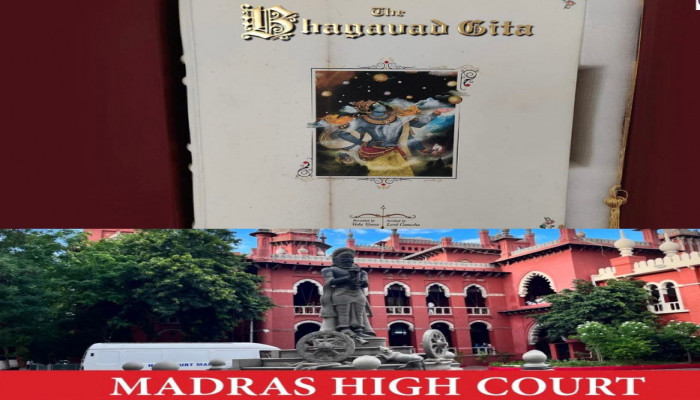
The Madras High Court has ruled that the Bhagavad Gita cannot be treated as a religious book alone and described it as a work of moral science and part of Bharatiya civilisation. Based on this reasoning, the court set aside an order of the Union government that had denied registration under the Foreign Contribution Regulation Act (FCRA) to a trust.
The ruling was delivered by Justice G.R. Swaminathan of the Madurai bench of the Madras High Court. The judge was hearing a petition filed by Arsha Vidya Parampara, a trust established in 2017. The organisation conducts online classes and residential courses that teach Hindu texts, yoga, and Sanskrit.
“What applies to the Bhagavad Gita would apply to Vedanta. It represents the pure philosophy evolved by our ancestors. As regards Yoga, it would be atrocious to view it through the prism of religion. It is something universal,” he said.
Under Indian law, registration under the FCRA is mandatory for any non-profit organisation that wishes to receive foreign contributions. The trust applied for an FCRA licence in 2021. However, the application remained pending for several years. During 2024 and 2025, the Union Ministry of Home Affairs sought clarifications from the trust regarding its activities.
In January this year, the trust submitted a fresh application for FCRA registration. This application was rejected in September. The main reason given by the Home Ministry was that the trust “appears to be religious” in nature.
Following the rejection, the trust approached the Madras High Court and challenged the Centre’s decision.
While delivering his order on December 19, Justice Swaminathan disagreed with the government’s reasoning. He stated that the Bhagavad Gita should not be confined to any single religion. “The Bhagavad Gita cannot be confined within a given religion,” he said. “It is a part of Bharatiya civilisation.”
The court observed that merely stating that an organisation “appears” to be religious is not sufficient under the Foreign Contribution Regulation Act. Justice Swaminathan noted that Section 11 of the FCRA, which deals with the registration of organisations, requires the government to arrive at a clear and definite conclusion before rejecting an application.
According to the court, the Centre failed to meet this requirement in the present case. Justice Swaminathan pointed out that the authorities had only formed a tentative view about the trust’s activities. “The authority could have rejected the application by forming a definite conclusion which should, of course, be based on materials,” he said. “It cannot be a tentative one.”
The court further held that the government must provide a well-reasoned and specific explanation while denying FCRA registration to an organisation. In this case, the reasoning given by the Centre fell short of the standards laid down under the Act.
The Union government had also informed the court that the trust had allegedly received foreign contributions before obtaining FCRA registration, which is a violation of the law. The trust acknowledged this issue during the hearing.
However, the trust chose to resolve the matter by compounding the offence under Section 41 of the FCRA. This provision allows certain violations to be settled by paying a prescribed fee.
Justice Swaminathan ruled that once the offence had been compounded, it could no longer be used as a ground to reject the trust’s application. The court made it clear that a settled violation cannot be held against the organisation while deciding on FCRA registration.
In his order, Justice Swaminathan directed the Union government to issue a fresh notice to the trust and reconsider the application. He instructed the Centre to pass a new order on the matter within three months.
The judgment comes at a time when Justice Swaminathan has been in the spotlight for other reasons as well. Earlier this month, several Opposition Members of Parliament submitted an impeachment notice against him to Lok Sabha Speaker Om Birla.
The MPs alleged that some of his recent orders and actions were “disruptive to social harmony and detrimental to the integrity of the judiciary.”
This controversy arose after Justice Swaminathan passed an order directing authorities at the Subramaniya Swamy Temple in Thirupparankundram, Madurai, to ensure that the Karthigai Deepam was lit at the deepathoon, a stone pillar located near a dargah at the top of a hill.
Despite the ongoing political controversy, the High Court’s ruling on the FCRA issue focuses strictly on legal interpretation. The court emphasised that decisions under the FCRA must be based on definite findings and clear reasoning, not assumptions or tentative conclusions.
By setting aside the Centre’s rejection order, the Madras High Court reaffirmed that cultural and philosophical texts like the Bhagavad Gita cannot automatically be treated as religious material for the purpose of denying statutory benefits under the law.



 Loading...please wait
Comments