



Kharg Island becomes centre of Trump’s Iran war calculations
- In Reports
- 06:08 PM, Mar 09, 2026
- Myind Staff
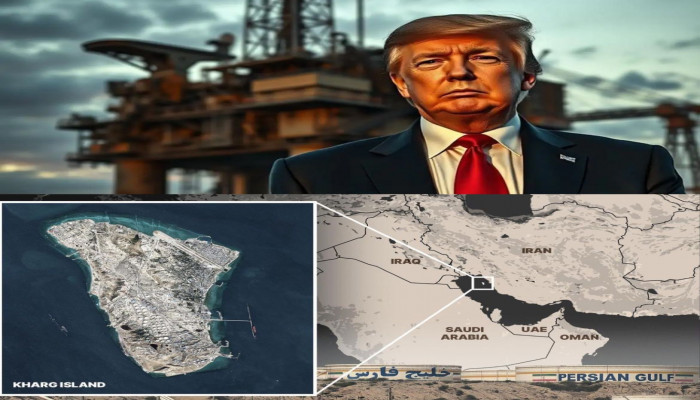
A small coral island in the Persian Gulf has become one of the most important strategic locations in the ongoing West Asia conflict involving Iran, the United States, and Israel. Kharg Island plays a key role in Iran’s economy since it handles the majority of the country’s crude oil exports. Despite the ongoing military campaign targeting Iran’s military and nuclear infrastructure, the island has not been attacked so far. Analysts say that any decision by Donald Trump regarding the island could influence both the direction of the conflict and global oil markets.
Kharg Island lies about 25 kilometres off Iran’s coast in the Persian Gulf. It has served as Iran’s main crude oil export terminal since the 1960s. The facility was originally developed with help from the American oil company Amoco. Today, the island can load up to seven million barrels of oil per day and handles roughly 90 per cent of Iran’s crude exports. This makes it one of the most important pieces of energy infrastructure in the region.
The island is connected to major oilfields in southern Iran through subsea pipelines. Large storage tanks and worker housing occupy much of the southern part of the island. Long jetties stretch into deep water so that very large oil tankers can dock and load crude. Because much of Iran’s coastline is too shallow for large tankers, Kharg Island serves as a crucial export point for the country’s oil shipments.
The importance of the island to Iran’s economy is widely recognised. Richard Nephew highlighted its significance while speaking to the Financial Times. He said, “The economy bottoms out without it.” His statement reflects how deeply Iran’s economy depends on the oil exports that move through Kharg Island.
Even though the conflict has intensified in recent days, the island has not been targeted. Reports suggest that Iran continued loading crude oil at the Kharg Island terminal even two days after the United States and Israel launched air strikes on Iran. Satellite images cited in a Bloomberg report showed a very-large crude carrier capable of carrying about two million barrels of oil docked at a loading jetty on the eastern side of the island on March 2. The images were obtained from the European Union’s Copernicus Browser.
This loading activity took place during the military campaign known as Operation Epic Fury, launched by the United States and Israel. However, it is unclear whether the loading operations continued afterwards, as no further satellite images of the island have been released since that date. Tankers that were earlier anchored near the island have also largely dispersed, as seen in previous conflicts in the region.
For years, Washington has treated Kharg Island as a red line because of the risks associated with attacking it. Destroying or seizing the island could severely damage Iran’s economy, but it could also lead to retaliation against energy infrastructure across the Persian Gulf. Such escalation could push oil prices sharply higher and disrupt global energy supply chains.
Another factor that adds to the risk is the nearby Strait of Hormuz. The strait carries about one-fifth of the world’s oil shipments and is considered one of the most critical energy chokepoints in the world. Any disruption in this region could therefore have serious consequences for global energy markets.
At the same time, the issue presents a strategic dilemma for President Donald Trump. He has indicated that the U.S. campaign could expand beyond military and nuclear targets. This has raised questions about whether energy infrastructure could also become a target in the future. Some officials and analysts have discussed the possibility of seizing Kharg Island in order to restrict Iran’s oil revenues, which remain a major source of funding for the government.
In an interview with Fox Business, White House energy adviser Jarrod Agen spoke about the long-term objective. He said the goal could be to remove Iranian oil resources from what he described as “terrorists.”
However, several policy experts have warned that attacking the island could have long-term consequences. If political change occurs in Iran after the war, damaging Kharg Island could weaken any future government by destroying a major source of economic recovery.
For decades, Kharg Island has been a strategic vulnerability. During the Iran-Iraq war in the 1980s, the island was repeatedly bombed because of its crucial role in Iran’s oil exports. Today, its importance has grown even further because almost all of Iran’s crude exports pass through the island before tankers travel through the Strait of Hormuz toward Asian markets, particularly China.
Because so much infrastructure is concentrated in one place, any disruption at Kharg Island could quickly affect global oil prices and energy markets. For now, the island remains operational even as the conflict continues. Tankers are still loading crude, and shipping routes around the area remain under close monitoring.
As military pressure on Iran increases, the future of Kharg Island may depend on decisions taken in Washington. Whether the United States decides to leave the island untouched, strike it, or attempt to seize it could shape both the course of the conflict and the stability of global oil supplies.



 Loading...please wait
Comments