




Karthigai Deepam of Thiruparankundram: A Battle of Faith, Constitutional Law and Supreme Court Showdown
- In Current Affairs
- 01:47 PM, Nov 28, 2026
- Rudra Dubey
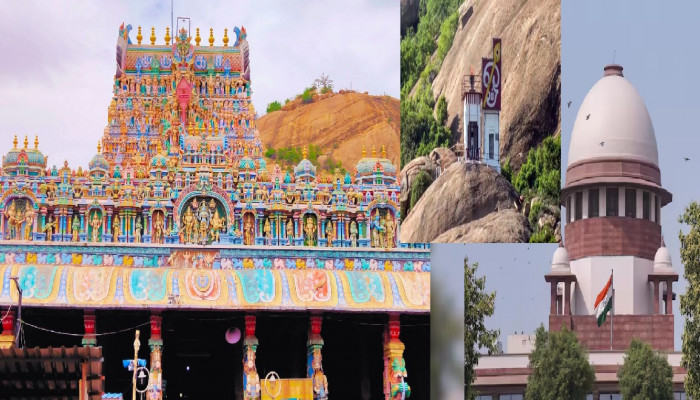
Under the security of the Central Reserve Police Force (CRPF) and the direct supervision of two retired High Court judges, the ceremonial Karthigai Maha Deepam is set to be lit today atop the Deepathoon stone pillar on Madurai's Thiruparankundram Hill. This judicial intervention marks a defining moment in a century-long battle over sacred geography, customary religious rights, and executive accountability. After finding wilful disobedience of state authorities, the Supreme Court suspended the temple's board of trustees, stripped state police of security control, and issued contempt notices to 15 top Tamil Nadu officials and trustees.
Vedic and Vedantic Roots of the Sacred Flame
In Sanatana Dharma, lighting a lamp is far more than a seasonal custom; it is grounded in Vedic cosmology and Vedantic philosophy. Vedic hymns honour Agni (sacred fire) as the cosmic messenger and the luminous manifestation of divine energy on earth. In the Rig Veda (Mandala 1, Sukta 1, Mantra 1), the seers invoke Agni as the foremost priest and illuminator of the sacred sacrifice:
"Agnim ile purohitam yajnasya devam rtvijam, hotaram ratnadhatamam."
This foundational Vedic mantra establishes fire as the direct conduit between human devotion and cosmic order (Rta). Vedanta philosophy deepens this symbolism by identifying light and fire with Brahman's supreme, self-luminous consciousness and Bhagwan Shiva. In the Svetasvatara Upanishad (Chapter 3, Verse 8), part of the Krishna Yajurveda Vedanta canon, the Supreme Being (Rudra-Shiva) is described as the radiant person beyond all darkness, whose light alone grants liberation:
"Vedaham etam purusam mahantam adityavarnam tamasah parastat, tam eva viditvati mrtyum eti nanyah pantha vidyate ayanaya."
Translated as "I know that Supreme Being, radiant like the sun beyond all darkness; knowing Him alone one transcends death, and there is no other path to liberation," this Vedantic verse encapsulates the spiritual essence of the Karthigai Deepam. In Shaivite tradition, Bhagwan Shiva manifested as the infinite pillar of fire (Lingodbhava) to humble Bhagwan Brahma and Bhagwan Vishnu, proving that cosmic light is the ultimate reality.
Observed on the full moon day of the Tamil month of Karthigai under the Krittika star, Karthigai Deepam (Deepotsav) commemorates this cosmic pillar of fire and honours Bhagwan Murugan, who emerged as six sparks from Shiva's third eye and was raised by the six celestial maidens (Karthigai Pengal) before being united by Maa Parvati. Mentioned in 2,000-year-old Sangam literature, the lighting of clay lamps (Agal Vilakku) in homes and temples signifies the triumph of spiritual wisdom over darkness. Thiruparankundram Hill near Madurai stands at the heart of this heritage as the first of the six sacred abodes (Arupadaiveedu) of Bhagwan Murugan, where the rock-cut Arulmigu Subramaniaswamy Temple dates to at least the 8th century CE alongside older Pandya-era foundations and 3rd to 4th century BCE Jain rock-cut caves. In Tamil temple architecture, a Deepathoon is an elevated stone lamp pillar crafted to hold oil and wicks so the sacred flame shines across the landscape. While modern temple authorities restricted the annual lighting to the Deepa Mandapam near the Uchipillaiyar shrine on the lower slopes, devotees have long maintained that the stone pillar higher up the hill is the authentic Deepathoon.
Historical Encroachments and the 1931 Privy Council Settlement
The continuous Hindu presence on Thiruparankundram Hill faced major disruption during the 13th and 14th centuries following Islamic military invasions into southern India under the Delhi and Madurai Sultanates. Historical records note that Sikandar Shah, an Islamic military commander and Sultanate warlord who died in battle during this era, was buried on the northeastern peak of the hill. Following his defeat by Vijayanagara ruler Kumara Kampana, his followers established the Hazrat Sultan Sikandar Badhusha Dargah on the summit (later rebuilt in 1805), placing an Islamic shrine directly atop an ancient sacred Hindu hill.
Over subsequent centuries, repeated attempts were made to alter the hill's Hindu identity, including efforts to rename Thiruparankundram Hill as "Sikandarmalai" and introduce practices such as animal sacrifice, both of which the Madras High Court later prohibited in October 2025 after affirming that official 1908 and 1923 Gazette records recognise only the name Thiruparankundram Hill.
Jurisdictional tensions over the summit triggered a landmark civil suit in 1920 between the Subramaniaswamy Temple Devasthanam and the dargah management. Although the Madras High Court briefly ruled in 1926 that the hill belonged to the colonial government, the London Privy Council overturned that decision in May 1931. Affirming the 1923 decree of the Subordinate Judge of Madura, the Privy Council ruled that the entire unoccupied Thiruparankundram Hill, including subsoil rights, belongs exclusively to the Arulmigu Subramaniaswamy Temple. The judgment carved out only three specific exceptions for the Muslim community: the Nellithope grove, the specific summit mound housing the dargah and mosque, and the flagstaff along with the flight of steps leading to it.
Decades of Prohibitions, the Rejected 2026 Survey, and the Litigants Who Fought the Battle
Despite the clear property boundaries settled in 1931, devotees faced decades of administrative prohibitions when seeking to light the Maha Deepam near the summit. In 1996, the Madras High Court ruled that while the temple could maintain its customary lighting at the lower Deepa Mandapam, lighting at an alternative hilltop location could be permitted provided it remained at least 15 metres away from the dargah perimeter.
The modern legal battle to reclaim the hilltop ritual was spearheaded by dedicated Hindu petitioners and devotees, led prominently by Hindu Tamilar Katchi founder Rama Ravikumar and Tirunelveli-based advocate V. Ramasubbu, alongside Hindu Dharma Parishad and Hindu Shree Foundation. In the Madras High Court and the Supreme Court, their legal team—including Senior Advocate J. Sai Deepak, Advocate K.V. Muthu Kumar, and submissions from Solicitor General Tushar Mehta—challenged state restrictions as unconstitutional infringements on religious freedom.
Their persistence yielded a major breakthrough on December 1, 2025, when Madras High Court Single Judge Justice G.R. Swaminathan ordered authorities to permit the lighting at the hilltop Deepathoon, located roughly 50 metres from the dargah and squarely within temple-owned land. Justice Swaminathan held that the state could not cite law and order concerns to curtail established religious rights. When the Madurai District Collector immediately imposed prohibitory orders under Section 163 of the Bharatiya Nagarik Suraksha Sanhita (BNSS) to block devotees, Justice Swaminathan quashed the ban on December 4, 2025, warning that executive defiance of court mandates invites anarchy. A Division Bench of the High Court upheld that ruling in January 2026.
To block the hilltop ritual during its Supreme Court appeal, the Tamil Nadu government submitted a five-volume, 1,800-page report prepared by the Departments of Survey and Settlement and Archaeology titled "Documentation of the Great Trigonometrical Survey Stations in Tamil Nadu." The state argued that the stone pillar near the summit was not a Hindu Deepathoon, but a 19th-century British Great Trigonometrical Survey (GTS) marker, citing colonial angular bearings and rock carvings of a dot within concentric circles flanked by triangles while claiming the original lamp post stood further down the slope. Both the Madras High Court and the Supreme Court refused to allow this late-stage survey report to deprive devotees of the ritual. Under the binding 1931 Privy Council decree, the land 50 metres outside the dargah belongs to the temple, and the 1996 High Court benchmark cleared any spot beyond 15 metres regardless of secondary colonial survey markings. Judicial observations and petitioners further noted that the state produced the report belatedly to frustrate binding orders, whereas Archaeological Survey of India (ASI) records and historical temple publications already recognised the hilltop Deepam tradition.
The November 2026 Defiance and Supreme Court Contempt Action
Ahead of the November 24, 2026 festival, the Supreme Court passed an interim order on November 20 permitting a one-time symbolic lighting at the Deepathoon. On the evening of November 24, however, district authorities again imposed Section 163 BNSS restrictions on the hill, and the temple's Board of Trustees, which was newly appointed on November 13, passed a resolution refusing to light the hilltop lamp and restricting the ceremony to the lower shrine.
On November 27, 2026, a Supreme Court bench of Justices Aravind Kumar and Vipul M. Pancholi heard the contempt petitions brought by V. Ramasubbu and fellow petitioners. Condemning the executive and temple board for wilful disobedience and acting at the behest of political bosses, the Bench suspended the temple's governing board and issued show-cause contempt notices to 15 state officials, police officers, and trustees.
Among the state administrative and Hindu Religious and Charitable Endowments (HR&CE) officials facing contempt notices are Chief Secretary Dr. M. Sai Kumar, IAS, who was ordered to file a personal affidavit detailing all internal emails, phone calls, and messages; Madurai District Collector Nishant Krishna, IAS, whose status report as nodal officer was rejected; the Secretary and Deputy Secretary of the HR&CE Department; HR&CE Commissioner Dr. T.G. Vinay, IAS; and Madurai HR&CE Joint Commissioner R. Pon Swaminathan. Top police officers named in the contempt proceedings include Tamil Nadu Director General of Police Dr. Mahesh Kumar Aggarwal, IPS; Madurai City Commissioner of Police S. Rajendiran, IPS; and Madurai District Superintendent of Police N. Devanathan, IPS. From the temple administration, notices were issued to Executive Officer G. Selvi and the five suspended trustees: Chairman V. Shanmugasundaram and members C. Rajapandiyan, K. Azhakappan, K. Regina Devi, and K. Chitra.
To purge the contempt and enforce its directive today, November 28, 2026, the Supreme Court placed custody of the ritual under two court-appointed joint receivers: Justice S. Vaidyanathan, former Chief Justice of the Meghalaya High Court, and Justice V. Parthiban, former Judge of the Madras High Court. Full security control of the temple perimeter and Thiruparankundram Hill was transferred from the Tamil Nadu Police to the CRPF. Using the continuous flame preserved from the November 24 ceremony, the receivers are overseeing the lighting of the Maha Deepam atop the Deepathoon today while maintaining a 50-metre buffer from the dargah compound.
What Remains in the Battle Ahead
While today's court-monitored lighting represents a historic victory for devotees, the broader legal and constitutional struggle is far from over. Several critical stages remain unresolved in the Supreme Court:
- The December 15, 2026 Contempt Hearing: All 15 named officials, police officers, and suspended trustees must file personal affidavits and appear before Justices Aravind Kumar and Vipul M. Pancholi on December 15, 2026. The Court will examine internal communications to determine whether senior bureaucrats and trustees intentionally colluded to subvert judicial orders, exposing them to potential fines, service penalties, or imprisonment under the Contempt of Courts Act.
- Permanent Customary Rights vs. One-Time Relief: Today's ceremony is being executed under an interim enforcement directive. The Supreme Court has yet to deliver its final verdict on the main civil appeals filed by the Tamil Nadu government and the Sikandar Badhusha Dargah management, which will decide whether lighting the Maha Deepam at the hilltop Deepathoon is recognised as a permanent, uninterrupted annual right of Hindus.
- Evidentiary Scrutiny of the 2026 Survey and ASI Jurisdiction: In the main appeal hearings, the Court will formally adjudicate the evidentiary weight of the Tamil Nadu government's 1,800-page GTS survey report against Archaeological Survey of India (ASI) records, Agama traditions, and the 1931 Privy Council title decree.
- Temple Governance and Trustee Reinstatement: With the temple's HR&CE-appointed Board of Trustees currently suspended and hill custody temporarily vested in retired judges, the Supreme Court will determine the future administrative structure of the Arulmigu Subramaniaswamy Temple and ensure that temple funds are not misused to litigate against the religious rights of Hindu devotees.
References
- Rig Veda, Mandala 1, Sukta 1, Mantra 1 (Hymn to Agni, the Sacred Fire).
- Svetasvatara Upanishad, Chapter 3, Verse 8 (Krishna Yajurveda Vedanta Canon on the Supreme Luminous Being).
- Privy Council Judgment (AIR 1931 PC 212), Arulmigu Subramaniaswamy Temple Devasthanam vs. Sikandar Badhusha Dargah Management (affirming the 1923 decree of the Subordinate Judge of Madura).
- Madras High Court Rulings, 1996 Deepam Site Judgment; October 2025 Order upholding the name Thiruparankundram Hill and prohibiting animal sacrifice; December 1 and December 4, 2025 Orders by Justice G.R. Swaminathan quashing Section 163 BNSS prohibitory orders; and January 2026 Division Bench Order.
- Supreme Court of India Orders, Interim Order dated November 20, 2026, and Contempt Order dated November 27, 2026, by the Bench of Justices Aravind Kumar and Vipul M. Pancholi.
- Tamil Nadu Government Report (2026), Documentation of the Great Trigonometrical Survey Stations in Tamil Nadu (Departments of Survey and Settlement and Archaeology).
- News and Legal Reporting, The Hindu, DD News, The Wire, LawBeat, and Open Magazine (2025 to November 28, 2026 coverage).
Disclaimer: The opinions expressed within this article are the personal opinions of the author. MyIndMakers is not responsible for the accuracy, completeness, suitability, or validity of any information on this article. All information is provided on an as-is basis. The information, facts or opinions appearing in the article do not reflect the views of MyindMakers and it does not assume any responsibility or liability for the same.



 Loading...please wait
Comments