



Karnataka Assembly passes bills to curb honour killings, manuscript preservation
- In Reports
- 04:54 PM, Mar 24, 2026
- Myind Staff
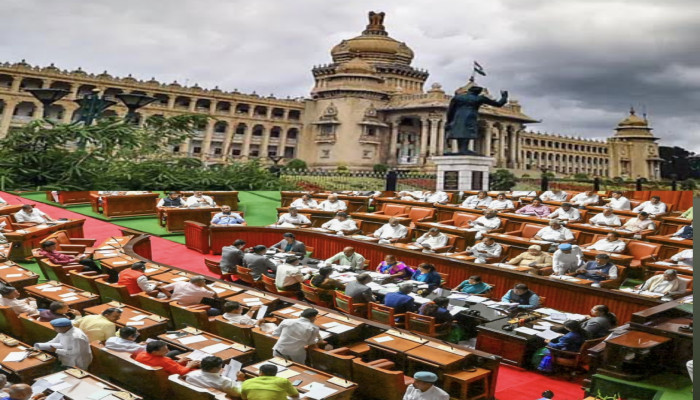
The Karnataka Legislative Assembly on Monday approved two significant pieces of legislation aimed at addressing social reform and safeguarding cultural heritage. These include the Karnataka Freedom of Choice in Marriage and Prevention and Prohibition of Crimes in the Name of Honour and Tradition Bill, 2026, and the Karnataka Jnana Bhandar Manuscripts and Digitisation Bill, 2026. The state government stated that both laws are designed to tackle pressing social concerns while also preserving valuable historical knowledge for future generations.
While presenting the Bill related to marriage, Law and Parliamentary Affairs Minister HK Patil explained that the legislation is intended to deal with serious social problems such as honour-based crimes. He emphasised that the law seeks to strengthen constitutional values like equality and personal freedom in society. According to him, the Bill is not just a legal measure but also a step towards broader social transformation. "This is a Bill aimed at bringing social change and, in a way, enabling a social revolution," he said.
The minister pointed out that although principles such as equality and inclusiveness have long been part of Indian philosophical thought, they have not been fully reflected in everyday life. "We have accepted these as social values, but they have not truly entered our lives-they have remained only as subjects of speeches," he said. He stressed that there is a need to convert these ideals into enforceable legal rights so that they can be practiced more effectively in society.
Addressing the issue of violence related to marriage, especially in cases involving individual choice, Patil noted that such incidents continue to occur in different parts of the state. "In matters of marriage, especially where freedom is involved, we have seen many instances of violence in society," he said. He added that the proposed law aims to provide stronger legal protection to couples and help create a more harmonious and inclusive social environment.
Leader of Opposition R Ashoka acknowledged the intent behind the Bill but raised certain concerns about its implementation. "The intention is good. But when a law is made, the government must consider facts," he said. He referred to repeated cases of honour killings, particularly in the Old Mysuru region, and questioned whether introducing a new law was necessary when existing provisions already deal with such crimes.
In response, Patil clarified that the government had carefully examined the issue before bringing the Bill. He assured the House that the new law has been designed to work alongside existing legal frameworks without creating any conflict. He specifically mentioned that it does not clash with the Bharatiya Nyay Sanhita. According to him, the legislation is meant to reinforce the government’s message against such crimes and to promote a healthier social atmosphere.
During the discussion, BJP MLA S Suresh Kumar sought clarification on certain provisions related to declarations by couples. He questioned whether the law could be interpreted as support for live-in relationships. Addressing this concern, the minister made the government’s position clear. "This enactment will not support the concept of living together. Let me make it clear. It is intended to strengthen the institution of marriage," he said.
Patil also explained that the scope of the Bill is not limited to addressing cases of murder. He highlighted that many forms of harassment, such as social boycott, threats, and exclusion, often go unreported. "It is not limited to murder. Many incidents of social boycott, harassment, and exclusion occur but are not reported," he said. He added that the law includes provisions for preventive action, protection for couples, civil remedies, and support systems to ensure their safety and well-being. Following the discussion, the Assembly passed the Bill.
The House also took up and passed the Karnataka Jnana Bhandar Manuscripts and Digitisation Bill, 2026, which focuses on preserving ancient manuscripts scattered across the state. While introducing this Bill, Patil stressed the urgent need to protect these valuable resources. He pointed out that a large number of manuscripts are currently in private hands, institutions, or even unknown locations, and many of them are at risk of being lost.
Explaining the purpose of the legislation, the minister said that these manuscripts represent a vast store of knowledge covering various fields such as religion, medicine, science, and history. "These manuscripts must be protected by the government. We must preserve this repository of knowledge," he said. He warned that without timely action, much of this knowledge could disappear permanently.
Highlighting the current situation, Patil observed that many families preserve manuscripts with great care and devotion, but they are rarely used or studied. "They are preserved with devotion, but in many houses they are neither opened nor read," he said. This, he added, increases the risk of deterioration and loss over time.
The Bill proposes to address this issue by creating a structured system for identifying, collecting, and digitising manuscripts. It includes plans to set up a dedicated authority and achieve specific targets. "We have set clear targets-for instance, digitising at least five lakh pages annually and conducting surveys to collect manuscripts," the minister said. He also referred to historical efforts in manuscript preservation, stating that the new law would build on such initiatives in a more organised manner.
While supporting the Bill, BJP MLA S Suresh Kumar suggested that the government should also focus on documenting traditional knowledge systems. "This is a very good and necessary Bill. However, there are traditional knowledge systems like those of the Soliga community. Such knowledge may be lost over time," he said. His remarks highlighted the importance of preserving not just written records but also oral and community-based knowledge.
Following the discussion, the Assembly passed the Manuscripts Bill as well. Together, these two pieces of legislation reflect the government’s dual focus on promoting social justice and protecting cultural heritage, addressing both present-day challenges and the need to preserve knowledge for future generations.



 Loading...please wait
Comments