




Juneteenth: Slavery, Labour & Freedom-Unfinished American Project
- In Current Affairs
- 07:44 PM, Jun 20, 2026
- Purnima Nath
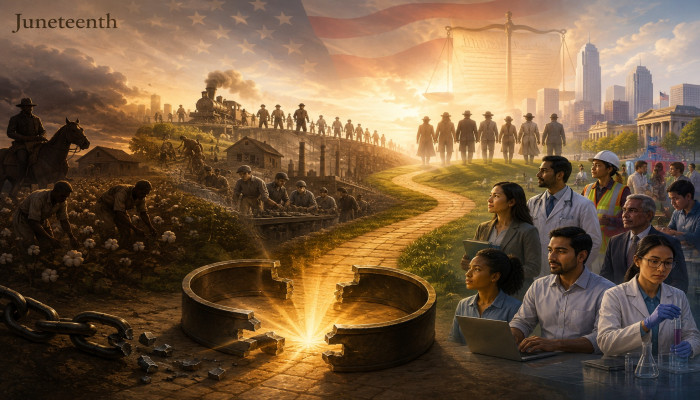
Every Juneteenth, America pauses to commemorate a defining moment in its history: the emancipation of enslaved Black Americans in Texas in 1865.
It is a day of remembrance. It is also a day of reflection. And if we are honest, it is a day that forces us to confront the unfinished questions at the heart of the American experiment.
Slavery Was Not an Abstraction. It Was an Economic System.
Slavery in America was not merely a moral failure or a historical anomaly. It was a legally protected economic system.
Human beings were treated as property. They were bought, sold, inherited, mortgaged, and exploited for labour and profit. Entire regional economies were built upon this structure. Federal and state laws protected and sustained it for generations.
This system did not persist by accident. It was defended with political power, economic interest, and ultimately, violence. The Civil War was not only a conflict over union and sovereignty—it was a conflict over whether such a system could continue to exist.
Juneteenth marks the moment when that system began to collapse in law and in practice.
But it also marks something deeper: the beginning of a long and unfinished struggle over what freedom in America actually means.
Emancipation Ended Slavery—But Not the Struggle Over Labour
The abolition of slavery ended the legal ownership of human beings. That is a profound and irreversible moral and constitutional transformation.
But it did not end the broader struggle over labour, dignity, and economic power.
In the decades that followed, many formerly enslaved Americans were pushed into systems such as sharecropping, debt dependence, and exploitative labour arrangements that limited true economic freedom.
The lesson is not that nothing changed. The lesson is that legal emancipation does not automatically resolve the deeper tensions between labour, power, and inequality.
A Repeating Pattern in American History
When economic systems change, anxiety follows.
In different eras, different groups have been pulled into the centre of those anxieties.
Irish, Italian, Chinese, Jewish, Japanese, and many other immigrant communities were at various points accused of taking jobs, lowering wages, failing to assimilate, or threatening the American way of life.
Today, Indian Americans are increasingly drawn into contemporary political narratives about immigration, labour competition, and economic change.
The pattern is not identical in each case. The experiences are not interchangeable. But the structure of the debate often rhymes: economic disruption is frequently translated into questions of identity and belonging.
The Modern Economy and New Forms of Labour Anxiety
Today, America is again in a period of economic transformation.
Globalisation, automation, corporate restructuring, and outsourcing have reshaped the labour market. Many Americans across all communities feel economic pressure, wage stagnation, and uncertainty about the future.
These concerns are real and deserve serious policy attention.
At the same time, immigration policy—particularly skilled immigration programs such as H-1B—has become part of this broader debate about labour, competitiveness, and fairness.
These are legitimate policy questions. They should be debated seriously, transparently, and on their merits.
Policy Debate Must Not Become Identity Judgment
Increasingly, Indian Americans encounter narratives suggesting that they are “taking jobs,” that their qualifications are inherently suspect, or that their degrees are fraudulent.
These narratives are not new in American history. But they are always dangerous when they shift from policy critique into broad generalisations about entire communities.
If there are abuses in visa systems, they should be investigated and corrected. If there is fraud in credentialing systems, it should be prosecuted. If corporate outsourcing harms American workers, it should be addressed through policy reform.
But none of that justifies turning entire communities into symbols of economic anxiety.
The Constitutional Principle at Stake
Juneteenth is not only about emancipation. It is about the meaning of freedom in a constitutional republic.
The American Constitution does not define citizenship by ancestry, race, or religion. It defines it through law and equal protection.
That principle has been tested repeatedly throughout American history. Entire communities have, at different times, been told they did not fully belong. Each time, America has had to expand its understanding of who counts as part of the civic community.
That expansion has never been easy. But it has been essential to the American story.
Indian Americans and the Question of Belonging
Today, Indian Americans are part of that story.
We are physicians in hospitals, engineers building infrastructure, researchers advancing science, entrepreneurs creating jobs, educators shaping the next generation, and citizens participating fully in public life.
Yet in broader public discourse, the experiences and contributions of Indian Americans are often underrepresented, and at times distorted through narrow stereotypes.
Visibility matters. So does recognition. But most of all, belonging matters.
The Unfinished American Project
Juneteenth should not only remind us of what America overcame. It should also remind us of what remains unfinished. The central question is not simply historical. It is ongoing:
Who belongs in America?
If belonging is defined by ancestry or origin, then America becomes something it was never meant to be—a hierarchy of inherited identity.
But if belonging is defined by citizenship, contribution, and equal protection under the law, then America remains what it has always aspired to be: a constitutional republic.
Juneteenth reminds us that freedom is not only the absence of bondage. It is the presence of equal standing. The unfinished American project is not to decide who belongs. It is to ensure that every citizen does.
Disclaimer: The opinions expressed within this article are the personal opinions of the author. MyIndMakers is not responsible for the accuracy, completeness, suitability, or validity of any information on this article. All information is provided on an as-is basis. The information, facts or opinions appearing in the article do not reflect the views of MyindMakers and it does not assume any responsibility or liability for the same.



 Loading...please wait
Comments