



‘J&K development budget more than Pak IMF bailout’, India rebukes Pakistan at UNHRC
- In Reports
- 06:05 PM, Feb 26, 2026
- Myind Staff
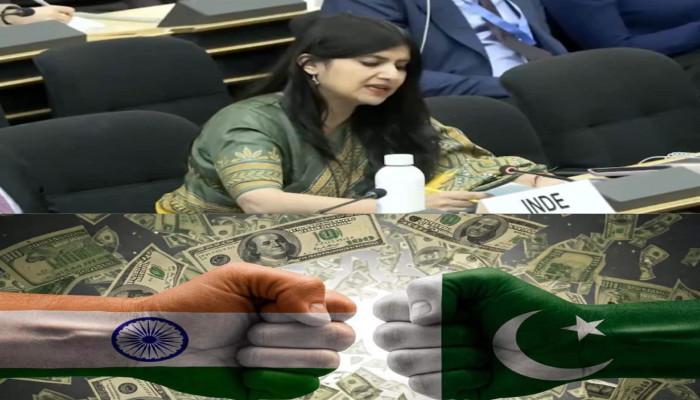
India strongly criticised Pakistan at the 61st Session of the United Nations Human Rights Council (UNHRC) for what it described as misinformation about the development situation in Jammu and Kashmir. Representing India at the session, Anupama Singh delivered a sharp response to comments made by Pakistan and rejected the allegations raised against India.
Speaking during the high-level segment, Singh said that Pakistan must be “hallucinating” or living in “La-La land” if it refuses to acknowledge the visible development taking place in Jammu and Kashmir. She made this comment while referring to the Chenab Rail Bridge, which is known as the world’s highest railway bridge and was inaugurated in the Union Territory last year.
“If the Chenab Rail Bridge, the world's highest bridge, inaugurated in Jammu and Kashmir last year, is fake, then Pakistan must be hallucinating or living in the 'La-la-land,'” Singh said.
India also dismissed the claims made by Pakistan and the Organisation of Islamic Cooperation (OIC). Singh stated that the OIC had allowed itself to be used as an “echo chamber” for Islamabad. She said, “We categorically reject these allegations,” and added that Pakistan's “incessant propaganda now reeks of envy.”
Reaffirming India’s position on Jammu and Kashmir, Singh made it clear that the region is an inseparable part of the country. She said that Jammu and Kashmir “was, is, and will always remain an integral and inalienable part of India.” She also stated that the accession of Jammu and Kashmir to India in 1947 was “completely legal and irrevocable,” and that it was carried out according to the Indian Independence Act and international law.
Singh further said that the only unresolved issue related to the region is Pakistan’s continued occupation of certain areas. “The only outstanding dispute regarding this region is the illegal occupation of Indian territories by Pakistan,” she said, and called on Islamabad to vacate the areas under its control.
Highlighting the development progress in Jammu and Kashmir, Singh pointed out that the Union Territory’s development budget is more than double the recent bailout package that Pakistan sought from the International Monetary Fund (IMF). She used this comparison to show the difference between governance and development in Jammu and Kashmir and Pakistan’s current economic difficulties.
Singh also responded to criticism from Pakistan regarding democratic practices in the region. She said it was “hard to take lectures on democracy from a country where civilian governments rarely complete their terms.” Referring to elections held in Jammu and Kashmir, she said that voter turnout in recent general and assembly elections shows that people in the region have “rejected the ideology of terrorism and violence” and are moving forward on the path of development.
Accusing Pakistan of attempting to create instability, Singh said that Islamabad has been involved in “relentless state-sponsored terrorism” in the region. Despite this, she stated that Jammu and Kashmir continues to move ahead politically, economically, and socially.
She also advised Pakistan to focus on its internal problems instead of targeting India at international platforms. “Pakistan would do well if it focuses on fixing its deepening internal crisis rather than masking it with grandstanding at such a platform,” she said. She further added that “the world can certainly see through its charade.”
The strong exchange at the UNHRC marks another instance of diplomatic tensions between India and Pakistan at multilateral forums. The issue of Jammu and Kashmir has often led to heated debates between the two countries at international platforms, including the UN Human Rights Council.
India’s response at the 61st Session clearly reflected its firm stand that Jammu and Kashmir is an integral part of the country and that development efforts in the region are real and visible. By referring to major infrastructure projects like the Chenab Rail Bridge and pointing to the size of the development budget, India sought to counter what it described as false narratives being spread by Pakistan.
At the same time, India rejected the involvement of the OIC in raising such concerns and accused Pakistan of using international forums to spread propaganda. Singh’s remarks underlined India’s position that the accession of Jammu and Kashmir in 1947 was lawful and final, and that the only pending issue is the territory under Pakistan’s control.
The exchange once again highlighted the ongoing diplomatic rivalry between the two neighbours, especially on the matter of Jammu and Kashmir, which continues to be raised at global platforms like the UNHRC.



 Loading...please wait
Comments