



Japan’s PM Kishida to step down due to political scandals and economic challenges
- In Reports
- 07:48 PM, Aug 14, 2024
- Myind Staff
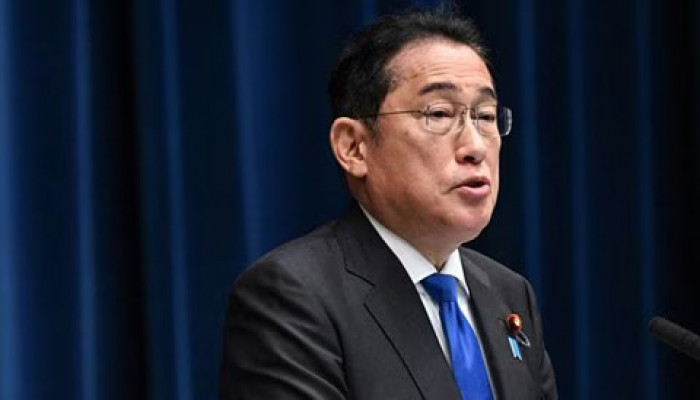
Japan's Prime Minister Fumio Kishida announced on Wednesday that he will step down next month, citing public dissatisfaction over political scandals and rising living costs that have overshadowed his three-year tenure. His decision not to seek re-election as the leader of the ruling Liberal Democratic Party (LDP) has sparked a race to find his successor. "Politics cannot function without public trust," Kishida stated during a press conference where he revealed his decision.
"I made this difficult decision with the public in mind, driven by a strong commitment to advance political reform," Kishida stated. The ruling Liberal Democratic Party (LDP) will hold a leadership contest in September to choose his successor, who will also become the next prime minister. Kishida's approval ratings have declined since he took office in 2021, following revelations of the LDP's connections to the controversial Unification Church. His popularity further suffered after a slush fund involving unrecorded political donations at LDP fundraising events was exposed.
Kishida also grappled with public dissatisfaction as wages lagged behind rising living costs, even as Japan emerged from years of deflationary pressure. "An LDP incumbent prime minister cannot enter the presidential race without a guaranteed victory," commented Koichi Nakano, a political science professor at Sophia University. "It's like being a Yokozuna in sumo—you don't just need to win, you need to win with grace."
During his tenure as Japan's eighth-longest-serving post-war leader, Kishida diverged from previous economic policies by shifting focus away from corporate profit-driven trickle-down economics, instead prioritising boosting household income through wage increases and promoting share ownership. He steered Japan out of the COVID-19 pandemic with substantial stimulus spending and appointed academic Kazuo Ueda as the head of the Bank of Japan (BOJ) to lead the country away from his predecessor's radical monetary stimulus policies.
In July, the Bank of Japan unexpectedly raised interest rates as inflation set in, leading to stock market instability and a sharp rise in the yen's value. Kishida's departure could signal tighter fiscal and monetary conditions, depending on who succeeds him, according to Shoki Omori, chief Japan desk strategist at Mizuho Securities in Tokyo. "In short, risk assets, particularly equities, are likely to be the most affected," Omori noted. Kishida's time in office was also marked by a shifting security landscape, prompting Japan to reconsider its traditionally pacifist policy.
Kishida launched Japan's largest military buildup since World War Two, committing to double defense spending to deter China's territorial ambitions in East Asia. Under U.S. encouragement, he also repaired strained relations with South Korea, enabling the two countries, along with their mutual ally, the United States, to enhance security cooperation in response to North Korea's missile and nuclear threats. "Personally, I wish he had continued a little longer as prime minister," said Naoya Okamoto, a 22-year-old office worker in Tokyo. "Maybe the low ratings and all the surrounding circumstances left him with no choice but to step down."
Former Defense Minister Shigeru Ishiba has already declared his intention to succeed Kishida, stating that he would like to "fulfill his duty" if he secures enough support, according to public broadcaster NHK. Other potential contenders include Foreign Minister Yoko Kamikawa, Digital Minister Taro Kono, and former Environment Minister Shinjiro Koizumi. Experts suggest that the LDP will need to choose a candidate who can distance the party from recent scandals if it hopes to succeed in the general election scheduled by the third quarter of 2025.
Experts warn that for the LDP to survive the general election due by the third quarter of 2025, it must select a leader who can distance the party from recent scandals. "If the LDP chooses its next leader in a way that disregards public criticism over political funding scandals, the party could face a devastating defeat," said political analyst Atsuo Ito. "The party needs to choose someone young, with no ties to the current administration, who can present a new vision for the LDP."
Image source: Reuters



 Loading...please wait
Comments