



Japan cabinet approves record defence budget to counter Chinese aggression
- In Reports
- 12:41 PM, Dec 26, 2025
- Myind Staff
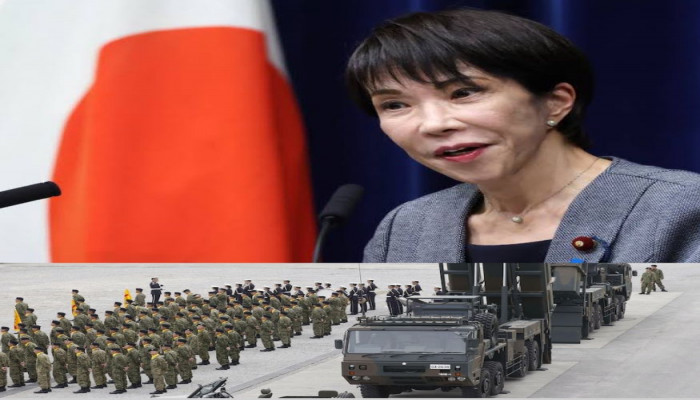
Japan’s Cabinet on Friday approved a record defence budget of more than 9 trillion yen (about $58 billion) for the next fiscal year, marking a major step in strengthening the country’s military capabilities amid growing regional tensions, especially with China.
The draft budget for fiscal year 2026, which begins in April, is 9.4% higher than the previous year. This is the fourth year of Japan’s ongoing five-year plan to double its annual defence spending to 2% of its gross domestic product (GDP). The plan reflects a major shift in Japan’s security policy as it seeks to respond to increasing security challenges in the region.
The rise in defence spending comes at a time of heightened concern over China’s military activities. Japanese Prime Minister Sanae Takaichi said in November that Japan’s military “could get involved” if China were to take action against Taiwan. Taiwan is a self-governing island that Beijing claims must come under its control.
Under pressure from the United States to increase its military spending, Takaichi’s government has pledged 2% of GDP target by March, two years earlier than originally planned. Japan also plans to revise its current security and defence policies by December 2026, to further toughen its military posture.
Japan is slowly moving away from its post-World War II principle that limited the use of force strictly to self-defence. In recent years, it has started building offensive capabilities, including long-range missiles that can strike enemy targets from a distance. This marks a significant change in Japan’s traditional defence-only approach.
The country’s current security strategy, adopted in 2022, identifies China as Japan’s “biggest strategic challenge.” It also calls for a more active and offensive role for the Self-Defence Forces under Japan’s security alliance with the United States.
A major part of the new defence budget focuses on missile capabilities. More than 970 billion yen ($6.2 billion) has been allocated to strengthen Japan’s “standoff” missile capability. This includes 177 billion yen ($1.13 billion) for the purchase of domestically developed and upgraded Type-12 surface-to-ship missiles, which have a range of about 1,000 kilometres (620 miles).
The first batch of these Type-12 missiles will be deployed in Japan’s southwestern Kumamoto Prefecture by March, a full year earlier than originally planned. This early deployment underscores how rapidly Japan is accelerating its missile build-up, particularly in the southwestern region near China and Taiwan.
Japan is also focusing heavily on unmanned systems due to its ageing and shrinking population, as well as ongoing difficulties in recruiting enough military personnel. The government believes that unmanned weapons will play a key role in future defence.
To protect its coastlines, Japan will spend 100 billion yen ($640 million) to deploy “massive” unmanned air, sea-surface and underwater drones for surveillance and defence. These systems will operate under a framework called “SHIELD,” which is planned for March 2028, according to defence ministry officials.
For faster deployment, Japan plans to rely mainly on imported systems at the initial stage, possibly sourcing them from countries such as Turkey or Israel.
The budget approval comes against the backdrop of worsening relations with China. Tensions escalated further this month after Chinese aircraft carrier drills near south-western Japan. Tokyo lodged a protest after Chinese aircraft reportedly locked their radar on Japanese aircraft, an action seen as possible preparation for missile firing.
Japan’s Defence Ministry has already expressed alarm over China’s rapid expansion of military operations in the Pacific. In response, it plans to set up a new office dedicated to studying operations, equipment and other requirements required to counter China’s growing presence in the region.
Concerns increased further in June when two Chinese aircraft carriers were spotted operating near the southern Japanese island of Iwo Jima around the same time. This was the first such incident that added to Tokyo’s worries about Beijing’s expanding military reach beyond its borders and areas around the disputed East China Sea islands.
Alongside strengthening its military capabilities, Japan is also working to boost its domestic defence industry. The government has eased arms export restrictions in recent years and is encouraging joint development with friendly countries, as well as promoting foreign sales.
For fiscal 2026, Japan plans to spend more than 160 billion yen ($1 billion) to jointly develop a next-generation fighter jet with Britain and Italy. The aircraft is expected to be deployed in 2035. There are also plans for research and development of AI-operated drones that would fly alongside the fighter jet.
In a significant boost to Japan’s defence industry, Australia selected Mitsubishi Heavy Industries in August to upgrade its Mogami-class frigate to replace its fleet of 11 ANZAC-class ships.
The new budget includes nearly 10 billion yen ($64 million) to support Japan’s defence industry base and arms exports.
The defence budget plan must receive parliamentary approval by March to take effect as part of a broader national budget worth 122.3 trillion yen ($784 billion).
Once the five-year defence build-up programme is completed, Japan’s annual defence spending is expected to reach around 10 trillion yen ($64 billion). This would make Japan the world’s third-largest defence spender after the United States and China. The Finance Ministry said Japan will meet the 2% of GDP target by March, as promised.
To fund the growing military budget, Takaichi’s government plans to raise corporate and tobacco taxes. It has also adopted a plan to increase income tax starting in 2027. However, the prospects for future defence spending growth beyond 2% of GDP remain unclear.



 Loading...please wait
Comments