




Janmashtami: From Celebrating Krishna’s Birth to Living Krishna’s Teachings
- In Reclaim Indic Festivals
- 01:06 PM, Sep 04, 2026
- Dr. Siddhartha Dave
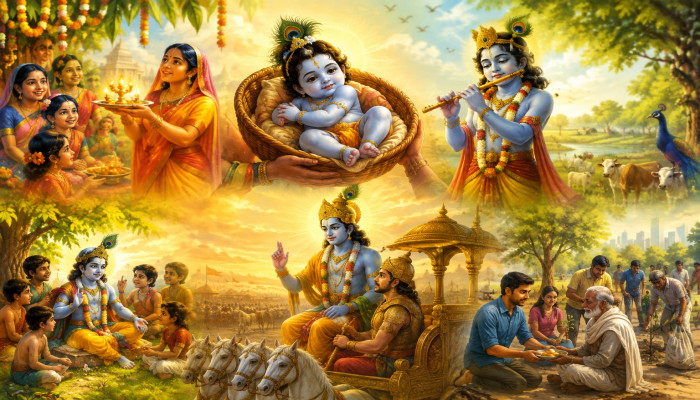
Every year, Janmashtami arrives with familiar images of celebration. Temples are beautifully decorated, devotional songs fill the air, midnight prayers mark the birth of Krishna, and children dressed as little Kanhas bring joy to homes and communities. Dahi Handi celebrations add colour and youthful energy to the festival.
All of this is beautiful. All of it is part of our living tradition.
Yet, perhaps, Janmashtami also invites us to ask a deeper question:
Are we merely celebrating the birth of Krishna, or are we seeking to understand the life of Krishna?
There is a profound difference between the two.
Celebrating Krishna’s birth is tradition.
Understanding Krishna’s actions is education.
Bringing Krishna’s dharma into our lives is संस्कार—character formation.
And keeping Krishna’s vision of human welfare alive in society is the true celebration of Janmashtami.
That is the deeper meaning of this sacred festival.
Krishna Is Not Merely a Deity to Be Worshipped
Krishna is perhaps one of the most complete and complex personalities in the Indian civilisational belief system.
He is the playful child of Gokul, the beloved of the Gopis, the protector of Mathura, the statesman of Dwarka, the friend and guide of the Pandavas, and, above all, the charioteer who transforms Arjuna's confusion into clarity on the battlefield of Kurukshetra.
Each form of Krishna conveys a different lesson.
The child Krishna teaches us the importance of joy and innocence.
The youthful Krishna teaches courage and confidence.
The Krishna of Dwarka teaches statesmanship and strategic wisdom.
The Krishna of the Mahabharata teaches us the complexities of dharma.
And Krishna of the Bhagavad Gita teaches us the timeless discipline of selfless action.
Yet, running through all these dimensions is one central principle:
Life must be lived in the service of dharma and the welfare of society.
This is what makes Krishna relevant not merely to a particular age or generation, but to every generation.
The Child Krishna: The Importance of Joy
Modern society has become increasingly obsessed with achievement.
Children are introduced to competition at an early age. Academic performance, examinations, careers and future success occupy an enormous part of their lives. In this race, something precious is often lost—the simple joy of childhood.
Krishna's childhood reminds us that joy is not frivolous; it is an essential part of a healthy life.
The stories of Krishna playing with his friends, stealing butter and wandering through Gokul are not merely charming tales meant to entertain children. They represent a childhood full of curiosity, friendship, spontaneity and fearlessness.
Perhaps this Janmashtami, instead of merely dressing our children as Krishna, we should tell them why Krishna's childhood matters.
Let them understand that childhood should have laughter, friendship, imagination and courage. Let them learn not merely to look like Krishna, but to imbibe something of the spirit of Krishna.
Youth Must Have Courage
Krishna's life also speaks powerfully to the young.
He did not choose the path of comfort. His life was marked by challenges, transitions and responsibilities. From leaving Gokul to confronting tyranny in Mathura and eventually establishing Dwarka, Krishna demonstrated the ability to respond to changing circumstances without losing sight of his larger purpose.
This is a lesson contemporary youth urgently need.
Courage does not mean recklessness. It means having the strength to act when circumstances demand action.
Krishna's life teaches young people that one cannot always choose one's circumstances. But one can choose one's response to them.
Youth must therefore possess courage—but courage guided by wisdom.
Strength without wisdom can become destructive. Wisdom without courage can become ineffective.
Krishna represents the union of both.
Karma: The Dignity of Duty
Perhaps Krishna's most enduring message comes through the Bhagavad Gita.
On the battlefield of Kurukshetra, Arjuna is overwhelmed by doubt. His crisis is not merely about war. It is a crisis of duty, responsibility and moral judgement.
Krishna does not simply tell him what to do. He gives him a framework through which he can understand his duty and make a conscious decision.
The celebrated teaching of karma is therefore much more than a philosophical statement. It is a practical guide to life.
We have control over our actions; we cannot completely control their consequences.
This principle has enormous relevance today.
A society that constantly asks, “What will I get?” eventually loses the ability to ask, “What should I do?”
Krishna reverses that order.
Duty comes before reward. Responsibility comes before entitlement.
This does not mean abandoning ambition. It means placing ambition within the framework of responsibility.
For the professional, it means integrity in one's work.
For the teacher, dedication to students.
For the administrator, fairness.
For the citizen, responsibility towards society and nation.
For the leader, putting collective welfare above personal interest.
This is Krishna's teaching of karma in everyday life.
In Relationships, Krishna Teaches Love
Krishna's life is also a celebration of relationships.
His bond with Yashoda, his friendships in Gokul, his relationship with Sudama, and his extraordinary friendship with Arjuna reveal different dimensions of human affection.
Yet these relationships are not merely emotional attachments. They are built upon trust, loyalty, affection and responsibility.
Consider the friendship between Krishna and Sudama.
It reminds us that genuine friendship does not measure a person by wealth, status or social position.
In an age where thousands of digital connections can coexist with profound loneliness, Krishna's relationships offer a simple lesson:
The value of a relationship lies not in how many people know us, but in how many people can trust us.
Love without possessiveness, friendship without calculation and relationships without selfish expectation—these are also part of Krishna's life lesson.
The Wisdom to Make Difficult Decisions
Perhaps one of the most misunderstood aspects of Krishna is his strategic wisdom.
The Mahabharata is not a simple story of good people versus bad people. It is a world of complicated choices, competing duties and difficult circumstances.
Krishna understands this complexity.
He does not teach Arjuna to escape difficult decisions. He teaches him to acquire the wisdom necessary to make them.
This distinction is crucial.
Modern society does not merely suffer from a lack of information. We suffer from an abundance of information and, often, a shortage of wisdom.
We can access facts instantly. But knowing what is right, what is necessary and what is appropriate requires viveka—discernment.
Information informs. Wisdom guides.
Krishna represents this wisdom.
Dharma Is Life Education
For Krishna, dharma cannot be reduced to ritual.
Dharma is not merely about visiting a temple, performing a puja or observing a festival.
Dharma is the principle that enables an individual and society to function according to righteousness, responsibility and justice.
Dharma means standing with truth.
Dharma means performing one's duty.
Dharma means resisting injustice.
Dharma means using strength responsibly.
Dharma means rising above narrow self-interest when the larger good demands it.
In this sense, dharma is life education.
And this education cannot be delivered only through textbooks.
Children learn values from what they see at home. They learn responsibility from their parents, integrity from their teachers and citizenship from society.
Therefore, Janmashtami should not remain merely a religious celebration. It can become an occasion for value-based education within the family and society.
From Personal Devotion to Lok Kalyan
There is another dimension of Krishna's life that deserves renewed attention: Lok Kalyan—the welfare of society.
Krishna did not live for himself.
His actions repeatedly demonstrate an orientation towards the larger good. Whether confronting tyranny, guiding the Pandavas, counselling Arjuna or establishing a new political order in Dwarka, his life remained connected to a larger social purpose.
This provides a powerful lesson for contemporary India.
The true celebration of Janmashtami cannot end with the midnight birth ceremony.
It should continue the next morning—in our conduct.
Help someone who needs support.
Teach a child.
Stand by someone who is vulnerable.
Serve the community.
Protect the environment.
Perform one's professional duties honestly.
Use one's position and abilities for the larger good.
These may appear to be ordinary acts. But this is precisely where the philosophy of Krishna becomes a living reality.
What Should We Teach Our Children This Janmashtami?
Perhaps the most meaningful change we can make is simple.
This Janmashtami, let us give our children more than a Krishna costume.
Let us give them Krishna's life as a lesson.
Teach them:
Joy in childhood.
Courage in youth.
Dedication in action.
Love in relationships.
Wisdom in decisions.
And commitment to public welfare throughout life.
If a child learns these six lessons, there is no need for that child to merely dress like Krishna. The values of Krishna will begin to appear in the child's conduct.
And perhaps that is the real test of a civilisation.
Not how magnificently we celebrate its festivals, but how faithfully we live their teachings.
When Will Krishna Be Born Within Us?
At midnight on Janmashtami, we wait for the birth of Krishna.
But there is another, more profound question worth asking:
When will Krishna be born within us?
Perhaps when silence before injustice gives way to courage.
When duty becomes greater than selfish interest.
When love becomes greater than possession.
When wisdom becomes greater than ego.
When strength is used to protect rather than dominate.
And when an individual rises above the narrow boundaries of self to work for the welfare of society and the nation.
That is when the spirit of Krishna is truly born within us.
Janmashtami, therefore, should not merely commemorate an event that happened thousands of years ago. It should renew a way of living.
Celebrating Krishna's birth is tradition.
Understanding Krishna's actions is education.
Living Krishna's dharma is संस्कार.
And keeping Krishna's vision of Lok Kalyan alive is the true celebration of Janmashtami.
This Janmashtami, let us not merely light lamps outside.
Let us light the lamp of Krishna's wisdom within.
Shri Krishnarpanamastu.


 Loading...please wait
Comments