



Israeli air strikes kill 32 Palestinians in Gaza amid ceasefire violations
- In Reports
- 06:42 PM, Feb 01, 2026
- Myind Staff
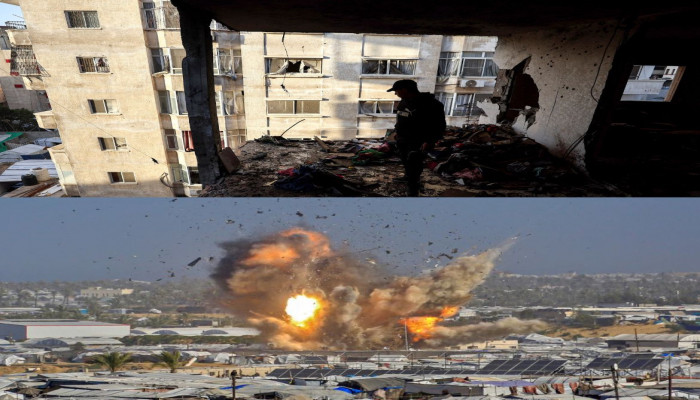
At least 32 Palestinians were killed in a series of Israeli air strikes across the Gaza Strip on Saturday, according to local rescue and civil defence officials. The strikes were described by residents as some of the heaviest attacks since the second phase of the ceasefire agreement came into effect earlier this month.
Gaza’s civil defence agency, which operates under Hamas, said that women and children were among those killed. Officials stated that one of the attacks involved Israeli helicopter gunships striking a tent that was sheltering displaced Palestinians in the southern city of Khan Younis. The agency added that several areas across Gaza were hit, including residential neighbourhoods and places where displaced families had sought refuge.
Palestinians living in Gaza said the scale and intensity of the attacks were unusual compared to recent weeks. Many described Saturday’s strikes as the most severe since the second phase of the ceasefire, which was brokered by US President Donald Trump last October, began earlier this month.
The Israeli military confirmed that it had carried out multiple strikes across the territory. In a statement, the Israel Defence Forces (IDF) said the attacks were conducted in response to what it described as a Hamas violation of the ceasefire agreement on Friday. Both Israel and Hamas have repeatedly accused each other of breaching the truce since it came into effect last year.
The IDF said that during operations in eastern Rafah, “eight terrorists were identified exiting the underground terror infrastructure in eastern Rafah,” an area where Israeli forces remain deployed under the terms of the October agreement. The statement added that the military, along with the Israel Security Agency (ISA), targeted several locations across Gaza.
According to the IDF, the strikes hit “four commanders and additional terrorists,” as well as a weapons storage facility, a weapons manufacturing site, and “two launch sites belonging to Hamas in the central Gaza Strip.” The military said these targets were linked to militant activity and posed a threat under the ceasefire framework.
Hamas strongly condemned the Israeli strikes and called on the United States to take immediate action. In a statement, the group said that “these ongoing violations” showed that the Israeli government “continues its brutal war of genocide against the strip.” Hamas also said that seven of those killed belonged to a single displaced family in Khan Younis.
A spokesperson for Gaza’s civil defence agency said the strikes hit residential apartments, tents, shelters, and even a police station. Medical officials reported that hospitals across Gaza were overwhelmed as casualties were brought in following the attacks.
At Gaza City’s Shifa hospital, officials said an Israeli air strike hit a residential apartment, killing five people, including three children and two women. Relatives of the victims expressed anger and grief over the loss of civilian lives despite the ceasefire.
“We found my three little nieces in the street. They say ‘ceasefire’ and all. What did those children do? What did we do?” said Samer al-Atbash, the uncle of the three children who were killed, according to Reuters news agency.
Video footage and images from different parts of Gaza showed bodies being pulled from the rubble of destroyed buildings. Several structures appeared severely damaged or completely flattened following the air strikes.
The attacks came just a day before the Rafah border crossing between Gaza and Egypt was scheduled to reopen on Sunday. The crossing had been closed but was set to resume operations after the Israeli military recovered the body of Israel’s last remaining hostage earlier this week.
International reactions followed quickly. Egypt’s foreign ministry condemned the Israeli strikes in a statement seen by AFP news agency and urged all sides to “exercise the utmost restraint.” Qatar, which has played a key role as a mediator during ceasefire negotiations, also denounced what it described as “repeated Israeli violations,” according to its foreign ministry.
In January, US special envoy Steve Witkoff announced the beginning of the second phase of the ceasefire agreement. Under the first phase, Hamas and Israel agreed to a ceasefire in October 2025, along with a hostage and prisoner exchange, a partial withdrawal of Israeli forces, and an increase in humanitarian aid to Gaza.
Witkoff said the second phase would involve the establishment of a technocratic Palestinian government in Gaza, the reconstruction of the territory, and its full demilitarisation, including the disarmament of Hamas and other Palestinian groups.
The conflict between Israel and Hamas began after a Hamas-led attack on southern Israel on 7 October 2023, during which about 1,200 people were killed and 251 others were taken hostage. Israel responded with a large-scale military offensive in Gaza.
According to Gaza’s Hamas-run health ministry, more than 71,660 Palestinians have been killed since the start of the war. The ministry said that at least 509 Palestinians have been killed since the ceasefire began on 10 October 2025. Four Israeli soldiers have also been reported killed during this period.
Although Israel has previously questioned casualty figures released by the Hamas-run health ministry, a senior Israeli security source was quoted by local media as saying that the military accepts that more than 70,000 Palestinians have been killed during the war. The figures from the health ministry have been considered reliable by the United Nations and other human rights organisations and are widely used by international media outlets. Israel does not allow news organisations, including the BBC, to enter Gaza to report independently.



 Loading...please wait
Comments