




Is the QUAD Truly Effective
- In Military & Strategic Affairs
- 01:20 PM, Nov 23, 2026
- Major General Harsha Kakar
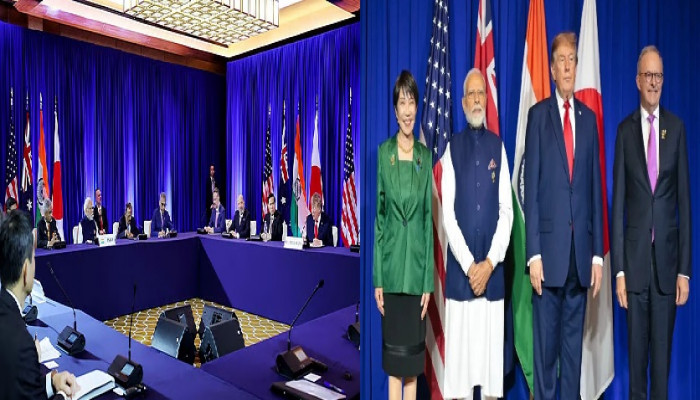
The latest QUAD (Quadrilateral Security Dialogue) summit was held on the sidelines of the ASEAN summit in Manila, Philippines, last week. It was attended by the heads of state of its four members, the US, India, Japan and Australia. India, which was scheduled to host the current summit, was unable to do so, as President Trump was hesitant to travel to Delhi with the ongoing trade dispute. It is likely to hold its summit in 2027.
The summit was conducted two days before President Trump was to hold a trilateral with President Xi Jinping of China and President Putin of Russia. The last QUAD summit was hosted by President Biden in September 2024. This was also the third summit in Manila. The first was the inaugural summit in 2007 and the second, the revival summit in 2017, which was attended by senior representatives and not heads of state.
A large part of the joint statement, issued at the end of the summit, was aimed at China, though its name was not mentioned. Members of the QUAD have repeatedly stated that the organisation is not aimed at any state. The MEA released joint statement mentioned, “We express grave concerns about economic coercion, including through arbitrary export restrictions.” The US also places export restrictions, largely on the transfer of technology, including AI chips to China.
China has imposed export restrictions on many nations. It has imposed restrictions on the movement of heavy machinery essential for infrastructure development in India, banned export of items on its dual-use control list to Japan, while placing 55% tariffs on excess beef imports and also imposed restrictions on export of specific iron ore shipments to Australia. It also blackmailed the US by threatening restrictions on the export of specific rare earth minerals. Though China was not mentioned, the finger-pointing was clear.
Other outcomes included establishing a QUAD business leaders forum, which would meet early next year in Mumbai and the Indo-Pacific Maritime Surveillance Cooperation, which would hold its first maritime exercise, involving P-8 and P-3C patrol aircraft. They also confirmed the Accelerator Initiative, announced at the foreign ministers’ meet in Atlanta. An added aspect was enhanced cyber cooperation, condemning terrorism, cross-border violent extremism and commitment to a free and open Indo-Pacific.
While the leaders’ meeting has been infrequent, cooperation between members continues through forums which interact regularly. The QUAD foreign ministers met in New Delhi in May this year, where they announced ‘new initiatives to strengthen maritime and transnational security, economic prosperity and security, critical and emerging technology and support humanitarian assistance and emergency response across the region.’
They subsequently met at the end of October in Atlanta. The focus then was on the role of economic security in maintaining global stability, reliable and open supply chains and resilient infrastructure. The initiatives launched thereafter were approved at the leaders’ summit in Manila.
Simultaneously, while nations do not view regional and international developments through the same prism, there appears to be increased collaboration in the maritime domain and critical infrastructure. The Malabar naval exercise, an annual feature, concluded on 12th Nov off the coast of Japan. ASEAN nations were specifically mentioned in the joint statement, with respect to “upholding a free and independent Indo-Pacific” being essential.
Security interests of nations forming part of the QUAD are also at variance. The US’s primary concern is the Indo-Pacific, where it seeks to ensure freedom of navigation across all choke points. The sole challenger to the US in the region is China. Japan’s concern remains the East China Sea and the survivability of Taiwan. It remains vigilant over Chinese expansionism and its claims over its outlying islands.
Australia is concerned about China's growing footprint across Oceania and SE Asia, while India focuses on the Indian Ocean region and chokepoints such as the Malacca Straits. Simultaneously, India is involved in a border dispute with China along its northern borders. While nations have different regions of interest, China is the primary concern for all. India’s Car Nicobar project aims to dominate the Malacca Straits, a major chokepoint. Its development would give a boost to QUAD initiatives in maintaining dominance over regional chokepoints.
The Chinese criticism of every QUAD summit has been almost the same. It terms it an “exclusive bloc that stokes regional confrontation and creates artificial tension.” The Global Times, in an opinion piece immediately after the Manila Summit, mentioned, “It is clear that the US is reluctant to invest significant additional diplomatic resources or make specific arrangements for a multilateral Quad summit.” It also termed it “photo-diplomacy.”
An earlier article mentioned India: “New Delhi is unwilling to jeopardise the improving China-India relationship by aligning with other nations' efforts to contain China, nor is it willing to make unilateral concessions on issues such as trade tariffs and market access.” It does appear that the Chinese were warning India that it risks much by being part of coalitions aimed at it. All QUAD member states have their own trading agreements with China which they consider essential for their economies. None would be willing to sacrifice these.
The prevailing view in the US of accommodating China has reduced its involvement in the Indo-Pacific, while concentrating on conflicts in other regions. The summit set this at rest. What remains doubtful is the role of India’s Quad presidency. As per the sequence, Australia is expected to chair the group in 2027. Whether India would conduct its summit early next year, prior to handing over the baton to Australia, is unknown. Conducting such summits implies projecting soft power. Time would tell.
The problem over the years has been that the QUAD has been unable to deliver what it proposes in its summits, impacting its credibility. Promises have rarely been fulfilled. The gap between ambition and implementation is high. Results largely flow from bilateral agreements between member states rather than from collective action.
While the utility of the QUAD is questioned, the fact that it irks China demonstrates that it has value. It is a counter to China’s grey-zone warfare in the region and its belligerent approach in the South and East China Seas. If the QUAD really needs to be effective, then enhancing the scope of its military exercises to include air and land power is essential. China respects strength, and this must be exploited.
Disclaimer: The opinions expressed within this article are the personal opinions of the author. MyIndMakers is not responsible for the accuracy, completeness, suitability, or validity of any information on this article. All information is provided on an as-is basis. The information, facts or opinions appearing in the article do not reflect the views of MyindMakers and it does not assume any responsibility or liability for the same.


 Loading...please wait
Comments