




Is BRICS Plus on the Way to Becoming the 21st Century NAM?
- In Military & Strategic Affairs
- 10:53 AM, Nov 12, 2026
- Shubhi Malhotra & Dr Adityanjee
Introduction
Twenty-nine newly decolonised nations met in Bandung, Indonesia, in 1955 to assert a third path, neither the American-led West nor the Soviet led East. The Non-Aligned Movement (NAM), an alliance based on the five principles of Panchsheel – sovereign equality, non-aggression, non-interference, mutual benefit and peaceful coexistence – was born out of that historic gathering. For 30 years NAM was the collective voice of the developing world, campaigning for decolonisation, for the end of apartheid, for moral sermonising and against the pressures of Cold War alignment.
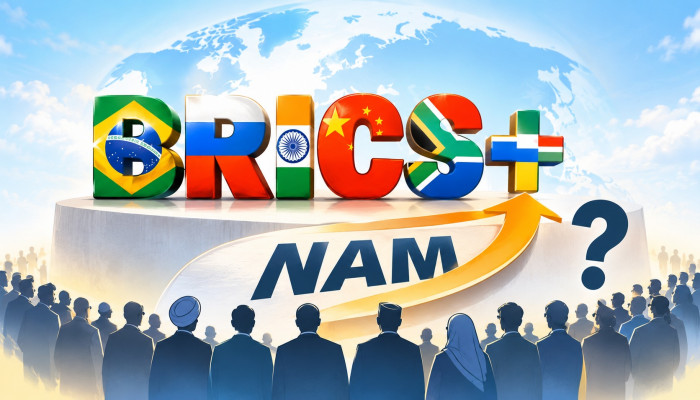
Today, as the world fractures again on great power lines, this time between a Washington-centered Western order (G-7) and a Beijing-Moscow revisionist axis, a strikingly similar impulse is driving the expansion of BRICS into BRICS Plus. What originally started as an acronym by Jim O’Neal from Goldman Sachs about newly emerging economies (Brazil, Russia, India and China) that could dominate the world economy by 2050, eventually became a loose intergovernmental organisation. South Africa was added later at the Beijing summit in 2011 to make it BRICS by Chinese manoeuvring, though South Africa was never in the same league. China had the chutzpah to foist South Africa onto the BRIC. Enlarging the economic grouping to BRICS tremendously helped China’s foreign policy objectives of containing Indian economic, strategic, political and diplomatic influence. China effectively managed to collapse BRIC and IBSA (India, Brazil, South Africa) trilateral into one single grouping (BRICS). South Africa’s small population, the size of its economy and the relatively slow growth rate did not meet the original BRIC standards. By inviting South Africa to BRIC(S), China had deftly dented India’s economic outreach in Africa.
Today, with twenty full members and partner states, BRICS Plus represents more than 55 per cent of the world population and about 44 per cent of world GDP as of 2026 and has become the most consequential grouping of the Global South since the Non-Aligned Movement itself. The parallel is not simply rhetorical. Pull toward BRICS for countries - instinctual and the desire for strategic autonomy, for fair representation in global institutions, and for freedom from great-power dictation is recognisably the same instinct that drew Nehru, Nasser, Sukarno, Nkrumah and Tito to Bandung.
But is the similarity profound enough to dub BRICS Plus the twenty-first century NAM? Or does it merely echo that previous project, differing in ways that matter profoundly? This article looks at the similarities and differences, the promises and limitations, and asks the question of whether BRICS Plus can avoid the contradictions that ultimately limited the geopolitical significance and credibility of its predecessor.
The NAM in Historical Perspective
The Non-Aligned Movement was born in anti-colonial solidarity and nourished by the moral authority of its founding generation. Nehru’s Panchsheel doctrine, Nasser’s pan-Arab nationalism, Sukarno’s Afro-Asian consciousness and Tito’s clever balancing between Moscow and Washington gave NAM an ideological cohesion and a charismatic leadership that drew the eyes of the world. At its peak, NAM had over 100 members and dictated the agenda of the United Nations General Assembly, seeing through landmark resolutions on decolonisation, racial equality and the New International Economic Order.
However, the limitations of NAM were also fundamental. The non-alignment policy was always more an aspiration than a practice. Many members declared themselves neutral. But they were largely aligned with the United States, the Soviet Union or increasingly China. The movement had no institutional architecture, no enforcement mechanisms, no development bank, no common economic vision. It was a club of common grievances, essentially a talking shop, not a vehicle for common action. By the 1990s, the Cold War was over, the post-colonial moment receding, and the NAM lost its animating purpose. It still meets at summits, the most recent in 2024 in Kampala, but it enjoys little strategic attention and less analytical respect.
The question of whether BRICS Plus can do better starts with the question of what NAM could not do, and whether BRICS Plus has the tools, the will, and the structural conditions to succeed where NAM failed.
Parallels: Why Comparison Resonates
The comparison between BRICS Plus and NAM is not frivolous. It is based on real structural and ideological parallels.
Common Roots in the Global South: With Indonesia, Egypt and India as members, most of the countries of the original Non-Aligned Movement are now members of the BRICS group. BRICS has become a forum which is now the most important voice of the Global South and the traditional non-aligned and non-OECD countries in the developing world. The overlap in membership is no accident, but reflects a shared historical experience of colonialism, uneven development and exclusion from the governance of institutions designed by and for the Western powers.
The Bandung Principles Reborn: BRICS Plus is formally founded on very similar principles as Panchsheel: non-interference, equality and mutual benefit. The requirement of unanimous decisions, the refusal of hierarchy among members, the emphasis on sovereignty rather than conditionality in development finance – all recall the Bandung spirit. At the 17th BRICS Summit in Rio de Janeiro in July 2025, when PM Modi said India would give BRICS a “new form” during its 2026 presidency, he was consciously invoking a Bandung-era tradition of Global South self-determination.
Anti-Hegemonic Assertion: Like the Non-Aligned Movement (NAM), which was galvanised by the struggle against superpower hegemony, BRICS is perceived as an “anti-hegemonic” platform to promote a truly multipolar world order and increase the clout of the Global South in institutions such as the UN Security Council (UNSC) and international financial bodies. The language of multipolarity, repeated at every BRICS summit, enshrined in every joint declaration, is the 21st-century equivalent of NAM calls for a New International Economic Order.
Institutional Innovation: Unlike NAM, which did not have any financial architecture of its own, BRICS Plus has created real institutions. The New Development Bank (NDB) was established in 2014 with equal shareholding among the founding members, a deliberate departure from the weighted voting structure of the IMF and the World Bank. It was created to prevent any single country from dominating, and it offers an alternative source of development financing for infrastructure and long-term projects. The Contingent Reserve Arrangement is an emergency liquidity facility. The new BRICS Pay platform is intended to reduce reliance on the dollar-dominated SWIFT system. These are not rhetorical gestures but institutional bets on alternative financial architecture.
The Vietnam Moment: Vietnam’s decision to join BRICS as a partner state in June 2025 is highly symbolic, reaffirming the country’s independent foreign policy and strategic non-alignment. Hanoi's refusal to choose between Washington and Beijing, laid out in its "Four Nos" policy, and its membership of BRICS while having a deep trade relationship with the United States captures exactly the kind of multi-vector diplomacy that NAM once espoused but could never institutionalise.
Where BRICS Plus Parts Company with NAM
The Problem of Great Powers Within: NAM's defining feature was the absence of superpowers from its ranks. Its members were aligned with no one. BRICS Plus, by contrast, includes China, the world's second-largest economy and the principal revisionist challenger to American hegemony, and Russia, a great power actively at war with a European neighbour and under sweeping Western sanctions. It is necessary to differentiate between BRICS states with a clear anti-Western agenda, Russia and China, and BRICS states in search of new trading partners and BRICS states aligned with the US like Saudi Arabia. This distinction matters enormously. NAM's moral authority rested on its members' genuine independence from great-power politics. BRICS Plus cannot claim the same while China and Russia shape its agenda and use it as a platform for their own strategic objectives.
China's Hegemony Within the Group: The internal power dynamics of BRICS Plus are as lopsided as anything NAM ever faced, but the asymmetry runs within the group rather than from outside it. China's GDP dwarfs every other BRICS member combined. Beijing has been the primary driver of BRICS expansion, using membership enlargement as a vehicle for its own multipolar agenda. The multipolar world order envisioned by Beijing for BRICS+ does not align with the desire of members like India and Brazil for a genuinely balanced platform. India has been explicit about its concerns: amid expansion, there are fears that BRICS could tilt more toward China, potentially sidelining India's interests. The spectre of Chinese domination of an institution nominally committed to equality is precisely the kind of hegemony NAM was designed to resist.
Heterogeneity as Paralysis: NAM was diverse but broadly democratic in its foundational politics. BRICS Plus is extraordinarily heterogeneous, spanning liberal democracies (India, Brazil, South Africa), authoritarian states (China, Russia, Iran), monarchies (UAE), and mixed regimes across the spectrum. The inclusion of countries like Saudi Arabia and the UAE, traditionally aligned with the United States, may complicate BRICS Plus's positioning as an independent bloc. The requirement for unanimous decision-making, designed to prevent domination by any single member, means that the larger and more diverse BRICS Plus becomes, the harder it is to act collectively. Carnegie India has noted that intra-BRICS trade remains structurally underdeveloped: although over two-thirds of the Global South's GDP comes from BRICS members, only about 20 per cent of South-South trade is intra-BRICS. A grouping that cannot translate its demographic and economic weight into integrated commerce has a fundamental coordination problem.
The De-Dollarisation Illusion: One of the most frequently cited aspirations of BRICS Plus is de-dollarisation, the reduction of dependence on the US dollar in international trade and reserves. In practice, this aspiration significantly exceeds what BRICS Plus can deliver. India's presidency of BRICS has categorically distanced itself from the idea of a BRICS common currency, while supporting local currency settlements as a pragmatic alternative. Intra-BRICS trade denominated in local currencies remains a work in progress, with the US dollar continuing to dominate cross-border transactions even among BRICS members. The NDB itself still largely operates in dollars. The gap between the rhetoric of financial sovereignty and the reality of dollar dependency is a structural limitation that no summit declaration can bridge overnight.
India's Presidency: The Moderate Camp Sets the Terms
India’s 2026 presidency could be the most obvious test of whether a third path is possible, if BRICS Plus is to avoid becoming either a Chinese-dominated anti-Western bloc or a structurally incoherent talk-shop.
India formally took over the rotating presidency of BRICS on January 1, 2026, promising to champion the cause of the Global South amid rising trade tensions with the United States. External Affairs Minister S Jaishankar put the vision in words: “India sees BRICS as a positive platform for dialogue and development, which complements the larger multilateral system.” This framing – that BRICS is complementary to, rather than a substitute for, the existing multilateral order – is a conscious shift away from the more confrontational posture of Russia and, at times, China.
India’s understated presidency of BRICS, a move away from the spectacle de-dollarisation rhetoric of prior summits, enabled it to host competently, extract bilateral value, including Chinese Premier Xi Jinping’s first visit to India since 2019, without letting BRICS define India’s global posture. India led the agenda on sustainability and digital public infrastructure and multilateral institutional reform, not on counter-Western confrontation. The adoption of the New Delhi Declaration confirmed that the moderate camp in India, for now, has set the terms of the BRICS discourse.
This is important. “BRICS is not anti-Western but simply non-Western”, Modi’s formulation echoes Nehru’s insistence, in the twenty-first century, that non-alignment was not neutrality but positive engagement with all. If this framing sticks, BRICS Plus could aspire to something truly similar to the NAM ideal: a platform for countries that do not wish to be defined by great-power rivalries they did not initiate.
Can BRICS Plus Escape NAM's Fate?
NAM's decline was not simply a result of the Cold War's end. It was the inevitable consequence of structural weaknesses: the absence of institutional architecture, the impossibility of collective action among a hundred-plus heterogeneous members, and the gradual capture of the movement's agenda by narrower political interests. BRICS Plus has avoided some of these pitfalls; it has institutions, a more manageable membership, and a clearly defined economic rationale, but it faces its own version of the same structural challenges.
The first is the alignment problem. Several BRICS Plus members are deeply embedded in Western economic and security arrangements. The UAE has extensive financial ties to New York and London. Indonesia is deepening its security cooperation with Washington. Brazil's Lula government, which held the 2025 presidency, explicitly declined to join China's Belt and Road Initiative and blocked Venezuela's BRICS membership bid. Many Global South countries are joining BRICS as a hedge, seeking to pursue non-alignment by participating in a range of organisations rather than picking a side between China and the United States. This is rational diplomacy, but it does not constitute the kind of collective identity that made NAM politically powerful in its prime.
The second is the China question. Beijing's vision for BRICS Plus, as a vehicle for a multipolar world in which Chinese-led institutions challenge American-led ones, is not the same as India's or Brazil's vision of a balanced, development-focused platform. The internal divisions within BRICS, between India and Brazil's preference for an economic development agenda and Russia and China's geopolitical maximalism, represent the movement's central unresolved tension. If China succeeds in pulling BRICS Plus decisively in an anti-Western direction, the movement will lose its appeal to the swing states of the Global South whose participation gives it legitimacy.
The third is the institutional gap. The NDB has disbursed only 35 billion USD in nine years to five countries, a fraction of what the World Bank deploys annually. BRICS Pay remains aspirational. The Contingent Reserve Arrangement has never been activated. The institutions exist, but they have not yet demonstrated the operational capacity to serve as genuine alternatives to the Bretton Woods architecture. Until they do, BRICS Plus remains a platform with enormous potential and limited delivery.
Is BRICS Plus the 21st Century NAM?
BRICS Plus has in common with NAM the basic instinct of Global South solidarity, the rejection of great-power conditionality and the demand for genuine multipolarity in international governance. It has outstripped NAM in institutional depth, in economic weight, and in the clarity of its development agenda. Where NAM ultimately became a bloc of shared grievances without shared agency, BRICS Plus at least has the institutional scaffolding – the NDB, the CRA, the expanding BRICS Pay architecture – to translate ambitions into outcomes.
But BRICS Plus is distinct from NAM in ways that are not incidental. But BRICS Plus, with China and Russia as the most prominent members, can never be truly non-aligned. At its heart, it is a group of the most consequential challengers to the existing Western order. This gives it a geopolitical weight that NAM never had, but it also compromises its claim to independence. The members of Global South like India, Brazil, South Africa, Indonesia, UAE are not non-aligned in Nehruvian sense. They are multi-aligned. They have ties with Washington, Beijing and Brussels at the same time, using BRICS membership as one instrument in a diversified foreign policy portfolio.
Better put, BRICS Plus is what NAM would have looked like if NAM had included a superpower from the Global South, i.e., not quite NAM at all. It is new and in some ways more powerful: a platform for strategic autonomy in a world of competing great powers, with real institutional architecture behind it and representing a genuine majority of humanity. Whether it becomes the most consequential multilateral platform of the twenty-first century or a structurally paralysed talk shop defined by the gulf between Chinese ambition and Global South diversity will depend, above all, on how India and Brazil, the movement’s moderate anchors, shape its trajectory in the years ahead.
The spirit of Bandung is alive in BRICS Plus. The fundamental question for multilateral politics in the next decade is whether it can govern itself. BRICS Plus has more relevance and future significance as a possible rival to G-7 and G-20 in altering the global geo-economic architecture, representing the Global South instead of post-World War II Bretton Woods institutions dominated by Western economic hegemony.
References
- Bne IntelliNews. (2026, January 2). India takes BRICS presidency amid US trade tensions. IntelliNews. https://www.intellinews.com/india-takes-brics-presidency-amid-us-trade-tensions-418034/
- Dessein, B., & Roctus, J. (2025, July). BRICS+: an Odd Family of (un)Likely Frenemies. Egmont Institute. https://egmontinstitute.be/app/uploads/2025/07/Bart-Dessein_Jasper-Roctus_Policy_Brief_384_vFinal.pdf
- Maini, T. S. (2026, September 29). With BRICS Presidency, India Will Have To Walk A Fine Balance. O.P. Jindal Global PURE Publications Repository. https://pure.jgu.edu.in/id/eprint/11792/
- Nachiappan, K. (2026, September 14). India’s 2026 BRICS Chairmanship: Quiet Diplomacy, Calibrated Outcomes. Institute of South Asian Studies. https://www.isas.nus.edu.sg/wp-content/uploads/2026/09/ISAS-Brief-1420.pdf
- Sahai, V. (2026, June 9). Managing divergence: India’s BRICS presidency in 2026. Carnegie Endowment for International Peace. https://carnegieendowment.org/china/research/2026/06/managing-divergence-indias-brics-presidency-in-2026
- Adityanjee, A (2011, November 11) Securitization of BRICS https://www.boloji.com/articles/14207/securitisation-of-the-brics
- Adityanjee (2011) Invading the strategic space: the Dragon fires another salvo at India https://udaywrites.com/articles/invading-the-strategic-space-the-dragon-fires-another-salvo-at-india
Disclaimer: The opinions expressed within this article are the personal opinions of the author. MyIndMakers is not responsible for the accuracy, completeness, suitability, or validity of any information on this article. All information is provided on an as-is basis. The information, facts or opinions appearing in the article do not reflect the views of MyindMakers and it does not assume any responsibility or liability for the same.


 Loading...please wait
Comments