




Iranian Kurdish Forces in Iraq say preparing to cross over into Iran
- In Reports
- 01:51 PM, Mar 05, 2026
- Myind Staff
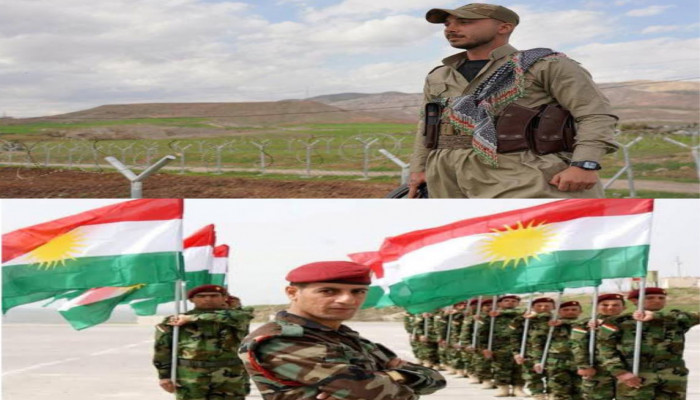
Pro-American Iranian Kurdish forces based in Iraq are preparing armed units that could potentially cross into Iran, opening a new front in the already expanding conflict in the region. According to Iraqi officials and senior members of Iranian Kurdish groups, these preparations are underway as tensions grow following recent military developments involving the United States and Israel.
Sources familiar with the matter said that the Central Intelligence Agency (CIA) had previously supplied small arms to Iranian Kurdish forces as part of a covert effort aimed at destabilising Iran. This program reportedly began before the current conflict started. However, the weapons provided are limited and do not include heavy military equipment.
Despite reports about a possible Kurdish insurgency in Iran, the White House has rejected claims that such a plan has been approved. During a briefing on Wednesday, White House press secretary Karoline Leavitt said reports suggesting that Donald Trump had agreed to a Kurdish plan to launch an uprising inside Iran were incorrect.
Leavitt said the reports were “completely false.”
The ongoing military campaign by the United States and Israel inside Iran began on Saturday. According to reports, the attacks have killed Iran’s supreme leader and several other senior officials. The strikes have also targeted government offices and security facilities across the country, including locations along the Iran-Iraq border.
Officials in the United States are currently debating whether supporting a Kurdish incursion into Iran would be strategically useful as the conflict continues to intensify. If Kurdish forces were to move into Iran in significant numbers, it could force Iranian army units to mobilise against them. This could create opportunities for American or Israeli aircraft to strike those Iranian forces.
The United States has historically worked with Kurdish militia groups in both Iraq and Syria. At the same time, the U.S. has often been criticised for abandoning Kurdish groups after conflicts end. A notable example occurred after the 1991 Persian Gulf War, when Kurdish fighters rose up against the Iraqi government after receiving encouragement from the United States. However, American forces did not intervene when the Iraqi military moved to suppress the uprising, leading to heavy Kurdish casualties.
People involved in discussions about a possible Kurdish operation in Iran have also expressed caution. They say that Kurdish forces alone would not be capable of overthrowing the Iranian government or significantly influencing who might lead the country in the future.
The weapons supplied by the CIA reportedly include only small arms. Kurdish groups do not have tanks, heavy artillery, or other major military equipment that would allow them to launch a full invasion or seriously threaten the Iranian government in Tehran.
Former officials have also pointed out that the majority Persian population in Iran may not support an armed Kurdish incursion. Kurds represent only a small portion of the country’s population. Estimates suggest that between six million and nine million Kurds live in Iran out of a total population of around 90 million people.
Sources familiar with the discussions said that the White House has not yet made a final decision on whether to support Kurdish forces entering Iran. Some officials believe the final decision may not even depend entirely on the United States or Israel. Kurdish leadership itself may choose whether to move forward with the plan.
Iran has already begun putting pressure on the Iraqi government to stop Kurdish fighters from crossing the border. Iraqi officials and Iranian Kurdish leaders said that Tehran has asked Iraq to ensure that such movements do not happen.
According to two Iranian Kurdish leaders and two Iraqi security officials, President Trump recently spoke with two major Iraqi Kurdish leaders — Massoud Barzani and Bafel Talabani. During those discussions, Trump reportedly asked them to allow Iranian Kurdish fighters based in Iraq to move into Iran.
One Iranian Kurdish official also said Trump held a separate call on Tuesday with Mustafa Hijri, the head of the Kurdistan Democratic Party of Iran, to discuss the possibility of sending forces across the border.
All of the officials who shared these details spoke on the condition of anonymity because of the sensitive nature of the discussions. None of them explained exactly what type of support the United States might provide to the Kurdish forces if such operations were to begin.
When asked about the calls, Leavitt said she would not comment on Trump’s conversations with foreign leaders. However, she confirmed that the president had spoken with Kurdish leaders about American military bases in northern Iraq.
She said that the president “did speak to Kurdish leaders with respect to our base that we have in northern Iraq.”
The CIA has declined to comment on the reported program that provided weapons to Kurdish groups.
While it remains unclear exactly when the CIA began arming Iranian Kurdish forces, sources familiar with the matter say the effort is part of a long-running covert campaign aimed at destabilising Iran’s government. Former officials explained that the goal was not to overthrow the government in Tehran but rather to create pressure on Iranian leaders and potentially trigger internal security challenges.
Earlier reports about the CIA arming Kurdish groups were first published by CNN. Another report by Axios said that Kurdish leaders in Iraq had spoken with Trump about the ongoing war in Iran.
Since the joint U.S.-Israeli military campaign began, several strikes have targeted western Iran, particularly in the country’s Kurdistan province. According to an analysis by The New York Times, many of these attacks appear focused on that region. However, it remains unclear whether the United States, Israel, or both were responsible for each strike.
Several Iranian Kurdish leaders said that the strikes in western Iran appear designed to support a possible infiltration by Kurdish fighters from Iraq.
The attacks have reportedly hit facilities belonging to the Islamic Revolutionary Guards, police stations, border guard posts and communications towers. Some civilian government buildings have also been struck, and nearby residential areas have suffered damage.
Video footage and satellite images analysed by The New York Times show that many of the strikes occurred near highways connecting the Iraq-Iran border with areas inside Iran. According to Iranians with relatives in the region, the bombing campaign has caused significant civilian casualties.
In the city of Sanandaj, the capital of Iran’s Kurdistan province, strikes destroyed security facilities and administrative offices. One video verified by the newspaper showed a large explosion at a police headquarters already surrounded by smoke. Later images showed the complex completely destroyed, including a broadcasting tower.
In Marivan, another city located closer to the Iraqi border, a prison and an adjacent jail building were heavily damaged, according to satellite imagery and videos posted online.
Other attacks struck the city of Baneh, where footage verified by the newspaper showed extensive destruction in the centre of the city.
Since the start of the war, Trump has described the military campaign as a major opportunity for Iranians to remove their ruling clerical leadership. He has called the moment a “historic opportunity” for Iranians to overthrow what he described as authoritarian rulers.
Iran’s Kurdish population has long experienced political repression under the country’s government. Kurdish leaders have repeatedly called for the creation of a Kurdish homeland, either as an independent state or through autonomous regions within existing countries.
Siamand Moani, a veteran leader of the Kurdistan Free Life Party, said Kurdish fighters are resisting Iranian military forces.
He said, “We are fighting for freedom and of course we are fighting against the military that is harming our people.”
Moani did not confirm or deny whether Kurdish militants were planning to cross into Iran, but he said the group had “broadened” their operations.
Since the conflict began, militia groups allied with Iran have launched attacks on a U.S. military base located in Iraq’s northern Kurdistan region. They have also targeted the region’s international airport, oil and gas infrastructure, and at least two bases used by Iranian Kurdish fighters.
Iraq’s central government, which maintains close relations with Iran, has instructed officials in the Iraqi Kurdistan region not to allow Iranian Kurdish militants to cross the border, according to two senior Iraqi officials. Regional authorities in Iraqi Kurdistan appear to have followed those instructions.
On Tuesday, the deputy prime minister of Iraqi Kurdistan, Qubad Talabani, emphasised that the region does not want to be involved in the conflict.
He said in a statement that the region “is not a part in the regional conflict, and adopts a neutral stance.”
Some Iranian Kurdish leaders have also expressed hesitation about cooperating with the United States to launch operations inside Iran. They worry about the consequences for Kurdish communities if the effort fails.
However, one Kurdish official said that certain Iranian Kurdish forces based in Iraq have already decided to move ahead with plans to send fighters into Iran.
Their strategy is based on the hope that once an insurgency begins, local residents will join the movement. Still, there is no guarantee that this will happen, since many Kurds in the region do not support these militant groups.
Iran’s Kurdish areas were among the most active regions during nationwide protests against the Iranian government earlier this year. The demonstrations were eventually suppressed by authorities during a violent crackdown.



 Loading...please wait
Comments