




Iran to close Hormuz Strait passage for US, Israel and European vessels
- In Reports
- 06:32 PM, Mar 05, 2026
- MyIndMakers
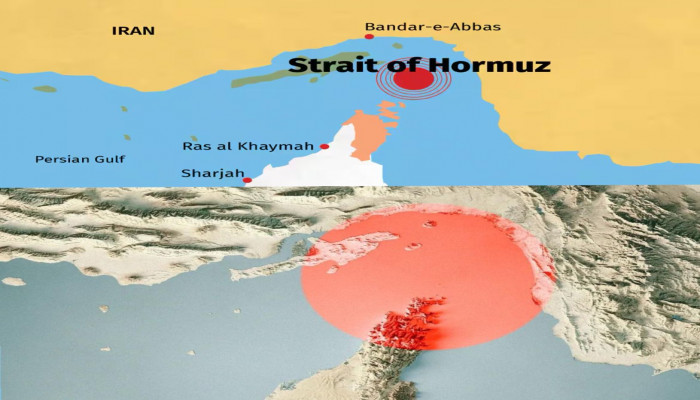
Iran’s Islamic Revolutionary Guard Corps has announced that the Strait of Hormuz will be closed specifically to vessels connected to the United States, Israel, Europe and their Western allies. The announcement was made on Thursday through Iran’s state broadcaster, Islamic Republic of Iran Broadcasting (IRIB).
The decision comes after several days of uncertainty surrounding one of the world’s busiest maritime shipping routes. Since the outbreak of hostilities in the Gulf, almost all commercial shipping traffic has stopped moving through the waterway. The halt has raised global concerns because the strait is one of the most important routes for oil and gas shipments.
In its statement, the Islamic Revolutionary Guard Corps (IRGC) said that it had already made its position clear. According to the group, Iran has the right to regulate movement through the strait during wartime under international law and related resolutions. The statement warned that ships linked to the United States, Israel, Europe and their supporters would face military action if they attempted to pass through the waterway.
“We had previously said that, based on international laws and resolutions, in times of war, the Islamic Republic of Iran will have the right to control the passage through the Strait of Hormuz,” the IRGC said, according to the report broadcast by IRIB.
The statement also included a direct warning. It said that vessels belonging to the United States, Israel, Europe, “and their supporters”, that are seen in the strait, “will certainly be hit.”
The situation in the waterway has been tense since the United States and Israel began a joint military operation against Iran on Saturday. The military action has led to the current confrontation in the region and has already pushed global oil prices higher. The developments have also increased fears of disruptions to the world economy because of possible impacts on energy supply and shipping.
Earlier in the week, Iran indicated that it might allow limited movement through the strait. On Tuesday, officials suggested that only vessels flying the Chinese flag would be permitted to use the route. According to officials, this step was taken as a gesture of appreciation for the position taken by China towards Tehran since the conflict in the Middle East began.
The importance of the decision is significant because the Strait of Hormuz acts as the only sea exit for ports located in the Persian Gulf. Iran has effectively blocked the passage since the latest round of fighting started. This has placed pressure on global supply chains because companies depend heavily on this route for transporting oil, gas and other goods.
With fighting continuing around the Gulf region, most ship captains are unwilling to risk travelling through the strait. As a result, international shipping companies are now trying to plan their operations without access to a route that has long played a central role in global energy trade.
The Strait of Hormuz is responsible for carrying about one-fifth of the total oil that is transported by sea worldwide. Because of this, the waterway is considered one of the most critical energy routes in the global economy.
Analysts, however, point out that even if the strait remains closed, the main east-west shipping lanes that connect Asia and Europe would not be directly interrupted. Despite that, the closure still affects trade within the Gulf region itself.
Geographically, the Persian Gulf functions like a dead-end water body. It is surrounded by the coastlines of countries including Kuwait, Iraq and Iran. Because of this layout, the Strait of Hormuz remains the only route through which ships can enter or exit the Gulf.
The route is also essential for major ports in the region. For example, it is the only maritime access point to the port of Jebel Ali in Dubai. Jebel Ali is the world’s tenth-largest container terminal and serves as an important hub that redistributes goods to more than a dozen countries.
Despite many tensions in the region over the years, the Strait of Hormuz has never been completely closed to commercial shipping before. Even during the Iran–Iraq War, merchant ships continued to pass through the waterway, although oil tankers were often targeted during the conflict.
Current ship-tracking data shows the impact of the present crisis. According to live tracking on the Marine Traffic website, large numbers of ships are currently stationary in nearby waters. Many of these vessels, including oil tankers, are waiting to the north near the coast of Kuwait and in waters near Dubai.
Iran’s own merchant ships are also anchored near the port of Bandar Abbas, which lies on the eastern side of the Strait of Hormuz. At the same time, additional groups of vessels are positioned just outside the entrance to the channel, waiting for clarity about whether it will become safe to cross again.
As tensions continue in the Gulf, the future of shipping through this vital waterway remains uncertain. For now, the strait remains largely inactive, with ships waiting in surrounding waters while the conflict and its consequences continue to unfold.



 Loading...please wait
Comments