




Iran launches retaliatory strikes on US military facilities in Bahrain, Kuwait
- In Reports
- 06:57 PM, Jul 08, 2026
- Myind Staff
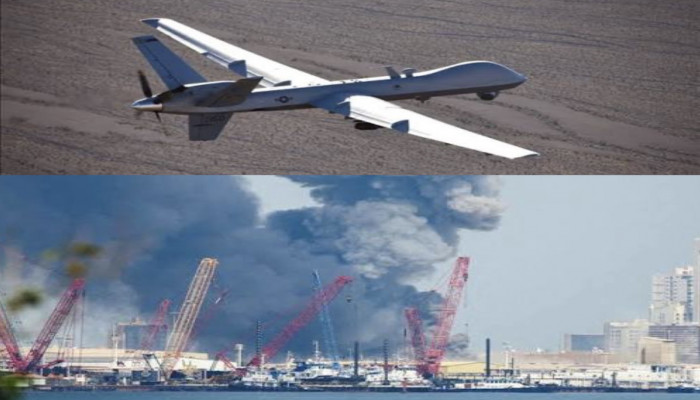
Iran has claimed that it carried out drone and missile strikes on US-linked military facilities in Bahrain and Kuwait in response to recent American military operations in southern Iran. The claims came through Iran's state-affiliated Fars News Agency, which cited statements from the Iranian Army and the Islamic Revolutionary Guard Corps (IRGC).
According to the Iranian Army Public Relations, army drones targeted the Sheikh Isa Air Base in Bahrain early on Wednesday. Fars News Agency quoted the official statement, which said, "Following the hostile invasion by the American enemy into areas in the south of the country, army drones targeted the gathering centres of the hostile American forces at the 'Sheikh Isa Air Base' located in Bahrain in an attack early this morning."
The IRGC also claimed responsibility for a large-scale joint missile and drone operation against several US military locations in Bahrain and Kuwait. According to Fars News Agency, the force said, "IRGC Navy and Aerospace Forces, during a joint missile and drone operation, pounded 85 key US military facilities in Salman Port, the US Fifth Fleet in Bahrain, and the Ali Al Salem Air Base in Kuwait."
In another statement carried by Fars News Agency, an IRGC spokesperson claimed that Iranian air defence systems shot down an American MQ-9 drone over Bushehr Province. The spokesperson said, "Following the aerial aggression by the terrorist US Army in the early hours of this morning, an MQ9 drone was struck and downed by the fire of the IRGC's advanced air defence system in the skies over Khormuj in Bushehr Province."
Iran announced these retaliatory actions after the US Central Command (CENTCOM) confirmed that it carried out a series of military operations on July 7. According to CENTCOM, American forces struck more than 80 military positions across Iran using precision-guided munitions. The US military said the operation targeted Iran's military infrastructure and focused on weakening its maritime offensive capabilities.
US defence officials said the strikes destroyed command-and-control networks, air defence systems, coastal radar sites, anti-ship missile positions, and more than 60 small boats operated by the IRGC. They stated that the operation aimed to reduce Iran's ability to carry out further attacks that could disrupt commercial shipping in the region.
CENTCOM also explained what led to the military action. According to the US military, Iran had launched attacks on three commercial tankers that were passing through the Strait of Hormuz. The affected vessels were identified as the Marshall Islands-flagged M/T Al Rekayyat, the Saudi Arabia-flagged M/T Wedyan, and the Liberian-flagged M/T Cyprus Prosperity.
In a post on X, CENTCOM said, "The US strikes are in response to Iranian attacks on three commercial vessels that were transiting the Strait of Hormuz. Iran's demonstrated aggression was unwarranted, dangerous, and a clear violation of the ceasefire."
Following the American strikes, Iranian state media reported several explosions in the port cities of Bandar Abbas and Sirik. Reports also mentioned blasts on Qeshm Island. State media said fires broke out at the Sirik pier and at Shahid Haqqani Port in Bandar Abbas after the attacks.
Iran's official news agency, IRNA, later quoted the Governor's Office in Hormozgan province. According to the report, "to date, there have been no civilian casualty reports resulting from Tuesday evening's attacks by the American adversary."
The latest military exchange marks the first direct American action against Iran since late June. At that time, both countries had carried out a brief period of strikes and counter-strikes before agreeing to a temporary halt in hostilities under a bilateral Memorandum of Understanding (MoU). The latest developments indicate that the understanding has come under severe strain.
Iranian Parliament Speaker Ghalibaf also criticised the United States in a post on X. He listed several "major violations" of the MoU by the US administration and suggested that diplomatic commitments between the two countries had significantly weakened.
Ghalibaf also issued a strong warning against Washington's approach and said Iran would not give in to military or economic pressure. He ended his statement by saying, "The era of bullying and extortion is over. It leads nowhere. We don't fold."
The recent exchange has sharply increased tensions in the region. Iran has presented its strikes as retaliation for the American military operation, while the United States has maintained that its actions focused on protecting commercial shipping and reducing threats to maritime security. The developments have raised fresh concerns over regional stability as both sides continue to exchange military action and strong public statements.



 Loading...please wait
Comments