




Iran announces live-fire naval drills near U.S. warships as tensions continue to rise
- In Reports
- 06:51 PM, Feb 01, 2026
- Myind Staff
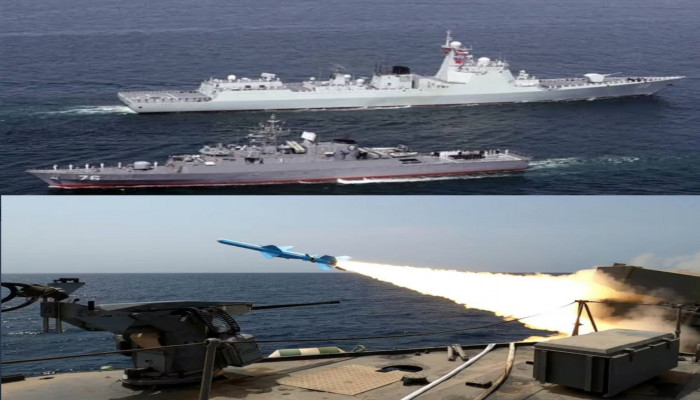
Iran carried out a two-day live-fire naval exercise in the Strait of Hormuz, a strategically important waterway through which nearly 20 per cent of the world’s oil supply passes, amid heightened regional tensions and increased U.S. military presence. The drills took place as U.S. Navy warships arrived in the region following strong warnings from Washington, raising concerns about a possible military confrontation.
Iran on Friday announced that its Islamic Revolutionary Guard Corps (IRGC) was conducting the naval exercise. The announcement came as President Donald Trump ordered the deployment of what he described as a “massive armada” to the Middle East. Earlier this week, Trump said the U.S. could act against Iran “with speed and violence, if necessary,” further escalating tensions.
Reacting to Iran’s actions, the U.S. Central Command issued a statement on Friday outlining what it considers unacceptable behaviour by the IRGC. “We will not tolerate unsafe IRGC (Islamic Revolutionary Guard Corps) actions, including overflight of U.S. military vessels engaged in flight operations, low-altitude or armed overflight of U.S. military assets when intentions are unclear, high-speed boat approaches on a collision course with U.S. military vessels, or weapons trained at U.S. forces,” the statement said.
At the same time, U.S. Central Command acknowledged Iran’s rights under international law. “U.S. forces acknowledge Iran’s right to operate professionally in international airspace and waters,” the statement added. However, it warned that “any unsafe and unprofessional behaviour near U.S. forces, regional partners or commercial vessels increases risks of collision, escalation, and destabilisation.”
Relations between the United States and Iran have remained strained, particularly after a brutal crackdown by Iranian authorities on nationwide protests against the government. Thousands of people were reportedly killed during the unrest. President Trump has recently called for regime change in Iran while also urging Tehran to make a “deal” to address international concerns about its nuclear program.
According to a report by The New York Times, which cited multiple U.S. officials, Trump has been presented with a list of military options against Iran. These reportedly include proposals for American forces to conduct raids on sites inside the country. However, NBC News said it could not independently verify these details.
Meanwhile, U.S. military activity in the region has continued. A U.S. Navy destroyer made a port visit to the southern Israeli city of Eilat on Friday. The USS Delbert D. Black is now one of six U.S. destroyers stationed in the Middle East, alongside an aircraft carrier and three additional combat ships. Israeli media reported that the destroyer’s arrival was planned in advance and was part of ongoing cooperation between the U.S. and Israeli militaries.
On the diplomatic front, Iran signalled some openness to talks. Iranian Foreign Minister Abbas Araghchi said on Friday that he was prepared for the resumption of negotiations, but stressed that they must be “fair and equitable” and should not include Iran’s defence capabilities.
Regional and international actors have also stepped in to ease tensions. Egypt said on Saturday that Foreign Minister Badr Abdel-Aty held phone calls with his Iranian, Turkish and Omani counterparts, as well as U.S. special envoy Steve Witkoff and Qatar’s prime minister. These discussions focused on continuing “serious efforts” to de-escalate tensions and seek diplomatic solutions. Egypt’s foreign ministry said that “constructive interaction and communication” could help bring the U.S. and Iran back to the negotiating table to reach “a peaceful and consensual settlement.”
Turkey has also opposed any military action against Iran. President Recep Tayyip Erdogan’s office said on Friday that he had offered to act as a “facilitator” between Iran and the U.S. during a phone call with Iranian President Masoud Pezeshkian. Earlier in the week, Saudi Arabia and the United Arab Emirates ruled out the use of their airspace or territory for launching attacks on Iran.
President Pezeshkian blamed Western countries and Israeli Prime Minister Benjamin Netanyahu for fuelling unrest inside Iran. According to the Student News Network, a hard-line outlet close to the Iranian regime, Pezeshkian said, “Unfortunately, Trump, Netanyahu and some Europeans tried to provoke the situation and create division.” He added, “They equipped and encouraged some people, pulled innocent citizens into this process and pushed them into the streets to break the country apart and create conflict, hatred and division among people.”
The protests in Iran began in late December as inflation surged and living costs became unbearable. They soon spread nationwide, involving people from all age groups, professions, and social backgrounds. The U.S.-based Human Rights Activists News Agency (HRANA) reported that at least 6,300 people have been killed, including around 200 security personnel. HRANA said it is also investigating reports of 17,000 additional deaths, noting that its data goes through “multiple internal checks.”
Amid these developments, an explosion at the southern Iranian port of Bandar Abbas on Saturday raised fresh concerns. Tasnim news agency said social media claims that a Revolutionary Guard navy commander was targeted were “completely false.” Iranian state media IRIB News later reported that the blast, which killed one person and injured 14 others, was caused by a gas leak, citing the Bandar Abbas Fire Department.



 Loading...please wait
Comments