




Interview with H.H. Spiritual Sovereign Jainacharya Yugbhushan Suri Maharaj Saheb For VK-4.0
- In
- 12:38 PM, Dec 31, 2025
- Dr. Siddhartha Dave
VK-4.0 marks the fourth and most expansive edition of Vasudhaiva Kutumbakam ki Oar, Jyot’s flagship civilisational conclave series. Scheduled to be held in Mumbai from January 16th to 22nd, 2026, this week-long engagement unfolds at a moment of profound global transition—what Bharatiya thought recognises as Sankraman Kaal. As inherited political, legal, and economic frameworks strain under the weight of contemporary crises, VK-4.0 seeks to revisit the idea of the world as one family, not as a rhetorical ideal, but as a governing principle rooted in ethics, interdependence, and collective well-being. Through rigorous dialogues, curated panels, and an immersive exhibition experience, the conclave explores how ancient Indian wisdom can engage meaningfully with contemporary challenges in law, governance, and geopolitics.
VK-4.0 is being shaped through active institutional partnerships and intellectual collaboration with leading national and global think-tanks and knowledge institutions, including the Ministry of External Affairs (MEA), Vivekananda International Foundation (VIF), India Foundation, Nalanda University, Maharashtra National Law University (MNLU), the Bar Council of India–affiliated bodies such as Bombay Bar Association and Bombay Chartered Accountants' Society (BCAS), and the National Institute of Mass Communication and Journalism (NMICJ). These collaborations reflect the conclave’s intent to bridge civilisational thought with policy, law, diplomacy, and academic inquiry, ensuring that the conversations emerging from VK-4.0 are both philosophically grounded and institutionally robust.
Guiding VK-4.0 is a distinguished advisory committee comprising eminent practitioners of statecraft, diplomacy, law, and strategic affairs. The committee includes Ambassador Harshavardhan Shringla—Member of Parliament, former Foreign Secretary of India, and Chief Coordinator of India’s G20 Presidency; Ambassador Ruchira Kamboj, India’s former Permanent Representative to the United Nations; Justice B. N. Srikrishna, former Judge of the Supreme Court of India and Shaurya Doval, Director, India Foundation. Their collective experience anchors the conclave in lived governance realities while enabling a forward-looking exploration of ethical leadership in a transitioning world order.
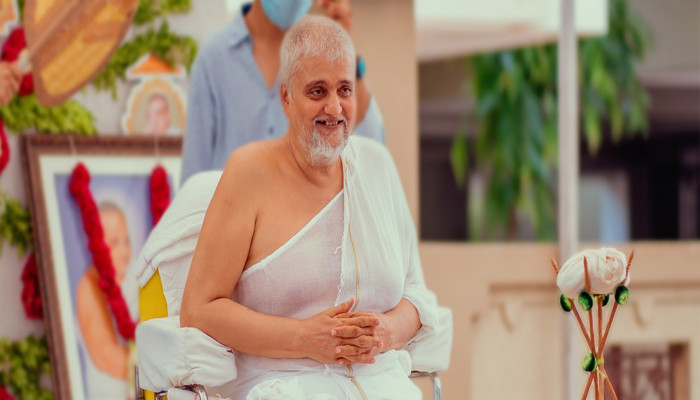
At the spiritual and civilisational core of VK-4.0 stands His Holiness, Spiritual Sovereign Jainacharya Yugbhushan Suri Maharaj Saheb—one of the 79th descendants of Bhagwan Mahavir Swami and a rare scholar-saint whose erudition spans all six Bharatiya Darshanas alongside contemporary disciplines such as law, science, economics, and geopolitics. Since his renunciation in 1979, Pandit Maharaj Saheb has engaged deeply with the evolution of the global order, perceiving early on that many threats to Bharatiya religions and cultures originate not merely from local factors but from entrenched global power structures. His extensive, though largely unpublished, research into the de jure architecture of the world order reflects a lifelong commitment to protecting civilisational continuity during times of transition.
This interview, situated within the larger framework of VK-4.0, brings together spirituality, statecraft, and civilisational inquiry. Pandit Maharaj Saheb reflects on Sankraman Kaal, the moral failures of the contemporary world order, and the enduring relevance of Dharmic principles in shaping law, governance, and geopolitics. It invites readers to move beyond inherited paradigms, to question the foundations of power, and to re-imagine a world order where restraint tempers authority and Dharma guides leadership.
Q1. Maharaj Saheb, the theme for VK-4.0 is Sankraman Kaal — an age of transition. How do you interpret this transition from a spiritual-civilisational perspective?
A: Every era experiences moments when accumulated ideas, systems, and structures begin to outgrow their usefulness. Sankraman Kaal is such a moment for the world, where external progress has accelerated, but structures holding them are old and unyielding. The transition is not merely political or economic; it is fundamentally moral and spiritual. Humanity is being asked to shift from an era of domination and extraction towards one of responsibility, restraint, and interdependence. Ancient principles such as rule of justice, vasudhaiva kutumbakam, provide a compass to navigate this turbulent shift.
Q2. You have studied not only Jain Darshan but all six Darshanas of Bharat. How can these diverse philosophical frameworks guide global leadership today?
A: The six Darshanas are six disciplined viewpoints to realise the summit of truth. When read together, they teach a leader to be holistic rather than unilateral. A statesman or policymaker who internalises these viewpoints will not reduce governance to power alone. He or she will understand consequences, diversity, and the long arc of ethics.
Q3. You have deeply researched the evolution of the modern world order from the Norman conquest of England to the decolonisation of Hong Kong. Why did you feel this research was urgently needed?
A: Because the threats facing Bharatiya society do not arise only within India—they are embedded globally. If the world order has been shaped by conquest, hierarchy, and legal fiction built over centuries, then its effects naturally percolate to cultures that value non-violence, pluralism, and self-restraint. Unless we understand how these systems were designed, we cannot protect the spiritual heritage of Bharat. My research was an attempt to see the full historical architecture of power, not its surface expressions.
Q4. The VK-4.0 exhibition critiques the present world order for fostering imbalance and mistrust. How can visitors approach this exhibition meaningfully?
A: Visitors should enter the exhibition not to confirm their assumptions but to widen their vision. The purpose is not to blame the past but to understand how inherited systems were constructed. When one recognises that global frameworks were shaped by a few empires for their benefit, one naturally begins asking deeper questions:
What is justice? Who defines progress? What is the role of Dharma (Duty/Responsibility) in world affairs? This reflection is the beginning of empowerment.
Q5. In the legal and constitutional panels, we examine fundamental rights, constitutional morality, and governance. What is your message on this?
A: A Constitution is fundamentally a moral contract. It succeeds when it safeguards the dignity of the last person, restrains the powerful, and inspires citizens to participate in collective welfare. When a society forgets the moral foundation behind its laws, legal debates become technical and soulless. The rule of justice and morality ensures that rights are matched with duties, freedoms with self-discipline, and governance with compassion.
Q6. Our geopolitics panel revisits Rajneeti as an ethical statecraft rooted in ancient wisdom. How does Dharma guide statecraft in a time of global transition?
A: Dharma teaches that statecraft is not manipulation—it is responsibility. Rajneeti becomes ethical when a leader understands four truths-
- Power without restraint becomes violence.
- Sovereignty is incomplete without morals.
- Decolonisation is not merely political—it is intellectual and psychological.
- Interdependence is natural, but exploitation is not.
In Sankraman Kaal, nations must revisit these principles to create a world order that is fair, stable, and just.
Q7. Many see your teachings as uniquely blending ancient spiritual wisdom with modern scientific and political analysis. How do you maintain this balance?
A: A spiritual teacher must not close his eyes to the world. Religion does not demand ignorance; it demands awareness. When I study physics or economics, I try to locate what its fundamental timeless principles are according to scriptures and what are in use today. When we integrate ancient Darshanas with contemporary sciences, we gain a holistic understanding of reality. Without this integration, science becomes directionless power.
Q8. You have often warned that threats to Bhartiya civilisation originate in global structures. What steps should Bharat take?
A: Three steps are essential-
- Intellectual decolonisation—Bharat must reinterpret global systems through its own civilisational lens, not borrowed frameworks.
- Cultural confidence—culture that emphasises Vasudhaiva Kutumbakam and Integrity must not apologise for their values.
- Strategic engagement—Bharat should participate in global institutions with clarity about its interests, not with diffidence or mimicry.
Protection does not come from isolation but from enlightened confidence.
Q9. Finally, what message would you like to offer to the participants of VK-4.0?
A: You are entering a space that encourages deeper questioning. Do not treat Vasudhaiva Kutumbakam as a slogan; understand it as a worldview. The world becomes one family only when each member respects the dignity and spiritual freedom of others. During this Sankraman Kaal, Bharat has a responsibility—not to dominate the world, but to guide it towards balance. If you learn to combine knowledge with compassion, and power with restraint, you will carry forward the true spirit of this conclave.


 Loading...please wait
Comments