




Intel agencies flag China’s ‘Twin Strategy’ of cultural erasure and military build-up in Tibet
- In Reports
- 06:19 PM, Aug 06, 2026
- Myind Staff
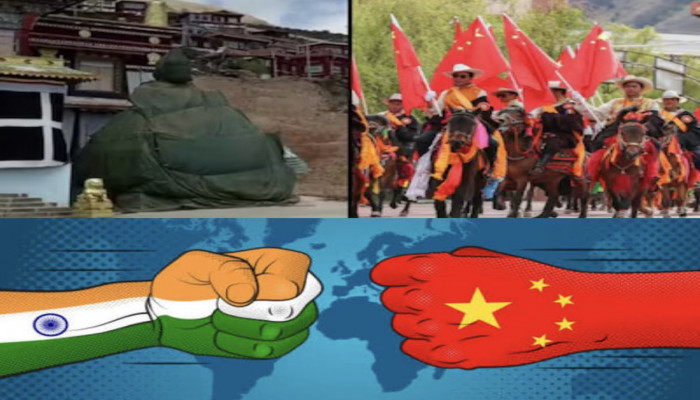
China is following a two-pronged strategy in Tibet by weakening the region’s Tibetan Buddhist identity while expanding infrastructure that could support military operations near the Line of Actual Control (LAC), according to top Indian intelligence sources quoted by CNN-News18. Officials believe Beijing is combining cultural assimilation with military preparedness, creating long-term security challenges for India along the northern border.
The assessment comes after fresh evidence presented in a report by Tibet Watch. The report includes satellite images, eyewitness accounts and Chinese state media reports. It highlights the demolition and repurposing of one of eastern Tibet’s well-known Buddhist sites.
According to the report, authorities in Drago County, located in Tibet’s Kham region, have transformed the site of the famous 99-foot Buddha statue in Sengdeng village into the “Drago County Red Army Cavalry Division Racecourse.” The area now hosts events linked to the Chinese Communist Party instead of serving as a place of worship.
The statue, known locally as the “People’s Buddha,” had great religious significance for Tibetans. Devotees visited the site daily to perform circumambulation and offer prayers. Local residents built the statue through community donations. It was meant to protect the region from earthquakes after the devastating 1973 earthquake that struck during China’s Cultural Revolution.
Since 2023, the county administration has organised state-sponsored sports and cultural festivals at the same location. Chinese authorities promote these events under the banner of “Red Tourism,” which highlights Communist Party history and ideology. According to Tibet Watch, many local Tibetans have described this transformation as a “second Cultural Revolution,” saying a sacred religious space has been replaced with a symbol celebrating the Chinese Communist Party and the People’s Liberation Army.
Indian intelligence officials believe this redevelopment reflects a larger policy rather than an isolated cultural change. “China’s development projects across Tibet are not purely civilian," top intelligence sources told CNN-News18.
According to the assessment, China is developing tourism projects, sports facilities and rural infrastructure with dual-use capabilities. Officials believe these projects can quickly support military operations by allowing the rapid movement of PLA troops, heavy military vehicles and logistics close to the India-China border. They say Beijing is gradually converting Tibetan settlements into military-support zones that can be activated during any future crisis along the LAC.
The intelligence assessment also points to increasing militarisation of communities living near the frontier. Officials claim Chinese authorities have launched programmes aimed at Tibetan children to strengthen local border security networks. Under initiatives carrying titles such as “I Am A Little Border Patrol Guard,” children reportedly receive training from an early age to become part of local border militia groups known as Liba. Indian officials believe these programmes are expanding China’s security presence in sensitive border regions.
Indian intelligence sources also claim that Beijing is encouraging Han Chinese migration into strategically important parts of the Tibetan Plateau. Officials say the policy aims to gradually change the demographic balance in areas close to the Indian border by reducing the relative presence of native Tibetan communities.
Alongside demographic changes, authorities have expanded the compulsory use of Putonghua, or Mandarin Chinese, in schools and public institutions. At the same time, Tibetan language, script and cultural education have been pushed to the margins. Analysts believe these policies are designed to weaken Tibetan cultural identity over time by distancing younger generations from their language, history and religious traditions.
Officials have also raised concerns over Tibet’s strategic importance beyond territorial control. The Tibetan Plateau is the source of several major Asian rivers, including the Brahmaputra, Indus and Sutlej. This makes the region one of the continent’s most important water resources.
According to Indian intelligence, replacing traditional Tibetan communities with state-controlled institutions, along with the construction of dams and other major infrastructure projects, could strengthen Beijing’s strategic leverage over downstream countries such as India and Bangladesh. Officials believe this could increase China’s influence over critical water resources in the future.
The intelligence assessment also highlights China’s growing use of the name “Xizang” instead of “Tibet” in official international communication. Indian officials say this is more than a simple change in terminology. They believe it forms part of a broader legal and diplomatic strategy to redefine Tibet as an inseparable administrative region of China while reducing the historical and civilisational identity linked to the name “Tibet.”
According to the assessment, the move is intended to strengthen Beijing’s territorial claims at the international level, including in disputed Himalayan border regions. Indian security agencies believe the developments indicate a coordinated strategy where cultural assimilation, demographic changes and military infrastructure expansion are advancing simultaneously. Officials say these measures have significant implications for Tibet’s identity and for the evolving security environment along India’s northern borders.



 Loading...please wait
Comments