




INSV Kaundinya receives water salute on arrival in Muscat after historic voyage
- In Reports
- 06:56 PM, Jan 14, 2026
- Myind Staff
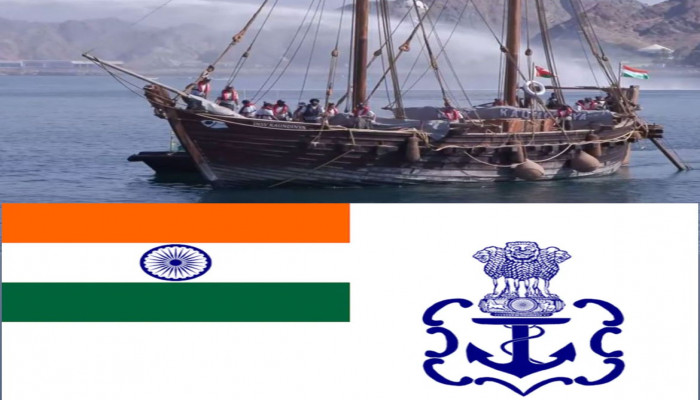
The Indian Navy’s indigenously built traditional stitched sailing vessel INSV Kaundinya was honoured with a water salute when it arrived at Muscat in Oman on Wednesday, marking the successful completion of its voyage from Gujarat’s Porbandar. The ship reached Port Sultan Qaboos after departing Porbandar on December 29, 2025, completing an ancient maritime route that retraces India’s long history of seafaring and cultural exchange.
The crew of the vessel was led by Commander Vikas Sheoran, the Captain, and Commander Y Hemant Kumar, who has been part of the project since its conceptualisation and served as the Officer-in-Charge of the expedition. The team on board included four officers and thirteen naval sailors. Prime Minister’s Economic Advisory Council member Sanjeev Sanyal, who was also part of the crew, shared daily updates about the vessel’s journey on social media.
INSV Kaundinya is a stitched sail ship based on a 5th-century CE vessel depicted in the Ajanta Caves paintings, representing an ancient Indian design. This project began after a tripartite agreement was signed in July 2023 between the Ministry of Culture, the Indian Navy, and M/s Hodi Innovations, a Goa-based shipbuilder, with funding from the Ministry of Culture.
The construction of the vessel followed a traditional method of stitching, where a team of skilled artisans from Kerala, led by master shipwright Babu Sankaran, carefully stitched wooden planks on the hull using coir rope, coconut fibre, and natural resin. After several months of work, the ship was launched in February 2025 at Goa.
Officials from the Indian Navy oversaw the vessel’s design, technical validation, and overall construction process. Because no original blueprints of similar ancient ships exist, the design had to be inferred from historical and artistic sources. To ensure seaworthiness, the Navy collaborated with the Department of Ocean Engineering at IIT Madras for hydrodynamic model testing and conducted internal technical assessments.
The newly inducted INSV Kaundinya features several culturally significant elements that highlight India’s maritime past. Its sails display motifs of the Gandabherunda and the Sun, its bow bears a sculpted Simha Yali, and a symbolic Harappan-style stone anchor adorns the deck. These decorative and symbolic features reflect the rich maritime traditions of ancient India.
The ship is named after Kaundinya, a legendary Indian mariner believed to have sailed across the Indian Ocean to Southeast Asia. The name symbolises India’s long-standing traditions of maritime exploration, trade, and cultural exchange with nations connected by the seas.
The water salute it received in Muscat was a ceremonial recognition of the voyage’s success and the strong historic ties between India and Oman. The traditional stitched-ship journey not only demonstrated the vessel’s capability to cross significant distances using age-old techniques but also served as a reminder of the enduring connections between maritime cultures.
This voyage stands as a celebration of India’s ancient shipbuilding heritage, bringing to life traditional craftsmanship and seamanship that date back centuries. The successful arrival in Muscat shows that these age-old techniques are not merely historical artefacts but can also be used today to foster cultural understanding and strengthen historical maritime bonds.



 Loading...please wait
Comments