



Indonesian coast guard stops Chinese research vessel bound for Maldives at Sunda Straits
- In Reports
- 03:08 PM, Jan 29, 2024
- Myind Staff
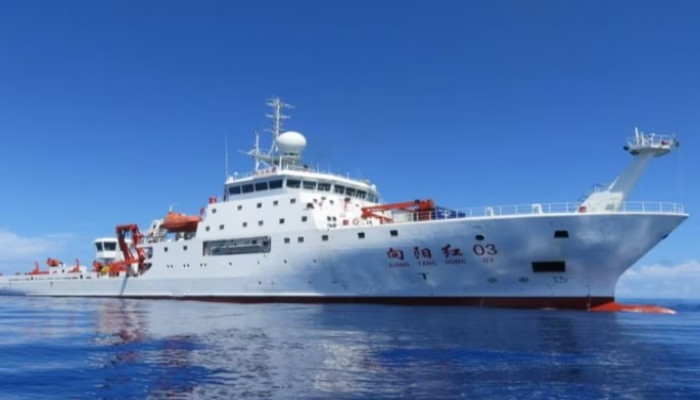
The Indonesian Coast Guard (ICG) intercepted a Chinese research vessel en route to Male, Maldives, after the vessel deactivated its automated information system, according to a report from Adhadhu based in the Maldives. The Indonesian authorities took action following the vessel's repeated instances of turning off its transponder three times between January 8 and 12 while traversing the country's waters.
According to the US Naval Institute, the Indonesian Coast Guard halted the Chinese government vessel "XIANG YANG HONG 03" in the Sunda Strait area on January 11. The report notes that the vessel's crew refuted allegations of intentionally turning off the transponder and asserted that it was malfunctioning.
Automatic Identification System (AIS) transponders are designed to automatically furnish position, identification, and other ship-related information to both other vessels and coastal authorities.
The Asia Times reported that the Indonesian Coast Guard (ICG) opted not to board the Chinese ship but instead instructed it to depart from the country's exclusive economic zone. By international maritime law, all vessels navigating the archipelagic sea lanes within Indonesian waters are obligated to have operational transponders.
Adhadhu reported that the vessel's current location in the Java Sea was untraceable, according to marine traffic monitoring sites. In a recent publication titled "China's Dual-Use Research Operations in the Indian Ocean," the Center for Strategic and International Studies (CSIS) highlighted the tendency of China's vessels to go dark for hours or days when in proximity to People's Liberation Army (PLA) installations.
The paper emphasizes that maritime behaviour, such as repeated instances of "spoofing" (providing falsified identification information) or "going dark" (disabling automatic identification system signals for extended periods), serves as significant warning signs. Data from Windward indicates that these activities occur frequently, sometimes near foreign military facilities, as stated in the paper.
According to a report from the Center for Strategic and International Studies (CSIS), China possesses the world's largest fleet of civilian research vessels, numbering 64 active vessels. The report, part of the Hidden Reach initiative, suggests that while these ships serve scientific and commercial purposes, over 80% of them have exhibited suspicious behavior, contributing to Beijing's strategic objectives.
Following Maldivian President Mohamed Muizzu's return from China on January 22, reports by open-source intelligence researcher Damien Symon indicated that China's research vessel, XIANG YANG HONG 03, was heading towards Male.
The Maldives Foreign Ministry confirmed the vessel's presence but asserted it wouldn't conduct research in Maldivian territory. However, geostrategist Brahma Chellaney criticized the claim, stating that China is actively mapping the Indian Ocean bed, collecting data for submarine operations, and the Maldives under its new president is enabling these activities.
Image source: Business Today



 Loading...please wait
Comments