



India’s own AI models take centre stage at the India AI Impact Summit 2026
- In Reports
- 08:23 PM, Feb 18, 2026
- Myind Staff
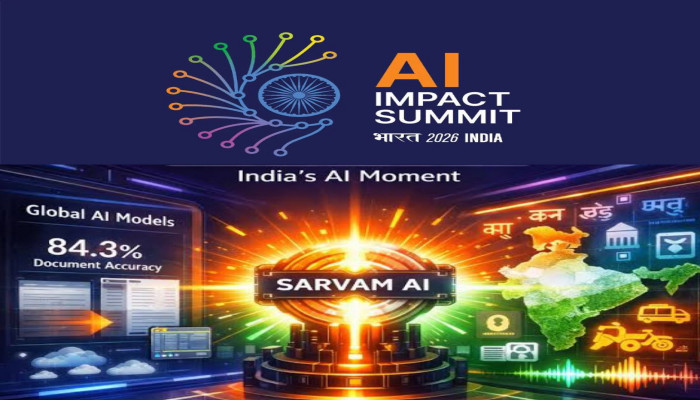
At the ongoing India AI Impact Summit 2026 in New Delhi, several Indian-developed artificial intelligence (AI) models and technologies have drawn widespread attention from tech leaders, government officials, and industry experts. This year’s summit, held from February 16 to February 20, 2026, highlights India’s growing efforts to create AI systems that are designed for India, by India.
Among the most talked-about innovations are Sarvam AI’s Bulbul V3, the Sarvam Kaze AI smart glasses, BharatGPT/Bharatiya GPT-style generative AI platforms, and AI Kosha, a national AI resource platform. These models and technologies represent different kinds of AI from language and speech tools to smart devices and generative systems and all are part of India’s broader strategy to build a sovereign AI ecosystem that supports local languages, cultural contexts, and economic goals.
1.Sarvam AI and Bulbul V3
One of the standout presentations has been by Sarvam AI, a Bengaluru-based AI technology company.
- Bulbul V3 is a text-to-speech AI model designed to create natural-sounding, expressive voices in over 11 Indian languages. This makes digital interactions more comfortable and familiar for Indian users who speak regional languages.
- The model is part of Sarvam’s portfolio of AI systems that also include speech recognition, document understanding, and conversational tools tailored for India’s diverse linguistic needs.
- Technology experts at the summit have highlighted that Bulbul V3 sounds more natural and fluent for Indic languages than many global counterparts, helping bridge the language gap in AI communication.
2. Sarvam Kaze AI
Another innovative product on display is Sarvam Kaze, AI-powered smart glasses developed by Sarvam AI.
- These smart glasses combine AI features with wearable technology. They are designed and built in India, showcasing the nation’s capacity to invent hardware with intelligent software.
- The device was even worn and demonstrated by Prime Minister Narendra Modi during the summit a symbolic moment that highlighted India’s push toward self-reliant AI innovation.
- The glasses aim to assist users through voice and visual capabilities, potentially helping in areas like translation, real-time information access, and hands-free computing.
3. BharatGPT / Bharatiya GPT-style AI Platforms
Emerging generative AI platforms, sometimes referenced as BharatGPT or similar Bharatiya GPT-style initiatives, also represent India’s push toward indigenous large language models.
- These platforms are designed to understand and generate human-like text across many Indian languages, making them useful for business tools, virtual assistants, and automated support systems.
- For example, BharatGPT launched by Indian AI developers offers conversational AI in 14+ Indian languages and supports text, voice, and video interactions.
- Another variant, BharatiyaGPT, aims to integrate Indian cultural knowledge and heritage with modern AI applications by training on traditional manuscripts and texts, helping generate culturally relevant responses in Indian contexts.
Although multiple AI products with similar names exist in India, all reflect a growing trend toward building homegrown generative AI technologies rather than relying solely on foreign platforms.
4. AI Kosha Datasets and Platform Support
In addition to AI models themselves, AI Kosha plays a key role as a national AI resource platform created to support researchers and developers.
- Launched by the Ministry of Electronics and Information Technology, AI Kosha provides datasets, tools, models, and computing resources to India’s AI community.
- The platform is intended to help Indian developers access data and tools needed to build better models for local languages, applications, and industries.
The India AI Impact Summit 2026 has underscored a new phase of AI development in the country. Technologies like Sarvam AI’s Bulbul V3 and Sarvam Kaze, BharatGPT-style generative platforms, and AI Kosha’s dataset ecosystem demonstrate that Indian companies and institutions are now building capabilities that are designed for India’s linguistic, cultural, and practical needs.
Although these technologies may still compete and coexist with global AI giants, their presence at a national summit and the supportive ecosystem around them shows the country’s determination to be an influential player in the future of AI. The summit has not only displayed innovation but also highlighted India’s ambition to lead in AI that is accessible, relevant, and culturally grounded for its own people and the world.



 Loading...please wait
Comments